
Reviewed · SILK ISLAND TOURS
Silk Island Tuk Tuk Tour
Silk Island gives you a sharp change of pace from Phnom Penh. After the ferry crossing, a tuk tuk carries you along narrow island roads past rice paddies, farms, villages, and small craft workshops. I like the handmade silk process, from moth eggs to finished cloth, and the chance to see local work instead of only looking at shop displays. I also like the pagoda and village stops, which add daily life to the craft theme.
The main drawback is the price: $80 per person is a serious spend for a half-day outing, especially if you are traveling alone. The tour also depends on good weather, and the rural roads, ferry, and tuk tuk ride may feel less comfortable if you prefer polished transport and a tightly timed schedule.
Key points to know before booking

- A real silk-making stop: See silk production by hand, with the process explained from moth eggs through finished fabric.
- A scenic tuk tuk ride: Travel across Koh Dach on smaller roads through farmland, villages, and working countryside.
- More than a craft shop: The route includes a local pagoda, market, farmers’ daily work, and traditional household production.
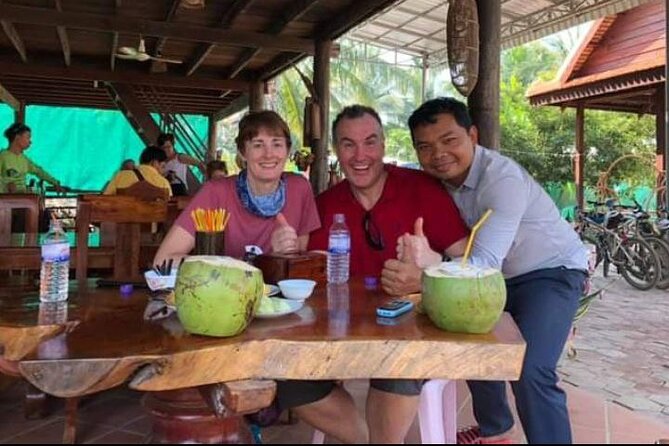
- Guide-led and small enough to manage: An English-speaking guide, including guide Visal on one reported outing, accompanies the group. The maximum is 20 people.
- A ferry ride is part of the day: You cross the Mekong to reach the island and return by ferry to Phnom Penh.
- Useful inclusions: Tuk tuk transport, a safe driver, bottled water, snacks, and entrance fees are covered.
Why Silk Island makes a good half-day escape
Phnom Penh can feel fast, noisy, and tightly packed. Silk Island, also called Koh Dach, offers a slower view of Cambodia just across the Mekong. The appeal is not a grand monument. It is the ordinary setting: farm paths, village homes, local workshops, crops, pagodas, and people making goods by hand.
You spend about four to five hours away from the city, with the ferry crossing helping mark the change. The island is known for silk production, but the visit is broader than a single workshop. You also see rice paddy farmland and crops such as lemongrass, bananas, ginger, and corn.
I would choose this outing if you want to understand how people work and live outside Phnom Penh. It suits you best if you enjoy seeing production in its actual setting rather than buying a craft with no sense of where it came from.
The tour is also easy to compare with other Phnom Penh day trips. A genocide museum or Killing Fields excursion deals with Cambodia’s difficult recent past. Silk Island offers something different: a look at present-day rural work and traditional skills. It is not a replacement for those important sites, but it gives your time in Phnom Penh a useful second side.
More Tuk-Tuk Tours in Phnom Penh
- Phnom Penh Silk Island Bike Tour/ E-Bike or Tuk Tuk
★ 5.0 · 495 reviews - Ultimate Phnom Penh Food Tour by Tuk Tuk: 20 Tastings and Drinks
★ 5.0 · 409 reviews - Phnom Penh’s Culinary Underground: Local Food Tour by Tuk-tuk
★ 5.0 · 234 reviews
Crossing the Mekong by ferry
The day begins at the G Mekong Hotel near Orussey Market, at 419 Monivong Boulevard in Phnom Penh. From there, the group heads toward the river and crosses to Silk Island. The ferry is not just a transfer. It gives you a brief view of Phnom Penh from the water and creates a natural pause before the countryside portion begins.
The crossing and road transfer take part of the available time, so keep your expectations realistic. This is not four or five hours spent continuously at workshops. The ferry, tuk tuk travel, stops, and return journey all fit into the experience.
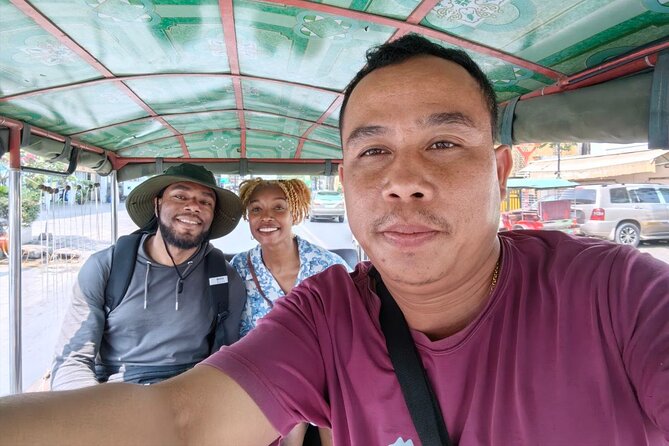
Once you arrive on the island, you board a tuk tuk for the rural roads. The open-sided ride lets you notice more than you would from a sealed vehicle. You can see fields, village paths, and small-scale activity close to the road.
The trade-off is comfort. Tuk tuk rides can expose you to dust, heat, wind, and uneven surfaces. The tour provides a safe driver, but the vehicle is still basic transport. Bring practical clothing and be ready for a ride that feels like part of the experience, not merely a way to move between attractions.
The first hour on Koh Dach
The first main section lasts about an hour and focuses on getting around the island by tuk tuk. You travel along path roads and see the countryside around Mekong Silk Island. The point is the setting itself: farmland, village life, and the quiet rhythm of work away from central Phnom Penh.
This is a good part of the tour for anyone who likes photography, though the experience is not presented as a dedicated photo trip. The view changes as you pass rice paddies, crops, and traditional villages. You might find the ride more memorable than any one formal sight because it shows how the island fits together.
The guide helps provide context as you go. An English-speaking guide is included, and the reported outing with Visal highlights the value of having someone explain what you are seeing. If you want a day with no interpretation at all, this may feel slower. If you want to ask about local work and customs, the guide makes the countryside easier to understand.
The tour allows a maximum of 20 people. That is not an especially tiny group, but it is manageable for a guide-led outing. Group size can affect how easily you hear explanations at a workshop, so stay close when the guide begins explaining the craft process.
Seeing silk made by hand
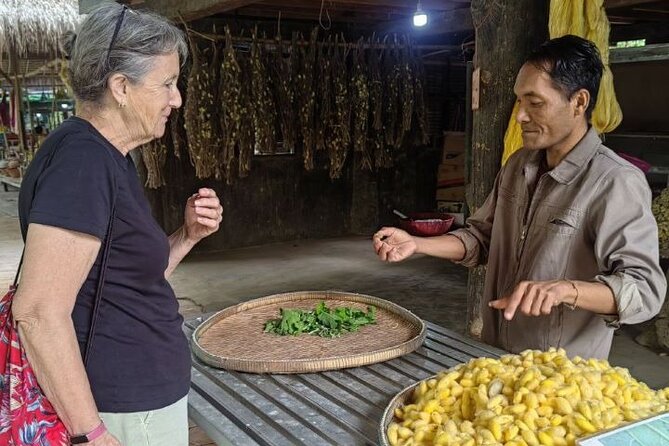
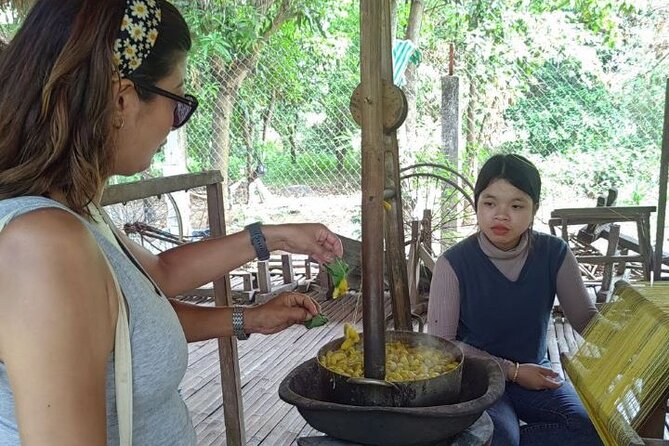
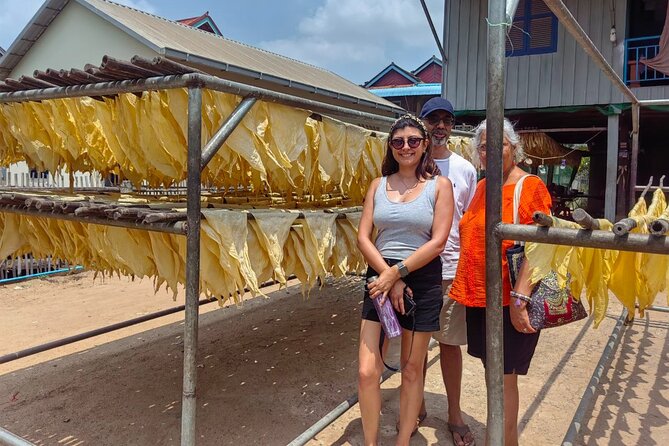
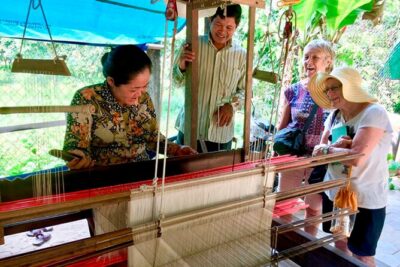
The main stop is the silk farm and craft area at Chamka Sne. Here you see traditional skills connected with silk weaving and other handicrafts. The silk demonstration follows the material from the moth laying eggs through processing and into finished products.
That sequence matters. A scarf in a shop can look simple, but the process behind it is not. Seeing the stages gives you a better basis for judging the work and price of finished goods. It also keeps the visit tied to local production rather than turning it into a generic souvenir stop.
You may see silk weaving, dyeing, pottery, and wood carving connected with the local craft economy. The available information specifically identifies these activities, so the exact demonstration can vary. Ask the guide what is being worked on that day instead of assuming every craft will be shown in equal detail.
You have the chance to buy local items, including scarves and silk goods. The purchase is optional. I would treat it as a chance to support the makers directly, not as a required part of the outing. If you are shopping, look closely at the fabric and ask which items were made locally. The guide can help explain what you are seeing.
The two-hour stop is the longest part of the trip, which makes sense. A quick glance at a loom would not tell you much. The longer visit gives you time to watch, ask questions, browse, and understand the link between raw material and finished cloth.
Still, a craft workshop is not a museum with a fixed display. Work may be happening at a different stage when you arrive. Some visitors may find that less polished, but it is also more honest. You are seeing working production, not a performance built around a timetable.
More Silk Island and Mekong island trips:
- Silk Island Cycling Adventure & lunch with locals
★ 5.0 · 246 reviews - Phnom Penh Silk Island Vespa Tour / Tuk Tuk Available
★ 5.0 · 102 reviews - Mekong Silk Island Cruise – Unlimited Beer, Soft Drinks & Fresh Fruit Platter
★ 4.5 · 95 reviews - Silk Island & countryside of Phnom Penh by Tuk Tuk
★ 5.0 · 68 reviews
Pagoda, market, and everyday village work
The next hour broadens the picture. You visit a local pagoda, a village, and a market, then see aspects of farmers’ daily lives. This is important because Silk Island is not only a place that makes silk for visitors. It is a functioning community.
The pagoda gives you a look at local religious life. Dress respectfully and follow the guide’s instructions inside the grounds. The stop is not described as a major monument, so do not expect a long architectural tour. Its value is the chance to place the island’s craft and farming communities in a wider social setting.
The village and market add ordinary detail. You may see household production of mosquito nets, silk sarongs, phamuong, Hol, and silk krama using traditional methods. These names refer to different forms of Cambodian textile work, and seeing them in a village context makes the products more meaningful than a quick purchase in a city shop.
The market stop may be brief, depending on the group and timing. I would use it to observe rather than rush to buy. Look at what is being sold, notice how local products fit beside daily goods, and ask the guide what items are made on the island.
This part also helps balance the workshop visit. If you only want silk, the pagoda and village might feel like extra stops. If you want a broader picture of local life, they are essential. The tour’s strength is that it connects craft, farming, religion, and trade within one short route.
What the $80 price includes
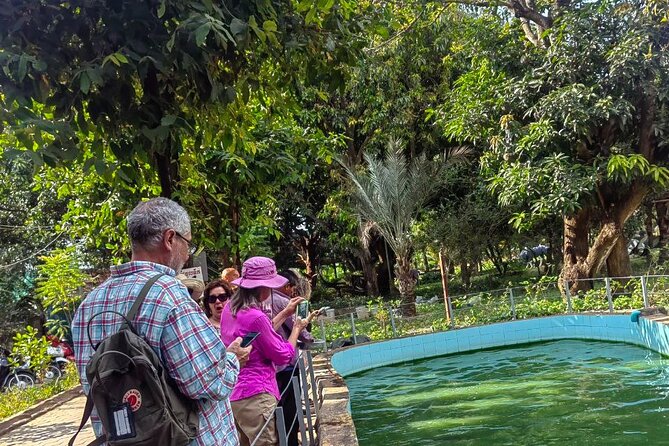
At $80 per person, this is not the cheapest way to see rural Cambodia. The price needs to cover a guide, driver, tuk tuk, ferry-related transport, snacks, water, and entrance fees. It also pays for a guided route that would be harder to arrange smoothly on your own.
I see the value most clearly if you have limited time in Phnom Penh. You get transport from the city, an English-speaking guide, several stops, and a return to the original meeting point. You do not need to arrange the ferry, find the silk center, or work out how to connect the village and pagoda visits.
The value is weaker if you are comfortable arranging local transport and prefer to spend very little on short excursions. It is also less attractive if your main goal is shopping. In that case, you may not need a guide-led half-day trip.
The included bottled water and snacks are useful in Cambodia’s heat, though they should not be mistaken for a full meal. Personal expenses are not included, so budget separately if you want to buy a scarf, textiles, pottery, or woodwork.
The tour has a 4.7 rating from nine submitted reviews, which is a positive signal but a small sample. The strongest praise centers on the guide, the clear explanation of silk production, and the experience of riding by tuk tuk through the island. Guide Visal is specifically named in one account, so if he is assigned to your departure, you can expect a guide with a strong focus on explanation and local detail. Guide assignments can change, however.
Timing, weather, and practical comfort
Plan on four to five hours. The listed times add up to about five hours, including the return ferry, but local traffic, the river crossing, weather, and time spent at the craft center can affect the final schedule.
Good weather is required. If rain or other poor conditions cancel the tour, you are offered another date or a full refund. That policy is useful because the experience depends heavily on open-air travel, ferry transport, and rural roads.
You can cancel for a full refund up to 24 hours before the start time. Changes or cancellations made inside that 24-hour window are not accepted for a refund. The cut-off uses local time, so check the start time carefully before making other plans.
The tour accepts service animals and is near public transportation. Most people can participate, but the information does not promise full accessibility for every mobility need. A tuk tuk, ferry, and rural path roads may create practical limits. If you have mobility concerns, confirm the details before booking rather than assuming the standard vehicle will work for you.
Wear clothes suited to heat and outdoor travel. Bring sun protection and keep personal items secure during the tuk tuk ride. These are sensible precautions for any open-air outing, even though they are not listed as formal tour requirements.
Who should book this island tour
I would recommend Silk Island to you if you want:
- A half-day break from Phnom Penh
- A guided look at Cambodian silk production
- Rural roads and village scenery
- A ferry crossing as part of the outing
- Traditional crafts with a chance to buy local goods
- A mix of religion, farming, village life, and textile work
Families and first-time visitors may appreciate the simple structure. The guide, transport, water, snacks, and entrance fees are arranged in advance. Most people can participate, and the group limit of 20 keeps the day from becoming completely unwieldy.
You should think twice if you dislike heat, open-air transport, uneven roads, or unplanned pauses. The experience is built around real working places, not air-conditioned exhibition halls. The charm comes from that rougher edge, but it will not suit everyone.
You should also be clear about the focus. This is not a major temple tour, a serious agricultural study, or an all-day countryside expedition. It is a compact introduction to Silk Island, with silk as the anchor and local life filling out the picture.
Should you book the Silk Island Tuk Tuk Tour?
Book it if you want to see how Cambodian crafts connect to village life, and if you value having the transport and explanations handled for you. The best parts are the ferry crossing, the tuk tuk ride through the island, the hand-worked silk process, and the chance to see textiles, pottery, dyeing, and wood carving in a local setting.
Skip it if $80 feels too high for a half-day or if you mainly want city sights. The price is easier to justify when you use the guide, ask questions, and take time with the craft and village stops. For a practical introduction to life beyond Phnom Penh, this is a worthwhile choice, provided you are ready for weather, basic roads, and a flexible pace.
FAQ
How long does the Silk Island Tuk Tuk Tour last?
The experience lasts approximately four to five hours, including the ferry crossing, island visits, and return to Phnom Penh.
Where does the tour start and finish?
It starts at the G Mekong Hotel near Orussey Market, at 419 Monivong Boulevard in Phnom Penh. The activity ends back at the meeting point.
Is an English-speaking guide included?
Yes. A professional English-speaking guide is included. Guide Visal is specifically associated with one reported outing, though guide assignments may vary.
Does the price include transportation and food?
The price includes tuk tuk transport with a safe driver, bottled water, snacks, and all entrance fees. Personal expenses, including purchases, are not included.
Can I buy silk products during the tour?
Yes. At the craft areas, you can buy local articles such as scarves and other silk goods, along with items connected with pottery, dyeing, and wood carving.
What happens if bad weather cancels the tour?
The experience requires good weather. If poor weather causes a cancellation, you are offered a different date or a full refund.
Just added around Phnom Penh
- Exploring the Best of Phnom Penh: A Full Day Tour★ 4.5 · 9 reviews
- Private Transfer : Phnom Penh ↔ Sihanouk Ville★ 5.0 · 15 reviews
- War Museum, Killing Field, and APOPO Hero RATs Tour★ 5.0 · 7 reviews
- Phnom Penh Intercity★ 4.5 · 11 reviews
- Phnom Penh Nightlife Street Food Tours★ 4.5 · 14 reviews
- War Museum, Killing Field and Floating Village ( Kampong Phluk)★ 4.5 · 6 reviews
- War Museum, Killing Field and Floating village ( Chong Kneas) Tour★ 5.0 · 14 reviews
- Warm Stone Massage★ 5.0 · 23 reviews
Silk Island Tours, compared.

Phnom Penh Silk Island Bike Tour/ E-Bike or Tuk Tuk
Read our review →
Silk Island Cycling Adventure & lunch with locals
Read our review →
Mekong Silk Island Cruise – Unlimited Beer, Soft Drinks & Fresh Fruit Platter
Read our review →
Half Day Silk Island Cruise and Tours with English speaking guide
Read our review →
Phnom Penh City and Silk Island Tour No Genocide Sites
Read our review →
Private Half-Day Silk Island Trip from Phnom Penh
Read our review →
Koh Dach Silk Island and Phnom Penh Full Day Private Tour
Read our review →Browse the lists this tour appears in