
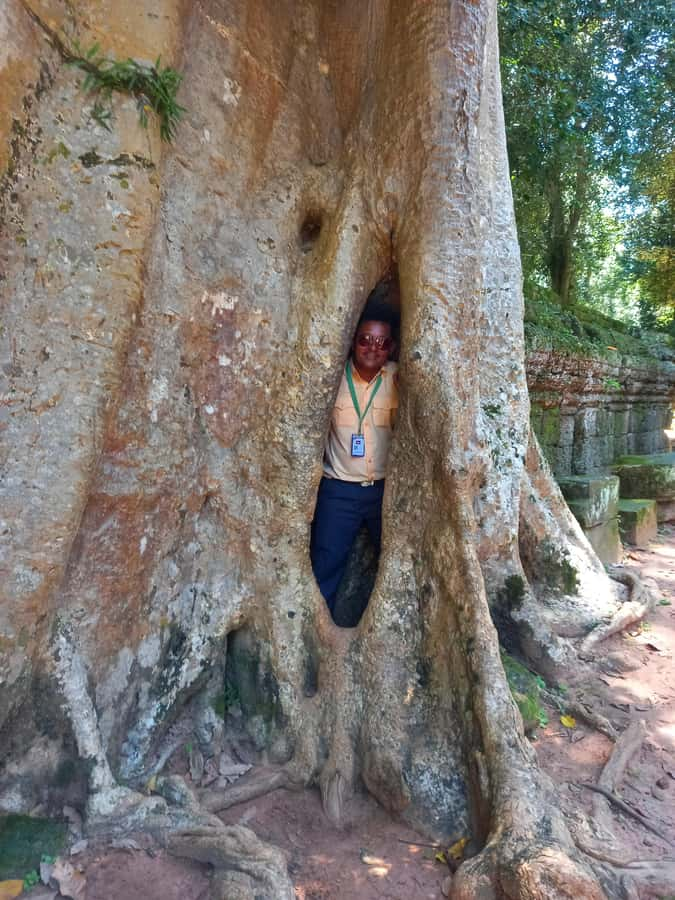
Reviewed · TEMPLE TOURS
Shared day tour with Spanish-speaking guide at Angkor Temple.
Angkor is not one temple waiting at the end of a road. It is a huge former capital, filled with gates, terraces, towers, carved faces, and jungle-wrapped ruins. This eight-hour tour gives you a useful first look at its biggest sights, moving from Angkor Thom and Bayon to Ta Prohm and the vast complex of Angkor Wat.
I like two things right away. First, the small group is limited to nine people, which should make it easier to hear the guide and ask questions. Second, the tour is offered in Spanish, Portuguese, and English. A Spanish-speaking guide named Sem has been praised for explaining the temples in detail, an important advantage when the carvings can otherwise become a blur of stone and symbolism.
The main drawback is the packed one-day route. You see the headline sights, but eight hours leaves limited time for quiet wandering or lesser-known temples. Angkor Wat comes in the afternoon, so anyone focused on sunrise light or cooler early-morning conditions should compare this with a sunrise or two-day option.
Key points at a glance
- South Gate entrance: Enter Angkor Thom across a causeway lined with gods, demons, and a giant naga.
- Bayon’s carved faces: See the famous towers with enormous serene faces at close range.
- Two royal terraces: Visit the Terrace of the Elephants and the Terrace of the Leper Kings.
- Jungle-covered Ta Prohm: Explore a temple that has remained relatively untouched since its discovery.
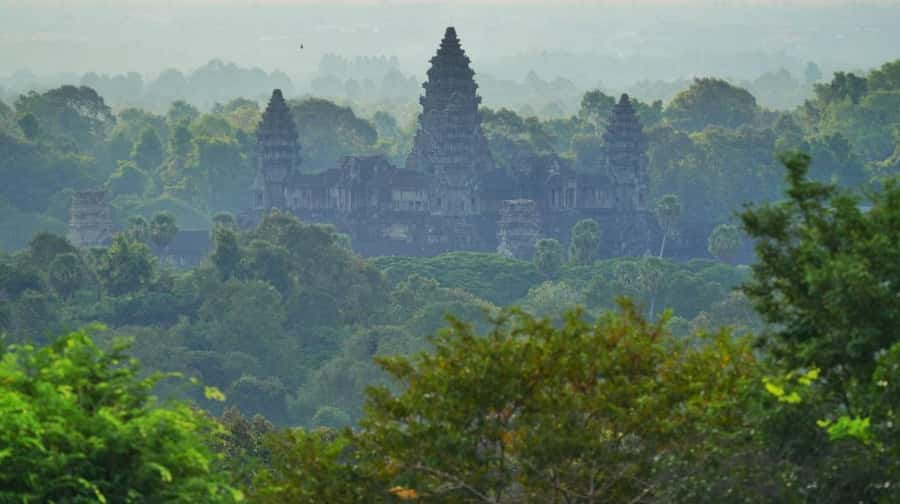
- Afternoon at Angkor Wat: Spend the second half of the day at Cambodia’s best-known temple complex.
- Spanish-speaking small group: Travel with up to nine participants, with English and Portuguese also offered.
A full day built around Angkor’s essential sights
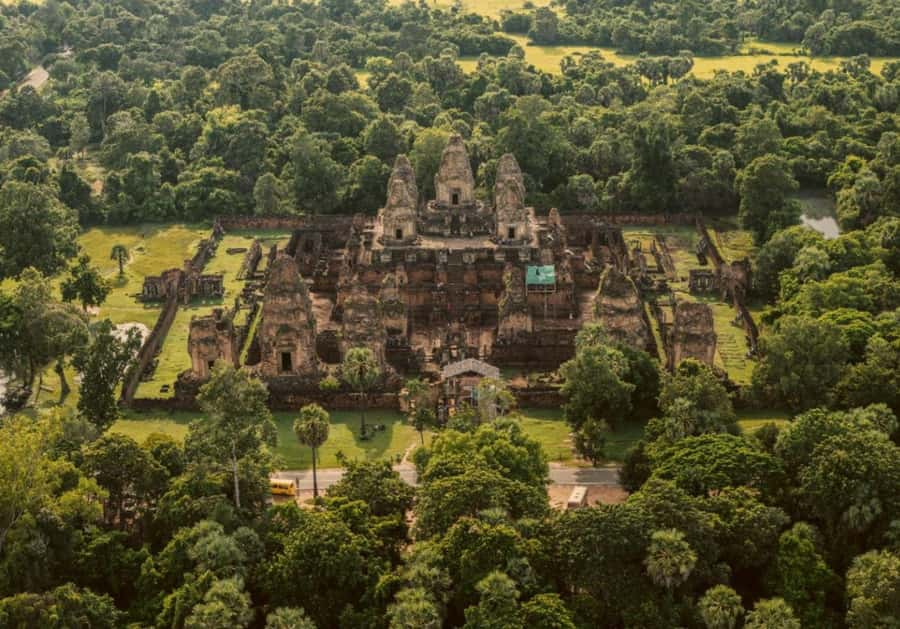
This tour follows a sensible route through the main Angkor sites. You are picked up at your Siem Reap hotel in the morning, then spend the day moving through the old capital before reaching Angkor Wat in the afternoon.
That order matters. Angkor Thom introduces the scale and power of the Khmer capital. Bayon supplies the most recognizable faces. The terraces show how royal ceremonies and public display shaped the city. Ta Prohm changes the mood with its trees and broken galleries. Angkor Wat then provides the grand finale.
You should expect a full day rather than a relaxed temple stroll. The tour lasts eight hours, and the schedule covers several large sites. Bring drinks, a jacket, and internet access, along with a GPS or map and a pen. The supplied packing advice is slightly unusual, but a map and pen can be handy when your guide points out names, layouts, or details you want to remember.
The tour is not suitable for people over 331 pounds, or 150 kilograms. Pets are not allowed.
More Temple Tours in Siem Reap:
- Angkor Wat Sunrise & 3 Main Temples with Breakfast – Small Group
★ 5.0 · 2,857 reviews - Siem Reap: Full Day Angkor Wat Temple Experience with Sunset
★ 4.9 · 1,490 reviews - 2 Days Exclusive Temple Highlights with Sunset and Sunrise Tour
★ 5.0 · 1,157 reviews
Entering Angkor Thom through the South Gate
Angkor Thom was a fortified capital covering about 10 square kilometers. That figure helps explain why this is not simply a temple stop. You are entering the remains of a city, with broad spaces and several major monuments inside its walls.
The South Gate makes a strong opening. You cross a causeway lined by statues of gods and demons, each side associated with a giant naga. This is one of those approaches where the entrance itself is part of the sight. You do not just arrive at a wall, you pass through a carefully staged symbolic gateway.
Take time to look along both sides of the causeway. The figures create a visual procession toward the gate, and the naga gives the scene a strong central shape. Your guide can help separate the repeating figures and explain what you are looking at, which is useful because the scale makes it easy to focus only on the gate tower.
Angkor Thom is also where the day begins to feel larger than a standard temple visit. The city’s defenses, entry roads, and wide area give you a sense of a planned royal center. The drawback is that the site can feel spread out. If you prefer a slow look at every carved detail, the schedule may move faster than you would choose.
Bayon and its enormous stone faces
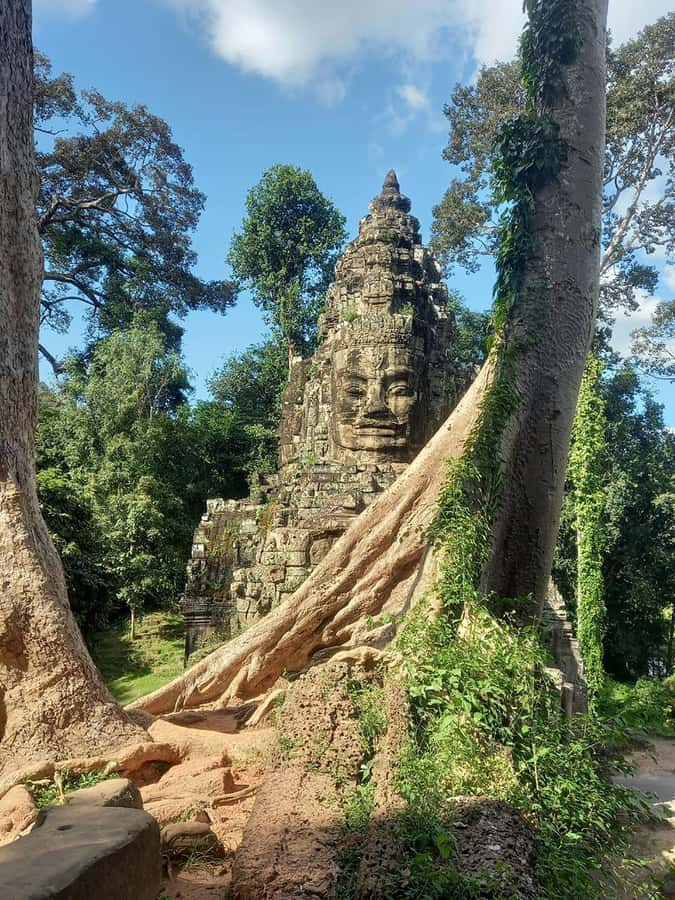
Bayon is the emotional center of the first part of the tour. Its towers carry large carved faces with calm expressions, and the effect changes as you move around the temple. Faces appear through openings, above galleries, and at angles you may not notice from the first path.
I like Bayon because it rewards both a guided explanation and simple wandering. Your guide can point out how the towers are arranged and help you understand why the faces are so memorable. Then you can look for your own favorite view without needing to turn the visit into a lecture.
The temple is not tidy in the modern sense. Corridors, towers, and stone blocks create a maze-like experience. That is part of the appeal, but it also means you should stay aware of the group. In a small party of no more than nine, you have a better chance of keeping track of everyone while still getting room to look.
Bayon is also a good place to have questions ready. Ask about the faces, the temple’s purpose, and the way the structure relates to Angkor Thom. The Spanish-language guiding is especially useful here if you want more than a quick identification of the famous towers. Sem, the named guide associated with especially detailed explanations, is a useful point of reference for Spanish-speaking visitors choosing this tour.
Royal display at the Terraces of the Elephants and Leper Kings
After Bayon, the route continues to the Terrace of the Elephants and the Terrace of the Leper Kings. These are shorter stops than Angkor Wat, but they add important variety to the day.
The Terrace of the Elephants is known for its elephant carvings and its role as a grand royal viewing platform. From the name alone, it is easy to expect a single sculpture or a small monument. Instead, think of it as part of the ceremonial face of the old capital, a place tied to public display and royal presence.
The Terrace of the Leper Kings gives you another carved stone setting, with a different mood and subject matter. Your guide can make these stops more meaningful by pointing out what the carvings show and how the terraces fit into the wider city.
These visits may feel brief compared with the main temples. That is not necessarily a flaw. They break up the day and keep the route from becoming four versions of the same tower-and-gallery experience. If your main goal is photography or detailed inspection, you may wish for more time here, but the schedule rightly gives more attention to Bayon, Ta Prohm, and Angkor Wat.
A few more Siem Reap half-days worth weighing up
- Angkor Wat Sunrise or Sunset Tour with Guide from Siem Reap
★ 5.0 · 12,109 reviews - Siem Reap: Angkor Wat: Small-Group Sunrise or Sunset Tour
★ 5.0 · 9,444 reviews - From Siem Reap: Kampong Phluk Floating Village Tour by Boat
★ 4.9 · 6,979 reviews - Sunset tour of Kampong Phluk stilts home village on the Tonle Sap
★ 5.0 · 4,865 reviews
Ta Prohm, where trees share the temple
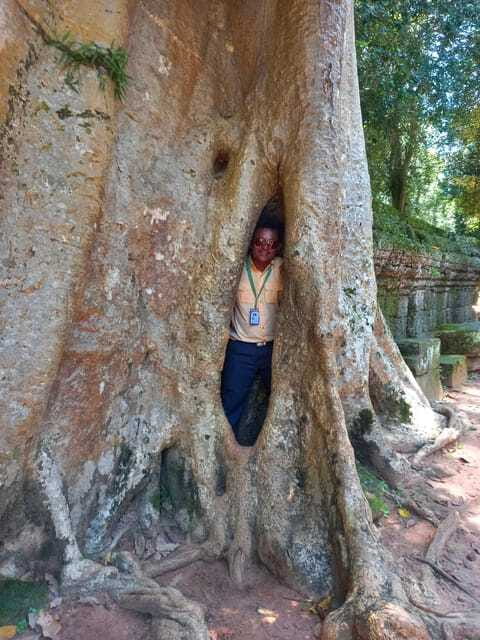
Ta Prohm is the day’s change of pace. This temple remains relatively untouched since it was discovered, and its galleries and stonework are closely associated with the jungle. The result is a place where walls, roots, doorways, and broken sections compete for your attention.
The appeal is immediate. At Ta Prohm, you can see how quickly a large stone structure feels less like a finished monument and more like part of the surrounding forest. Trees and masonry create narrow views, shadowed passages, and dramatic interruptions in the walls.
I would give Ta Prohm your full attention instead of treating it as a quick photo stop. Look at the way the trees press against the temple and how the surviving galleries lead you from one section to another. The site’s condition is also a reminder that Angkor is not a single polished monument. It is a huge archaeological area with different levels of preservation.
The practical tradeoff is space and time. A jungle temple can feel harder to navigate than a wide open terrace, and the eight-hour schedule does not allow unlimited wandering. Stay close enough to follow the guide’s route, especially after stepping aside to examine a doorway or carved panel.
Angkor Wat in the afternoon
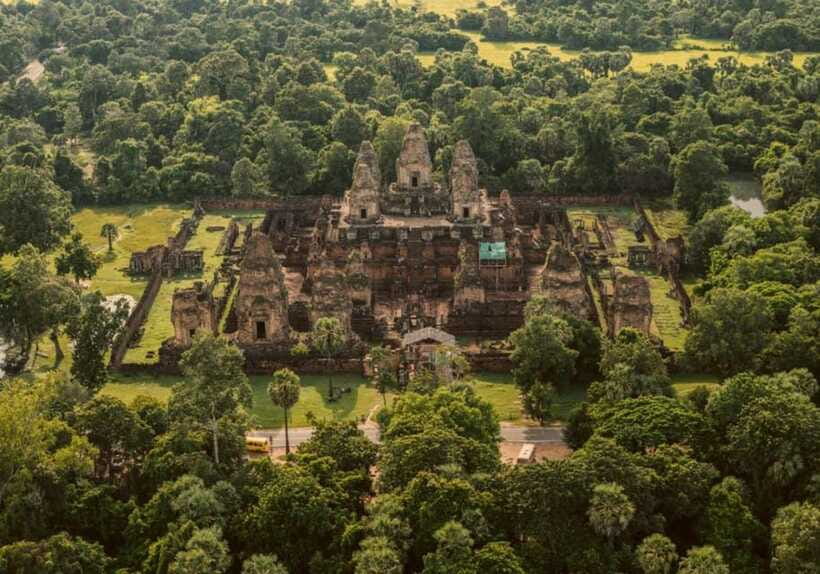
The final major stop is Angkor Wat, the best-known temple on the Angkor plain. The complex covers 81 hectares, roughly comparable in size to Beijing’s Imperial Palace. That comparison gives you a better idea of the scale than a simple description of large.
Angkor Wat’s power comes from control and balance. Its composition, proportions, and sculptural detail work together, creating a monument that feels planned from the broadest view down to individual carvings. After the more tangled experience of Ta Prohm, the order of Angkor Wat can feel striking.
Do not rush straight to the most famous view and assume you have seen the temple. The grounds are vast, and the complex deserves time for its approach, galleries, courtyards, and stone details. The guide helps you set priorities, which is valuable on a first visit because you could easily spend the entire afternoon covering only part of the site.
The afternoon timing has both strengths and weaknesses. It gives you the most famous temple as the day’s climax, and the route avoids using the whole day on one monument. On the other hand, this is not a sunrise tour. If your priority is dawn photography or very early light, choose a different Angkor product that specifically includes sunrise.
The supplied details do not promise sunset, a meal, or a special photography stop, so do not book this tour expecting those extras. Its purpose is a broad, guided introduction to the four main areas in one day.
What the Spanish-speaking guide adds
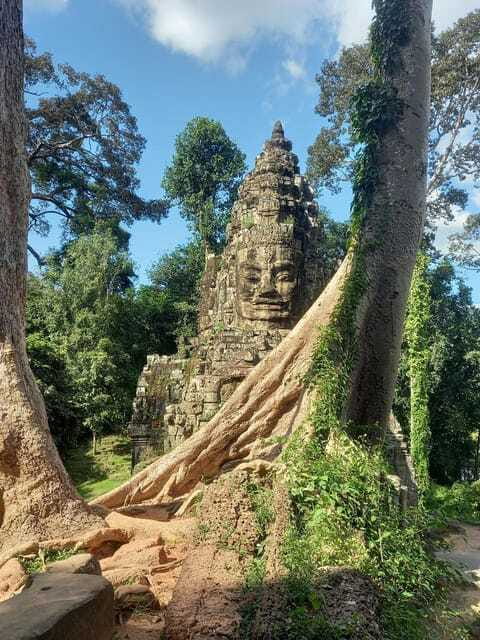
Angkor is easier to appreciate when someone explains what connects the sites. A guide can tell you why the entrance procession matters, help identify the faces at Bayon, and show how the terraces relate to Angkor Thom as a city.
This matters even more on a shared tour. You are not setting the pace alone, so the guide becomes the person who turns a series of stops into a coherent day. The tour offers Spanish, Portuguese, and English. Some content may appear in its original language, so it is sensible to confirm your preferred language when booking.
Sem is the only guide named in the available information. A Spanish-speaking participant specifically praised the detailed explanations, which fits the strongest reason to choose a guided visit: you get context at the exact place where the carving or structure makes sense.
The group limit of nine is another practical plus. It is not a private tour, and you should not expect to stop whenever you want. Still, nine people is a manageable size for hearing instructions, staying together, and asking a question without turning the visit into a large procession.
Is $50 a fair price?
At $50 per person, this tour sits in the reasonable range for a full eight-hour guided day, especially if hotel pickup and a multilingual guide are included as stated. The value comes from combining four major Angkor areas in one organized route rather than arranging separate transport and explanations yourself.
The price is strongest for first-time visitors who want the main temples in a single day. You are paying for structure, interpretation, and the convenience of moving between sites. The small group also makes the price more appealing than a large coach outing.
The value is less clear for repeat visitors who already know Angkor well or who want long periods alone at one temple. A private tour could offer more control, while a two-day tour would give you more breathing room. The supplied information does not state that entrance tickets, meals, or drinks are included, so check those details before paying.
Free cancellation up to 24 hours before the tour and reserve-now, pay-later booking make it easier to keep plans flexible. Those policies are useful in Siem Reap, where you may not want to lock every day of a longer trip into place.
Who should book this Angkor day tour?
I would point this tour toward a first visit to Siem Reap, especially for someone who wants the main Angkor sights without planning a route from scratch. It also suits Spanish-speaking visitors who want a guide able to explain the temples in their language.
It is a good match for you if:
- You have one day for Angkor’s major temples.
- You want Bayon, Ta Prohm, and Angkor Wat in the same outing.
- You prefer a small shared group to a large coach.
- You value explanation over simply being dropped at each site.
- You want flexible cancellation and payment terms.
I would compare other options if you want sunrise, sunset, a two-day pace, or a private vehicle and guide. Those priorities need more time or more control than this compact route provides.
Should you book it?
Book this tour if you want an efficient first look at Angkor with a Spanish-speaking guide and a small group. Its best features are the carefully chosen route, the striking South Gate approach, Bayon’s faces, jungle-set Ta Prohm, and a full afternoon at Angkor Wat.
Skip it if your ideal day means lingering at one temple, photographing sunrise, or exploring well beyond the famous four stops. For most first-time visitors with only one day, though, $50 buys a practical introduction and the added help of a guide who can explain what the stones are trying to say.
FAQ
Where does this Angkor temple tour take place?
The tour takes place in Siem Reap Province, Cambodia, with pickup from your hotel in Siem Reap.
How long does the tour last?
The tour lasts eight hours.
What temples and sites are included?
The route includes Angkor Thom, the South Gate of Angkor Thom, Bayon, the Terrace of the Elephants, the Terrace of the Leper Kings, Ta Prohm, and Angkor Wat.
Is Angkor Wat visited on this tour?
Yes. Angkor Wat is visited in the afternoon.
What languages are available?
The live guide is available in Spanish, Portuguese, and English.
Is this a private tour?
No. It is a shared small-group tour limited to nine participants.
How much does the tour cost?
The price is $50 per person.
Can I cancel the tour?
Yes. You can cancel up to 24 hours in advance for a full refund.
Can I reserve now and pay later?
Yes. The booking option allows you to reserve your place and pay later.
What should I bring?
Bring drinks, a jacket, internet access, a GPS or map, and a pen. Pets are not allowed, and the tour is not suitable for people over 331 pounds, or 150 kilograms.
Just added around Siem Reap
- Twilight Tastes of Siem Reap Include Dinner★ 5.0 · 13 reviews
- Ultimate Sunrise to Angkor Wat, Angkor Thom and Bayon Temple★ 5.0 · 3 reviews
- Trekking Tour at Phnom Kulen National Park from Siem Reap★ 5.0 · 3 reviews
- Professional Photo Shoot in Angkor Archaeological Park, Siem Reap★ 5.0 · 42 reviews
- Full-Day Private Tour of Angkor Wat with Pick Up★ 5.0 · 12 reviews
- Unveiling 2 Days Private Angkor Wat/Beyond In Sunrise/Sunset Tour★ 5.0 · 48 reviews
- Siem Reap City Tour with War Museum and Killing Field★ 5.0 · 27 reviews
- Private Day Trip to Angkor Temples with Expert Guide★ 5.0 · 4 reviews
Temple Tours, compared.
Angkor Wat Sunrise & 3 Main Temples with Breakfast – Small Group
Read our review →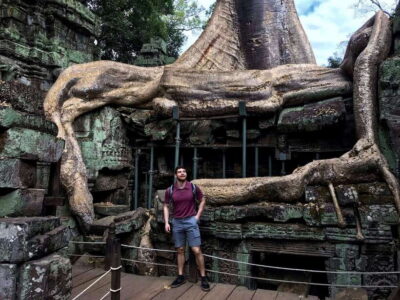
Full Day Angkor Wat Temple Experience with Sunset
Read our review →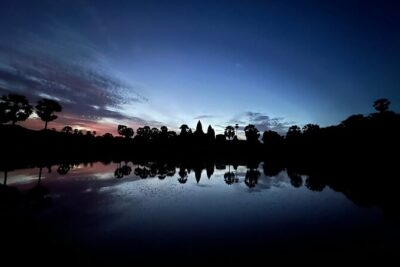
2 Days Exclusive Temple Highlights with Sunset and Sunrise Tour
Read our review →
Full-Day Banteay Srei & 4 Temples – Grand Tours Join-in Tour
Read our review →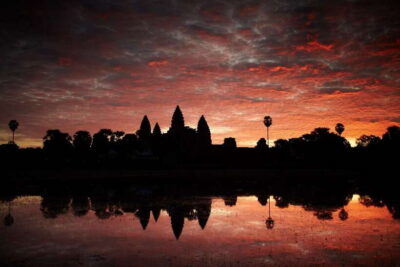
Angkor Sunrise 1- or 2-Day Guided Temples Tour
Read our review →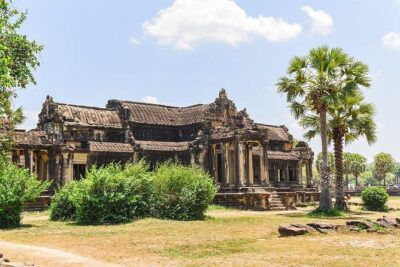
Angkor Wat Sunrise Explore The Most Iconic Temples
Read our review →
Koh Ker Temple Group & Beng Mealea Full-Day Join-in Tour
Read our review →Browse the lists this tour appears in