
Reviewed · 1-DAY TOURS
One day normal Angkor tour
The best feature of this Angkor tour is its early start and sensible temple circuit. At about 7:30 AM, you head into the archaeological park while the day is still cooler, beginning with Angkor Wat before moving through Angkor Thom, Bayon, Ta Prohm, and several smaller monuments. That gives you the essential Angkor experience in one day without wasting time on long transport between unrelated sites.
I like the private air-conditioned vehicle, especially in Cambodia’s heat, and I like the guide-led approach. Bunleat is repeatedly praised for explaining Hindu and Buddhist ideas, temple construction, restoration, and good photo angles. The main drawback is the pace: seven or eight hours is enough for the highlights, but not enough for slow, detailed exploration of every temple.
Key points to know before booking
- Angkor Wat comes first: The 7:30 AM departure aims to reach the park before the worst heat and larger crowds.
- Bunleat is the guide to request: He is praised for clear temple explanations, cultural context, and helping with photographs.
- The $45 price is not the full cost: Add the $37 one-day Angkor ticket and pay for lunch separately.
- You visit the major central temples: Angkor Wat, Ta Prohm, Bayon, Angkor Thom, Baphuon, Phimeanakas, and the Royal Terraces are included.
- Private transport makes the day easier: Your group rides in an air-conditioned car or minivan with bottled water.
- Dress for temple rules: Men and women must cover shoulders and knees at places of worship.
Why this one-day Angkor route works
Angkor is too large to absorb in a single day, but this outing makes a good first pass. You see the three temples most people hope to visit, Angkor Wat, Bayon, and Ta Prohm, then add the main monuments inside Angkor Thom and a few lesser-known stops.
That mix matters. Angkor Wat gives you the grand ceremonial setting. Bayon gives you the famous stone faces. Ta Prohm offers the atmospheric ruins entwined with trees. The Angkor Thom stops fill in the story of the old capital rather than treating the park as a string of unrelated photo stops.
The tour lasts about seven to eight hours. That is a full morning and early afternoon, not a quick loop. You will spend much of the day walking over uneven ground, climbing steps, and crossing exposed courtyards. A moderate level of physical fitness is expected, and comfortable shoes are more useful than smart ones.
Because this is a private activity, only your own group takes part. That gives you more control than a large coach tour. You can ask questions as you go, and the guide can usually adjust the amount of explanation or walking to suit the group, although the published schedule still packs a lot into one day.
A few more Siem Reap half-days worth weighing up
- 1-Day Amazing Angkor Wat Tour with Sunset & All Interesting Major Temples
★ 5.0 · 308 reviews - Angkor Wat one Day Private Tour for All Highlight Angkor Temples
★ 5.0 · 199 reviews - 1-Day private Angkor Temple Tour from Siem Reap
★ 4.9 · 178 reviews
Starting at Angkor Wat around 7:30 AM
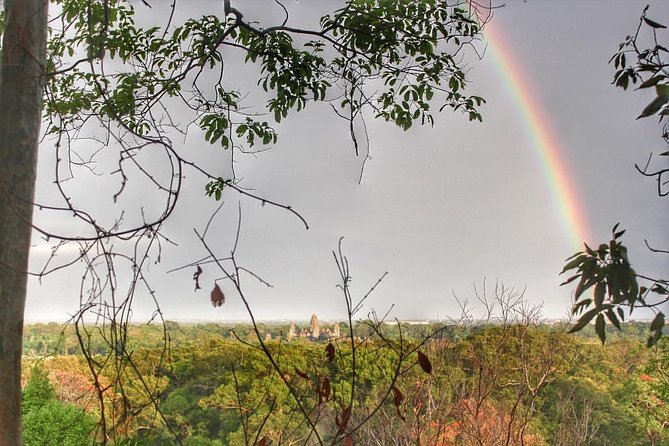
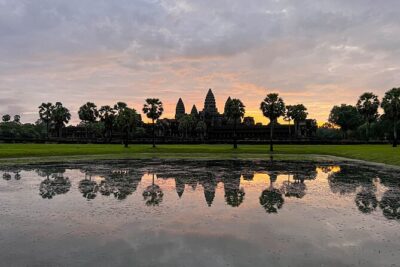
The first major stop is Angkor Wat, the enormous temple complex that gives the wider park its name. Getting there early is a practical choice. The stone surfaces heat up quickly, and the temple is easier to appreciate before the strongest sun of the day.
Your guide should begin with the basic story of the monument, including its religious purpose and the way its galleries, towers, courtyards, and basins fit together. That introduction is valuable here because Angkor Wat can feel confusing at first. Without context, you may see impressive towers and long walls but miss how carefully the temple was planned.
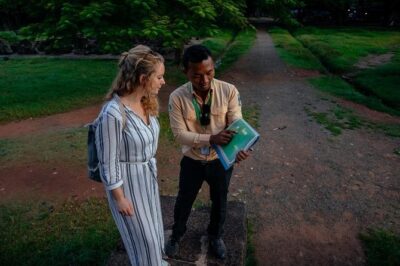
Allow time for the approach, the outer galleries, and the central temple area. Photography is a major part of the experience, and Bunleat is specifically praised for showing useful angles and helping take photographs. That can save you from returning home with only the usual straight-on view of the main towers.
The tradeoff is that an early start means you need to be ready at the agreed pickup point in Siem Reap. The tour information lists hotel pickup and drop-off, while the meeting point is given as Royal Angkor Resort on National Road 6. Confirm the pickup details before the morning of the tour, especially if you are staying elsewhere in town.
Baksei Chamkrong and the route toward Angkor Thom
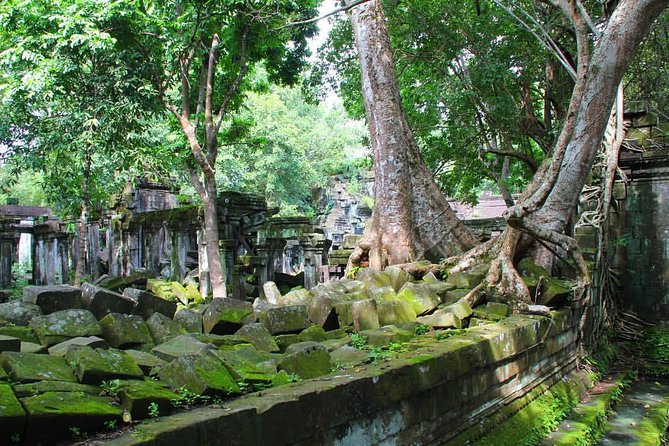
After Angkor Wat, the route heads north to Baksei Chamkrong. This smaller pyramid temple was built in the 10th century and dedicated to Shiva. It is not as famous as Angkor Wat or Ta Prohm, but it helps show how Khmer temple design developed across different periods.
The temple is described as a pyramid form, with comparisons to the Maya temple at Tikal. The point is not that the cultures were connected, but that different ancient societies used high, stepped structures to express religious importance. Your guide can make this kind of architectural comparison more useful than a simple list of construction dates.
Baksei Chamkrong is also a change of scale. After the vastness of Angkor Wat, a smaller monument lets you focus on the basic shape of a Khmer temple without trying to take in miles of galleries and courtyards.
Do not expect a long visit here. The schedule is built around the major temples, so this is more of a concise historical stop than a place for extended wandering. That is appropriate for a one-day route, but visitors who prefer quiet ruins and slow photography may wish they had more time.
Bayon and the stone faces of Angkor Thom
Next comes Bayon, located near the center of Angkor Thom. The temple is known for its large carved faces, which appear from many directions as you move through the towers and passageways.
Bayon rewards a guide. The faces, galleries, reliefs, and changing viewpoints are easier to understand when someone explains what you are looking at. The guide also adds religious and cultural context, including the relationship between Hindu and Buddhist traditions that shaped the monuments of Angkor.
The tight interior spaces can feel crowded, even on a day when other parts of the park are calm. Take your time with the faces, but watch your footing and be patient around narrow passages. You may find that the best view is not the first obvious one. Looking up and back through the towers often gives a stronger sense of how the temple was designed.
This is one of the places where Bunleat’s photo help could be particularly useful. Good framing depends on distance, light, and the angle of the towers. The guide’s role is not just to point out famous features, but to help you notice how the monument changes as you move through it.
Same base, a completely different kind of day:
- Angkor Wat Sunrise or Sunset Tour with Guide from Siem Reap
★ 5.0 · 12,109 reviews - Siem Reap: Angkor Wat: Small-Group Sunrise or Sunset Tour
★ 5.0 · 9,444 reviews - From Siem Reap: Kampong Phluk Floating Village Tour by Boat
★ 4.9 · 6,979 reviews - Sunset tour of Kampong Phluk stilts home village on the Tonle Sap
★ 5.0 · 4,865 reviews
Baphuon, Phimeanakas, and the former royal center
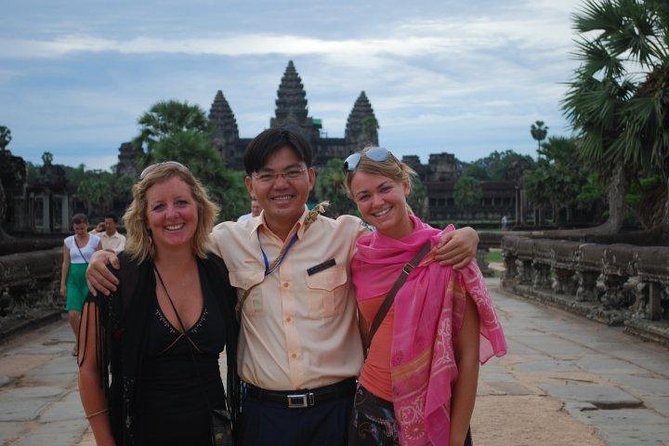
The tour continues through nearby monuments within Angkor Thom, including Baphuon, Phimeanakas, and the Royal Palace area. These stops broaden the visit beyond the best-known temples.
Baphuon is another large pyramid-style temple. Its height gives you a different visual experience from the enclosed galleries at Bayon, though steps and uneven surfaces make sturdy footwear important. The scale also helps explain that Angkor Thom was not simply a walled temple complex. It was a major urban and ceremonial center.
Phimeanakas is connected with the former royal area. The remains are less immediately dramatic than Angkor Wat, but they help place royal power within the wider city. A guide can explain how the palace zone and temples worked together, even though much of the original royal construction did not survive in the same way as the stone sanctuaries.
These stops may be less rewarding for someone interested only in famous photographs. I would still keep them in the day because they add structure to the visit. You are not just collecting monuments. You are seeing parts of a capital city, its ceremonial center, and its religious buildings.
The Royal Terraces and the meaning of the city
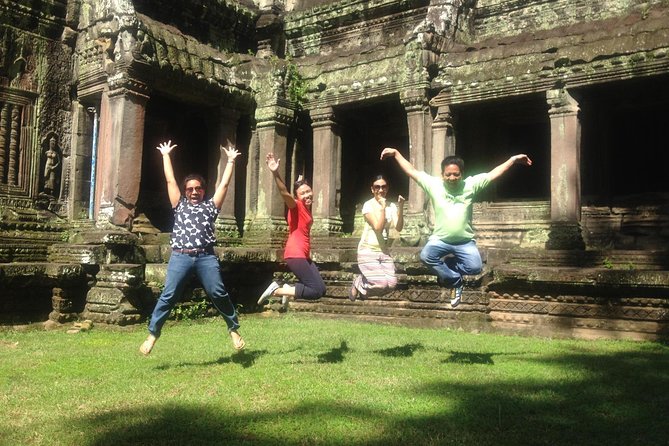
The Royal Terraces are another nearby part of the Angkor Thom visit. They are connected with public and royal display, and their carved surfaces offer a different type of experience from a tall temple.
The terraces are especially useful after Bayon and the central monuments because they show how Angkor’s rulers used open spaces and decorated walls as part of the city. You may spend less time here than at Angkor Wat, but the stop gives you a clearer sense of the old city’s layout.
This section of the route is also a reminder that Angkor is not one building. It is an archaeological park containing temples, roads, gates, terraces, reservoirs, and former urban areas. A good guide helps connect those pieces. Bunleat is praised for explaining construction, restoration, religious ideas, and historical setting, all of which are useful when the remains are spread across a large area.
Ta Prohm and the atmosphere of the ruins

Ta Prohm is often the emotional high point of the day. Unlike the carefully restored feel of some major monuments, Ta Prohm is famous for its dramatic trees, collapsed sections, stone corridors, and roots growing around the ruins.
It is also one of the busiest stops, so the early start helps, though the tour reaches it later in the route. Be prepared for narrow paths and pauses while people take photographs. The combination of popular views and uneven ruins means you should leave some patience in reserve.
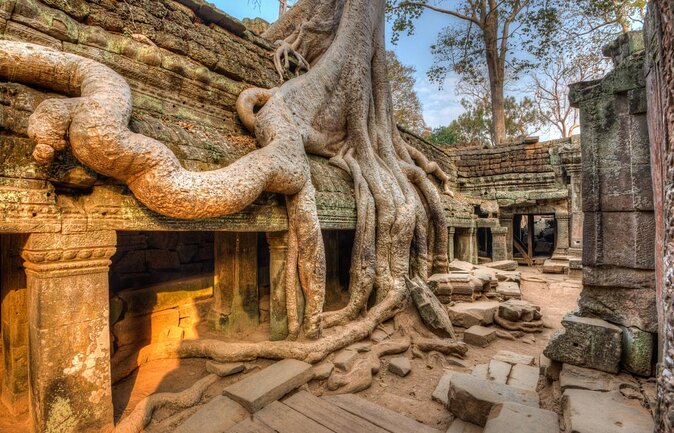
Ta Prohm is not simply a photo backdrop. Look at how the tree roots, fallen blocks, doorways, and galleries interact. The damage and vegetation make the temple feel less orderly than Angkor Wat, but that is part of its character. Your guide can explain what you are seeing and separate the original design from later restoration work.
If your main goal is quiet photography, this itinerary may move too quickly here. If your goal is to see the famous temple as part of a larger Angkor story, the stop earns its place.
Lunch, water, and handling the heat
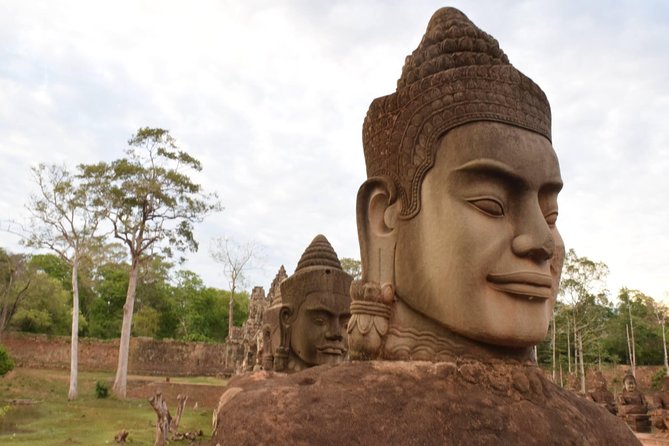
Lunch is not included. The vehicle stops at a restaurant where you can purchase a meal, so budget extra and expect the lunch stop to be practical rather than part of the tour price.
Bottled water is included, which is welcome in the Cambodian heat. Several guide comments also emphasize cold water, cold towels, and strong air-conditioning, though the formal inclusions specifically guarantee bottled water and an air-conditioned vehicle. You should not assume every extra comfort is guaranteed on every departure.
Wear light clothing that still meets temple rules. Shoulders and knees must be covered for both men and women, and shorts or sleeveless tops can lead to refused entry. Bring a hat or other sun protection if useful, but keep your clothing respectful for places of worship.
The tour requires moderate physical fitness. You will walk across temple grounds and may encounter steps, rough paving, and exposed areas. The private car gives you a cool break between sites, but it does not remove the walking.
What the $45 price really covers
The listed price is $45 per person. It includes a professional art historian guide, hotel pickup and drop-off, private air-conditioned transport, bottled water, local taxes, and the services of a private activity for your group.
The important extra is the one-day Angkor ticket, listed at $37 per person. Lunch is also extra, and tipping is optional. In practical terms, the minimum known cost becomes $82 per person before lunch and any tip.
That is not a bargain-basement temple transfer, but it can be fair value if you want a guide who explains the monuments rather than simply driving you between them. Private transport matters in the heat, and a good guide can save you from spending your only Angkor day confused about what you are seeing.
The value is weaker if you already know the temples well or mainly want a driver and short photo stops. In that case, a guided full-day tour may provide more explanation than you need. For a first visit, though, the guide, route, water, and transport make the price easier to justify.
Group discounts are listed, but the available information does not state the discount amount. Ask before booking if you are traveling with several people.
Who should book this Angkor tour
I would choose this tour if you have one full day in Siem Reap and want the major Angkor temples covered in a logical order. It suits first-time visitors who want historical, religious, and architectural explanations without arranging separate transport.
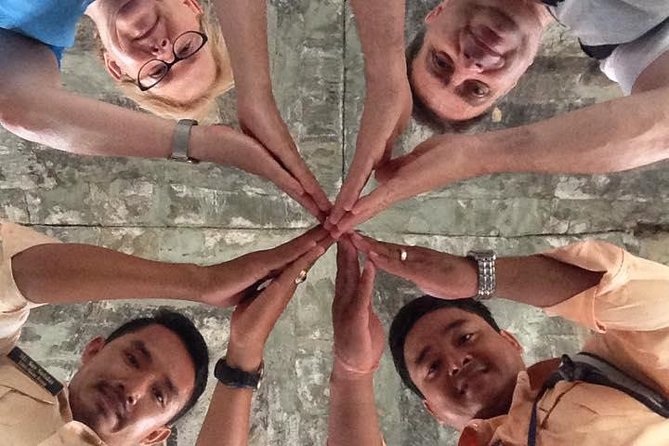
It is also a good fit for people who value a private car and personal guide. Bunleat is the guide name most strongly associated with this experience, and the available feedback repeatedly highlights his patience, explanations, photo suggestions, and more than ten years of experience guiding at Angkor Wat.
I would hesitate if you want sunrise photography, a very slow pace, or a full day focused on lesser-known ruins. This itinerary begins at about 7:30 AM, not at a stated sunrise time, and it aims for the principal sites rather than remote temples.
The experience has a 5 out of 5 rating from 25 ratings, with 100 percent recommending it. Those numbers suggest a strong record, but your own experience will still depend on the guide assigned, the heat, crowd levels, and how much time you prefer to spend at each stop.
Booking, dress, and cancellation details
Confirmation is normally provided at booking. If you book within three days of the tour, confirmation can take up to 48 hours and remains subject to availability.
Free cancellation is available when you cancel at least 24 hours before the start time. Cancellations made less than 24 hours before departure are not refunded, and changes inside that period are not accepted.
A vegetarian meal option is available if requested at booking. The listed operating hours are 7:00 AM to 3:00 PM daily, and the tour itself begins around 7:30 AM.
Should you book it?
Book this one if you want a well-organized first look at Angkor with a private vehicle and a guide who can explain the religious and architectural details. The route covers the big three, Angkor Wat, Bayon, and Ta Prohm, while still making room for Baksei Chamkrong, Baphuon, Phimeanakas, the Royal Palace area, and the Royal Terraces.
Before paying, add the $37 temple ticket and lunch to the $45 tour price. Confirm your hotel pickup, request Bunleat if available, and dress with covered shoulders and knees. If you can accept a busy, full schedule, this is a practical way to see the essential Angkor monuments in one day.
FAQ
How long does the Angkor tour last?
The tour lasts approximately seven to eight hours. The stated itinerary begins around 7:30 AM.
What temples are included?
The route includes Angkor Wat, Baksei Chamkrong, Bayon, Baphuon, Phimeanakas, the Royal Palace area, the Royal Terraces, and Ta Prohm.
Is hotel pickup included?
Yes. Hotel pickup and drop-off are included. The listed meeting point is Royal Angkor Resort on National Road 6, so confirm the exact pickup details before departure.
Is the Angkor entrance ticket included?
No. The one-day Angkor ticket costs $37 per person and is not included in the $45 tour price.
Is lunch included?
No. Lunch is purchased separately at a restaurant stop. A vegetarian option is available if requested when booking.
Is transportation private?
Yes. The activity is private for your group and uses an air-conditioned car or minivan.
What should I wear?
You must cover your shoulders and knees. Shorts and sleeveless tops are not allowed at places of worship and selected museums, and entry may be refused if you do not follow the dress rules.
Can I cancel for a full refund?
Yes, if you cancel at least 24 hours before the experience start time. Cancellations or changes made less than 24 hours before departure are not accepted for a refund.
Just added around Siem Reap
- Twilight Tastes of Siem Reap Include Dinner★ 5.0 · 13 reviews
- Ultimate Sunrise to Angkor Wat, Angkor Thom and Bayon Temple★ 5.0 · 3 reviews
- Trekking Tour at Phnom Kulen National Park from Siem Reap★ 5.0 · 3 reviews
- Professional Photo Shoot in Angkor Archaeological Park, Siem Reap★ 5.0 · 42 reviews
- Full-Day Private Tour of Angkor Wat with Pick Up★ 5.0 · 12 reviews
- Unveiling 2 Days Private Angkor Wat/Beyond In Sunrise/Sunset Tour★ 5.0 · 48 reviews
- Siem Reap City Tour with War Museum and Killing Field★ 5.0 · 27 reviews
- Private Day Trip to Angkor Temples with Expert Guide★ 5.0 · 4 reviews
1-Day Tours, compared.

Visit 11 Places in One Day including S21 & Killing Field
Read our review →
1-Day Amazing Angkor Wat Tour with Sunset & All Interesting Major Temples
Read our review →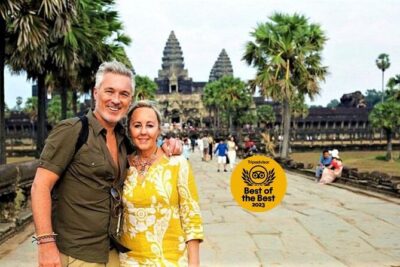
Angkor Wat one Day Private Tour for All Highlight Angkor Temples
Read our review →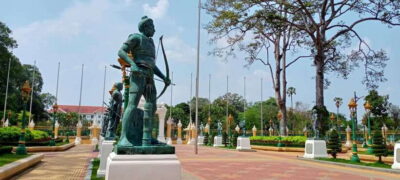
1-Day private Angkor Temple Tour from Siem Reap
Read our review →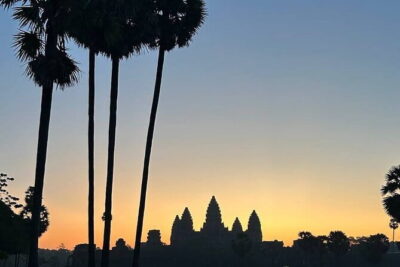
Angkor Wat Sunrise Small-Group 1-Day Tour from Siem Reap
Read our review →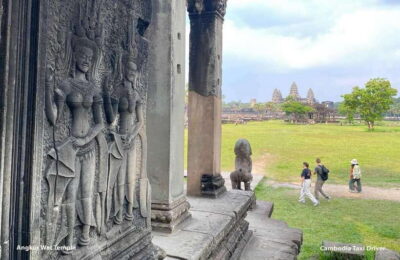
Browse the lists this tour appears in