
Reviewed · ANGKOR WAT TOURS
1-Day Angkor Wat Cycling Tour: Scenic Bike Adventure in Siem Reap
The best thing about this private Angkor cycling tour is the change of pace. Instead of moving from temple to temple in a vehicle, you pedal through forest, village roads, and quiet paths between the major sights. I like the chance to see Angkor Wat, Bayon, and Ta Prohm while also reaching smaller Ta Nei and Kravan Temple. I also like that guide Hok has been praised for keeping a safe, comfortable pace.
The main consideration is the heat. You ride about 20 kilometers over six to seven hours, and the Angkor Pass costs an extra $37. The route is mostly flat, but this is still a full morning and afternoon on a bicycle, not a short sightseeing ride.
Key points to know before you book
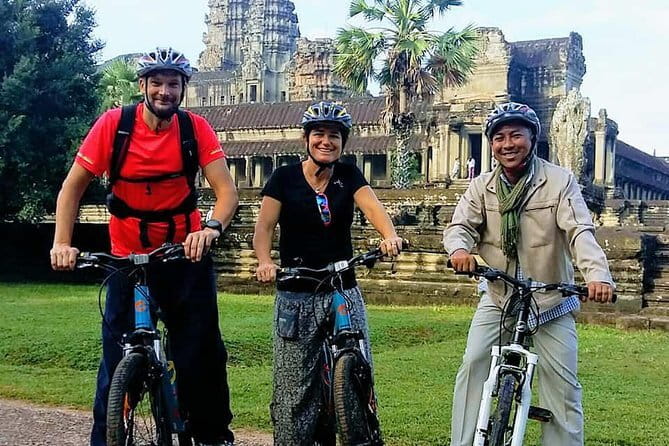
- Private riding pace: Your group rides together, so you can set a speed that feels comfortable rather than follow a large group.
- Five important temple areas: The route includes Angkor Wat, Angkor Thom, Bayon, Ta Prohm, Ta Nei, and Prasat Kravan.
- About 20 kilometers of cycling: Expect a mix of roads, forest paths, and village routes on generally flat ground.
- Hotel pickup at 8:00 a.m.: The guide brings the bicycles and returns you to your hotel after the tour.
- Water and cool towels included: These small touches matter in Cambodia’s heat, especially during the longer temple stops.
- The temple pass is extra: Add $37 per person to the $49 tour price when working out your total cost.
Why cycling Angkor changes the day
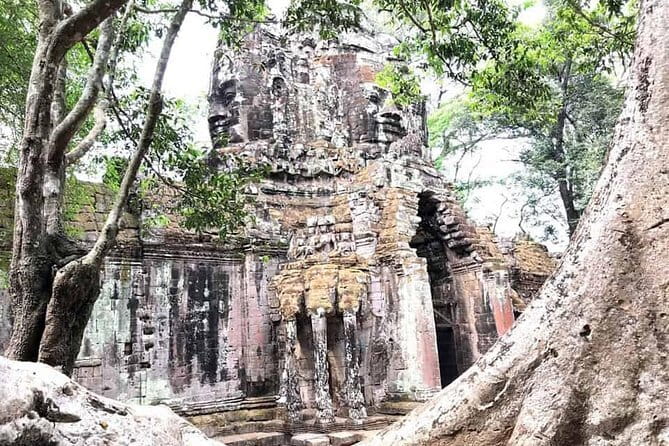
Angkor is enormous. The famous temples are spread across a large park, and the distances between them can make a standard sightseeing day feel like a series of vehicle transfers. A bicycle gives you a more direct connection with the setting. You notice the trees, the forest paths, the sounds around the ruins, and the small changes in the route from one temple to the next.
I like this format because the riding is part of the sightseeing, not just transportation. You pass through local villages and forest areas around Angkor, then arrive at the stone temples with a better sense of how widely the old city spread.
This is a private activity, so only your group participates. That matters if one person wants more time at a temple, if your group has mixed cycling ability, or if you prefer not to spend the day keeping up with strangers. The guide can set a pace that works for your party, within the limits of the full route.
The tour runs for roughly six to seven hours and begins at 8:00 a.m. That early start gives you a useful block of time at the park, but you should still expect a warm, active day. Wear light clothing that covers your shoulders and knees, as required for temple visits, and bring the attitude of someone ready to exercise between the ruins.
More Cycling Tours in Siem Reap
- Siem Reap Countryside Bike Tour / E-Bike or Tuk Tuk
★ 5.0 · 935 reviews - Angkor Sunrise Bike Tour / E-Bike or Tuk Tuk
★ 5.0 · 615 reviews - Siem Reap: Bike the Angkor Temples – Full-Day 30km Tour
★ 5.0 · 463 reviews
Starting at Angkor Wat after hotel pickup
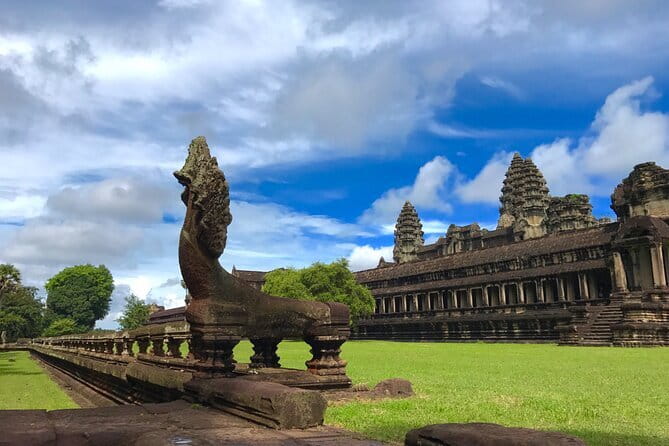
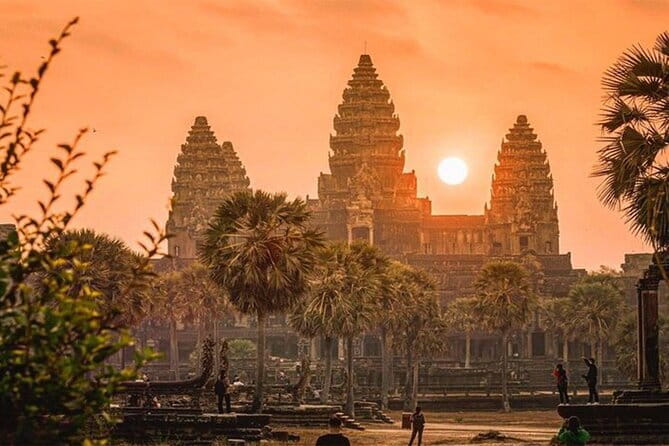
Your guide collects you from your Siem Reap hotel at 8:00 a.m. with the bicycles. The first major stop is Angkor Wat, where you have about two hours to see the temple complex and hear the story behind what you are seeing.
Angkor Wat is the grand opening to the day. Its scale can be difficult to understand from a quick exterior view, so the long stop gives you time to look at the towers, galleries, courtyards, and carved details. The guide’s role is important here. Without context, a large stone complex can become a blur of walls and photographs. With explanation, the layout and purpose begin to make sense.
The bicycle also changes your arrival. You are not simply stepping out of a vehicle at a parking area. You approach through the wider Angkor setting, with forest and open routes around you. That extra movement helps make the temple feel like part of a larger ancient city rather than an isolated monument.
The downside is that two hours can pass quickly. Angkor Wat rewards close looking, and you may want more time if you are especially interested in carvings or architectural details. Still, with several more temples on the schedule, the timing is a practical compromise.
Entering Angkor Thom through the South Gate

From Angkor Wat, the route continues to Angkor Thom, the old royal city. You enter through the South Gate and cycle through the ancient city for about an hour, with stops at the Bayon, the Terrace of the Elephants, and the Victory Gate.
This section gives you some of the best riding of the day because Angkor Thom is not just one temple. It is a broad historic area with roads and monuments spread through the trees. You move between important sites by bicycle instead of treating each one as a separate stop.
The South Gate is a memorable entrance, and cycling through it gives the approach a sense of ceremony. The route then brings you toward the Bayon, located at the center of Angkor Thom. I like this arrangement because you see the city first, then reach its central temple with a clearer idea of the place it once occupied.
The one-hour estimate includes several points of interest, so you should not expect a long, detailed visit at each one. If you want to spend a great deal of time at every monument, this tour may feel brisk. Its strength is coverage: you see the main structure of Angkor Thom and keep moving through the old city.
Bayon Temple and the Terrace of the Elephants
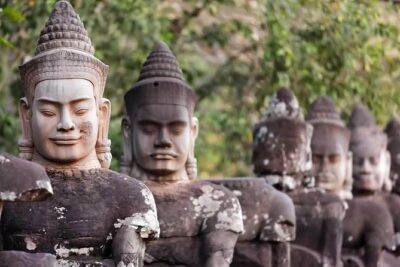
Bayon receives a separate visit of about 30 minutes. The temple is known for its large carved faces and its connection to King Jayavarman VII and Mahayana Buddhism. Your guide can help explain why this temple differs from Angkor Wat and why its central position in Angkor Thom matters.
Thirty minutes is enough for an introduction and photographs, but it is not a slow study session. Bayon can feel confusing at first, with towers, narrow passages, and faces appearing from different angles. Stay close enough to hear the guide, then use any free time to look upward and around the corners.
The Terrace of the Elephants follows as another 30-minute stop. This long platform served as a royal viewing and ceremonial area. Its name comes from the elephant carvings along the terrace, and the setting helps you picture public events connected with the royal center.
These two short stops work well for a first visit because they provide variety. Bayon is enclosed, vertical, and full of carved faces. The terrace is more open and linear. You get two different views of Angkor Thom without spending the whole day inside one complex.
A food stop is also planned around the Angkor Thom section. Meals are not included, so budget separately for what you eat. The tour does provide local snacks, water, and cool towels, which helps, but those items are not a substitute for a proper meal during a long day.
More ways to walk into Angkor Wat:
- Angkor Wat Sunrise or Sunset Tour with Guide from Siem Reap
★ 5.0 · 12,109 reviews - Siem Reap: Angkor Wat: Small-Group Sunrise or Sunset Tour
★ 5.0 · 9,444 reviews - Siem Reap: Angkor Wat 2-Day Tour with Sunrise and Sunset
★ 4.9 · 4,429 reviews - Siem Reap: Full-Day Angkor Wat Guided Tour with Sunset
★ 4.9 · 3,803 reviews
Ta Nei, a quieter forest temple
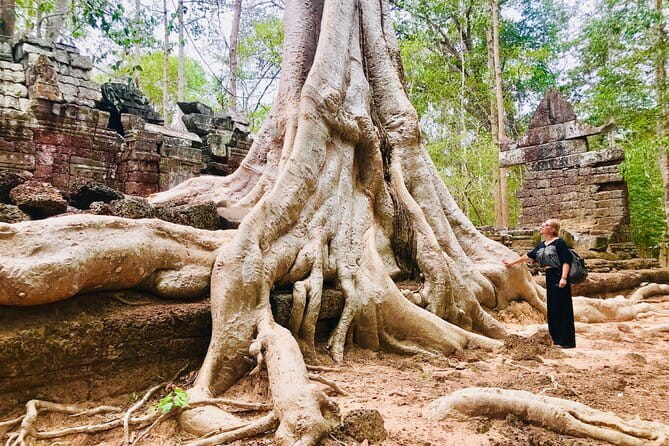
Ta Nei is one of the most appealing parts of the route for anyone who wants a calmer temple visit. You leave the main route and follow a small path through the forest to this smaller complex. The stop lasts about 30 minutes.
Ta Nei does not have the same scale as Angkor Wat or the same instant recognition as Ta Prohm. That is exactly why it fits well into a bike tour. The forest approach and quieter setting make the stop feel less rushed and more connected to the surrounding trees.
I would treat Ta Nei as a chance to slow your breathing, look carefully, and enjoy the setting. The cycling route gives the temple its proper context. You are not just checking off another monument. You are riding through the forest to reach it.
The path is also a reminder that this is an active outing. Conditions can vary between paved roads and smaller trails, and you should be comfortable handling a bicycle for the full distance. The route is described as flat, but flat does not mean effortless after several hours in the heat.
Ta Prohm and the appeal of the jungle setting
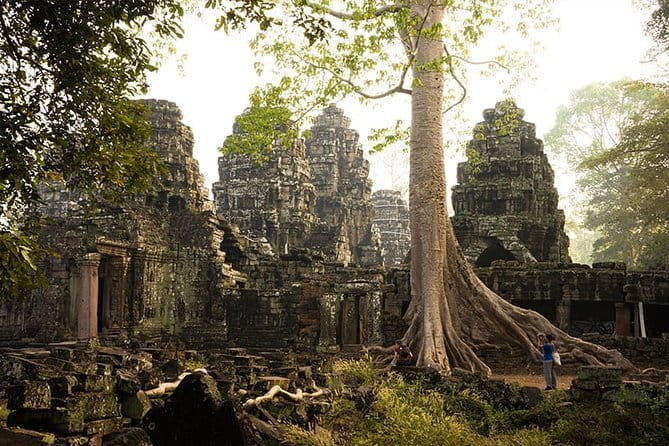
Ta Prohm gets about an hour, making it one of the longer stops after Angkor Wat. King Jayavarman VII built the temple in 1186 and dedicated it to his mother. It is also widely known as the jungle temple associated with the film Tomb Raider.
The film connection brings many people here, but the temple has more to offer than a famous backdrop. Ta Prohm shows how trees and stone share the same space, with roots pressing against walls and courtyards. The result is visually striking, but it also helps you understand the scale and age of the site.
An hour gives you time to walk through the main areas without treating the visit as a quick photo stop. Your guide can add the historical context, while you can focus on the details that catch your eye: doorways, carved surfaces, collapsed sections, and the way the forest frames the ruins.
Ta Prohm is one of the places where crowds can affect the experience, although the supplied tour details do not promise a quiet visit or a particular low-traffic time. The private format helps with your group’s pace, but it cannot control how busy the temple is.
Prasat Kravan and the ride through local villages
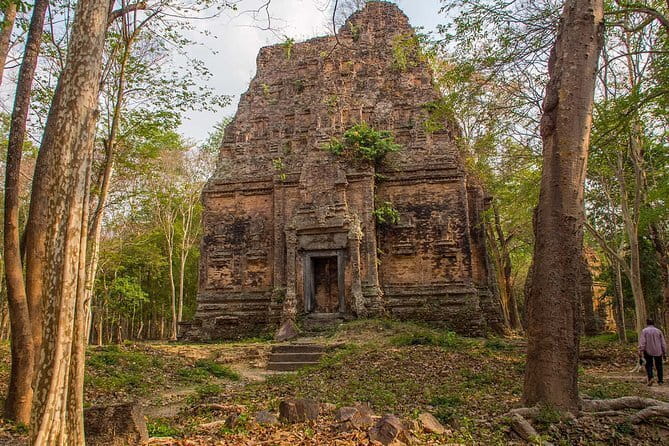
The final temple stop is Prasat Kravan, reached after more cycling through local villages. The stop lasts about 30 minutes and adds a different kind of temple experience to the day.
Prasat Kravan is smaller than Angkor Wat and Ta Prohm, so it works best as a closing visit rather than the main event. The value here is variety. After grand royal centers and forest ruins, you see a more compact monument before riding back toward Siem Reap.
The village route is an important part of this section. You see local surroundings and everyday living areas rather than only the protected temple zone. The tour description refers to local interaction, culture, traditions, and daily life, but the exact nature of those encounters can vary. I would approach this as a respectful glimpse from the bicycle, not as a staged cultural performance.
After Kravan Temple, you cycle back to your hotel. By then, the return ride gives you a quiet finish and lets you reflect on how much ground you covered under your own power.
What the $49 price really covers
The listed price is $49 per person. That includes the bicycle, an English-speaking guide, cool water, cool towels, and local snacks. Hotel pickup and drop-off are also part of the arrangement, which saves you the trouble of arranging transport to the park.
The Angkor Temple Pass is not included and costs $37 per person. That brings the basic cost to $86 per rider before meals and a tip for the guide. Accommodation is also excluded, as you would expect from a day tour that begins and ends at your hotel.
I consider the price reasonable for a private full-day activity, especially if your group values flexibility. You are paying not only for the bicycle but also for transport coordination, guiding, a planned route, and access to several major sites in one day.
The value is less clear if you dislike cycling in heat or want a very slow temple study day. A vehicle-based tour may feel easier physically. On the other hand, the bicycle route provides an experience that a car cannot fully copy, especially on the forest paths and village roads.
Who will enjoy this Angkor cycling tour?
I would recommend this tour to people who want to see the major Angkor temples while staying active. It suits couples, families with capable riders, and small private groups that want to control their own pace.
The route is also a good fit if you have only one day for Angkor and want more than the standard three-stop circuit. Angkor Wat, Angkor Thom, Bayon, and Ta Prohm cover the essential sights, while Ta Nei and Prasat Kravan add smaller and less familiar places.
You should think twice if you are not comfortable riding for about 20 kilometers. The terrain is generally flat, and the tour provides safety equipment, but the day still involves sustained activity, heat, temple walking, and outdoor exposure.
The tour requires clothing that covers your shoulders and knees. Most people can participate, but the private format does not remove the physical demands. If your group has different fitness levels, tell the guide at the start and use the private setting to keep the pace sensible.
The activity has a five-star rating from nine published ratings, and the strongest praise centers on the guide’s flexibility, safe riding pace, and knowledge of the sites. Guide Hok has been singled out for leading a route that mixed roads and trails while keeping the ride comfortable. Those are the details I would value most when choosing a cycling tour.
Should you book it?
Book this tour if you want Angkor to feel like a place you move through, not simply a list of monuments reached by vehicle. The combination of a private guide, mostly flat 20-kilometer route, forest riding, village views, and six important temple areas gives you a full and varied day.
The best case for booking is your interest in active sightseeing and smaller sites such as Ta Nei. The main reason to skip it is physical: the heat and distance may outweigh the benefits if you prefer a relaxed, low-effort day.
At $49 plus the $37 temple pass, it is a fair choice for a private Angkor experience with hotel pickup, equipment, water, towels, and guiding. Go in prepared for a long ride, dress properly for the temples, and you will get a more personal view of the park than a basic transport loop provides.
FAQ
What time does the Angkor cycling tour begin?
The tour begins with hotel pickup at 8:00 a.m.
How long does the experience last?
The tour lasts approximately six to seven hours, including cycling and temple visits.
How far do I cycle?
The route covers about 12 miles, or 20 kilometers, over generally flat terrain.
Which temples are included?
The route includes Angkor Wat, Angkor Thom, Bayon, the Terrace of the Elephants, Ta Nei, Ta Prohm, and Prasat Kravan.
Is the Angkor Temple Pass included?
No. The Angkor Temple Pass costs $37 per person and must be paid separately.
What does the tour price include?
The price includes a bicycle, an English-speaking guide, cool water, cool towels, local snacks, and hotel pickup and drop-off.
Can I cancel for a full refund?
Yes. You can cancel at least 24 hours before the start time for a full refund. If poor weather causes the tour to be canceled, you will be offered another date or a full refund.
Just added around Siem Reap
- Twilight Tastes of Siem Reap Include Dinner★ 5.0 · 13 reviews
- Ultimate Sunrise to Angkor Wat, Angkor Thom and Bayon Temple★ 5.0 · 3 reviews
- Trekking Tour at Phnom Kulen National Park from Siem Reap★ 5.0 · 3 reviews
- Professional Photo Shoot in Angkor Archaeological Park, Siem Reap★ 5.0 · 42 reviews
- Full-Day Private Tour of Angkor Wat with Pick Up★ 5.0 · 12 reviews
- Unveiling 2 Days Private Angkor Wat/Beyond In Sunrise/Sunset Tour★ 5.0 · 48 reviews
- Siem Reap City Tour with War Museum and Killing Field★ 5.0 · 27 reviews
- Waterfall & River of 1000 Siva Linga- Kulen Mountain Private Tour★ 5.0 · 3 reviews
Angkor Wat Tours, compared.
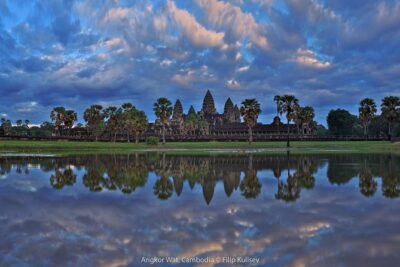
Angkor Wat Sunrise or Sunset Tour with Guide from Siem Reap
Read our review →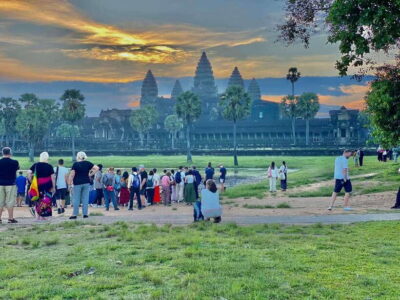
Angkor Wat: Small-Group Sunrise or Sunset Tour
Read our review →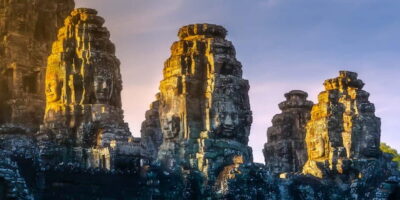
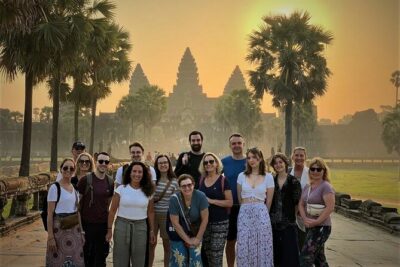
Angkor Wat Highlights and Sunrise Guided Tour from Siem Reap
Read our review →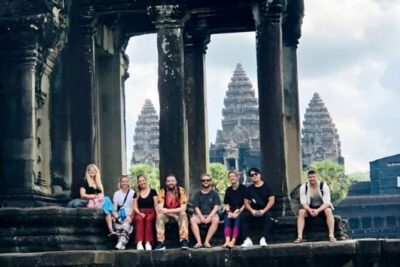
Angkor Wat Sunrise & 3 Main Temples with Breakfast – Small Group
Read our review →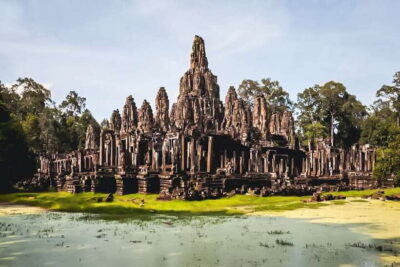
Angkor Wat Sunrise and Full-Day Sightseeing Tour
Read our review →
Angkor Wat Small-Group Exploration with Expert Guide
Read our review →Browse the lists this tour appears in