
Reviewed · 3-DAY EXPERIENCES
3 Days Siem Reap Explorer – Small Group
Angkor Wat at sunrise is the headline, but the real strength of this three-day trip is its range. You move from the vast stone towers of Angkor Wat to tree-covered Ta Prohm, the delicate carvings of Banteay Srei, and the very different world of Kampong Phluk on Tonlé Sap Lake. I like the maximum group size of 15, and I like that an English-speaking guide gives the temples a clear story instead of leaving you to puzzle over every fallen stone.
The tour also includes air-conditioned transport, hotel pickup and drop-off, water, and either a Tonlé Sap boat trip or Phare Circus, depending on the season. The main drawback is cost planning: the advertised $129 does not include the required $62 three-day temple pass, and meals are extra. You should also be ready for a pre-dawn start and a good deal of walking.
Key points to know before booking
- Sunrise at Angkor Wat: Leave around 4:00 to 4:30 am, depending on the season, and enter from the quieter eastern side.
- A useful small-group size: With no more than 15 people, the guide can usually give more attention than on a large coach tour.
- Tonlé Sap or Phare Circus: Kampong Phluk is included when scheduled, while Phare Circus is the alternative from March 1 through August 31.
- A strong temple mix: The route covers Angkor Wat, Angkor Thom, Bayon, Ta Prohm, Preah Khan, Neak Pean, Banteay Srei, and Pre Rup.
- Budget beyond the headline price: Add $62 per person for the temple pass, plus your meals.
- Good preparation matters: Wear shoes suited to uneven ground, and cover your shoulders and knees inside the temples.
Why three days works well in Siem Reap
Angkor is not one temple. It is a large collection of religious sites spread across the countryside, built over centuries by different Khmer kings. A rushed one-day visit can show you the famous towers, but it leaves little room for smaller sites, changing styles, or a slower look at the carvings.
This tour gives you three distinct days. The first combines rural Cambodia with early Khmer architecture and evening culture. The second focuses on the famous central temples, beginning with sunrise. The third reaches quieter and more distant sites, including Banteay Srei.
I like that shape. You get the essential Angkor monuments without spending every hour at the same type of ruin. The group limit also matters here. A guide working with 15 people has a better chance of answering questions, helping with meeting points, and keeping the pace under control than a guide managing a full bus.
The tour has a strong rating of 4.9 from 50 ratings, and the most specific praise centers on the small group and a guide named Sok. If Sok is assigned to your departure, you can expect a guide who has received especially warm praise for making the temple visits memorable. Guide assignments can vary, so I would not book solely on the assumption that he will lead your group.
A few more Siem Reap half-days worth weighing up
- From Siem Reap: Angkor Wat and Floating Village 3-Day Trip
★ 5.0 · 100 reviews - 3-Day Angkor Wat with All Interesting Major Temples, Banteay Srei & Beng Mealea
★ 5.0 · 70 reviews - 3-Day Angkor Wat & All Interesting Major Temples & Kulen Mount Waterfall
★ 5.0 · 63 reviews
Day one: Kampong Phluk and the changing Tonlé Sap
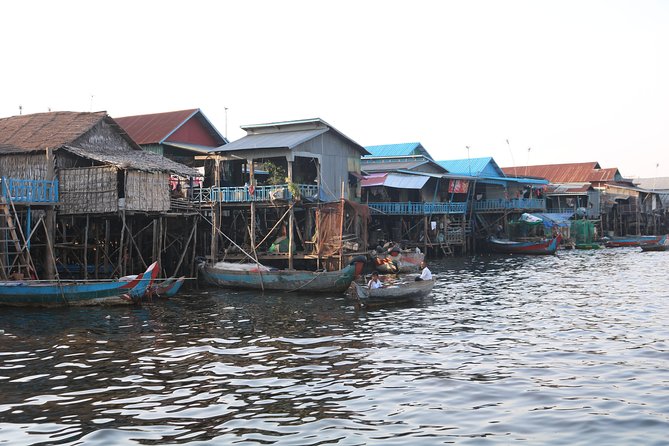
The first morning begins with a 7:30 am hotel departure for Kampong Phluk, a traditional fishing village on Tonlé Sap Lake. The lake expands dramatically during the wet season, reaching about 12,000 square kilometers, and that seasonal change shapes how people live around it.
The visit gives you a useful view of Cambodia beyond the temple zone. You see traditional Khmer stilt houses and learn how a community adapts to a lake whose size rises and falls through the year. The boat cruise and entrance fee are included, which keeps this part of the day simple.
The main thing to understand is that Tonlé Sap is not just a scenic boat ride. It is a working environment and a source of food and income. A guide can help you read the stilted homes, fishing activity, and seasonal conditions instead of treating the village as a quick photo stop.
The three-hour visit may feel long if you want only temple ruins. For many people, though, it is the best change of pace in the tour. You trade carved sandstone for daily life and open water, which gives the rest of the trip more context.
Season and water levels can affect what you see. The supplied schedule notes that the Tonlé Sap visit is replaced by Phare Circus from March 1 through August 31. Confirm the exact program for your dates before booking if the lake is a priority.
Bakong and the early Khmer style
After the lake excursion, the route continues to Bakong, one of the major temples in the Roluos group. These ruins date from the ninth-century reign of King Indravarman I, making them older than the best-known Angkor monuments.
Bakong helps you see how Khmer temple design developed. It has the upward shape of a temple mountain, but the setting and structure feel less grand than Angkor Wat. That difference is useful. Instead of seeing Angkor as a single burst of genius, you can watch ideas change over time.
The schedule allows about three hours for the Roluos area. The temple admission is not included in the tour price, but the required three-day pass covers the Angkor sites visited during the trip. The pass costs $62 per person and is paid directly at the site.
This stop may appeal most to travelers who enjoy architecture and historical sequence. If you care only about the most polished and famous temples, Bakong may seem less immediately dramatic. I would still keep it in the plan because it gives the famous sites a clearer place in the story.
Phare Circus and Cambodia’s modern cultural story
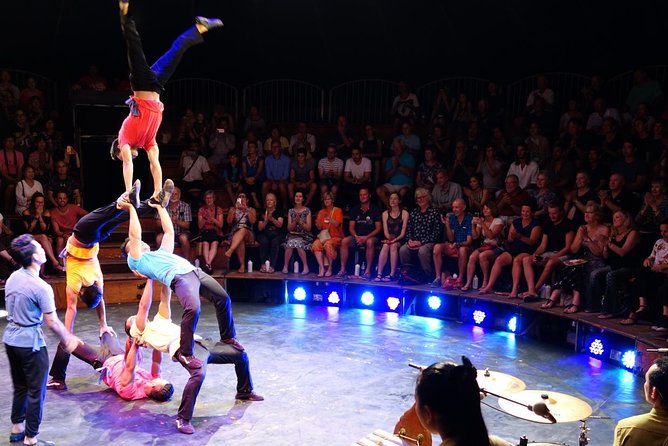
During the March 1 to August 31 alternative schedule, the group attends Phare, The Cambodian Circus, with a seat in section C. The performance lasts about two hours, and admission is included.
Phare is more than an evening acrobatics show. It grew from post-Khmer Rouge efforts to help young Cambodians through art and performance. The show combines acrobatics with a distinctly Cambodian cultural purpose, making it a worthwhile counterpoint to the ancient temples.
You should think of this as an evening performance rather than a traditional circus built around animals or grand spectacle. The acrobatics are the central draw, but the social background gives the visit extra meaning.
The location of your section matters. Seat C is included, so do not expect the same placement as a premium ticket. Even so, the show adds a lively night to a schedule otherwise dominated by ruins, walking, and early mornings.
Same base, a completely different kind of day:
- Angkor Wat Sunrise or Sunset Tour with Guide from Siem Reap
★ 5.0 · 12,109 reviews - Siem Reap: Angkor Wat: Small-Group Sunrise or Sunset Tour
★ 5.0 · 9,444 reviews - From Siem Reap: Kampong Phluk Floating Village Tour by Boat
★ 4.9 · 6,979 reviews - Sunset tour of Kampong Phluk stilts home village on the Tonle Sap
★ 5.0 · 4,865 reviews
Day two: sunrise at Angkor Wat
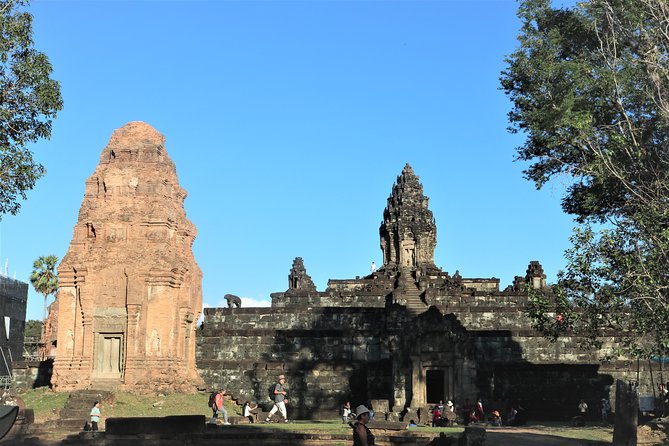
The second day starts very early, usually between 4:00 and 4:30 am. The exact departure changes with the season. This is not a gentle morning, but it is the right way to reach Angkor Wat before the heat of the day.
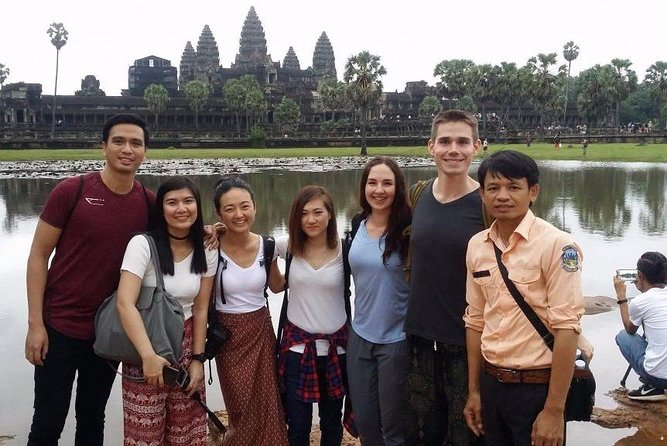
The group enters through the less-used eastern side in darkness. That approach gives the opening of the visit a calmer feel before you reach the famous reflecting pools and temple front. Sunrise conditions are never guaranteed, so treat the early departure as a chance to see Angkor Wat in changing light, not as a promise of a perfect sky.
Allow three hours for the temple. That is enough time for the main courtyards, galleries, towers, and reliefs, though the site is large enough that you will not see every corner. The guide’s role is particularly valuable here. Angkor Wat can be confusing, and a good explanation helps you notice how its religious purpose, layout, and decoration fit together.
You will need the three-day temple pass for this visit. It is not included in the $129 tour price. Add the $62 pass when comparing this tour with other options, bringing the basic combined cost to $191 per person before meals.
Angkor Thom, Bayon, and the faces in stone
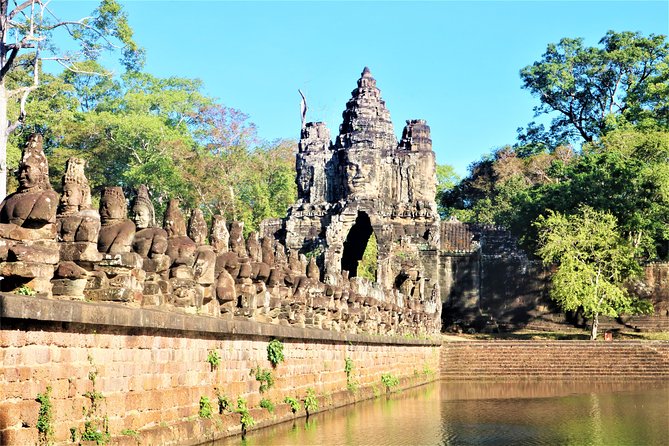
From Angkor Wat, the tour continues to Angkor Thom through the South Gate. The gate gives you a strong sense of the old capital’s scale, with its monumental entrance and the city walls beyond.
The stop at the South Gate lasts about 30 minutes. That is enough for an introduction and photographs, but not a long archaeological study. The bigger visit comes inside Angkor Thom, once the capital of the Khmer Empire.
The schedule allows about 90 minutes in Angkor Thom, including Bayon. Bayon is famous for its huge carved faces, which look out from the temple towers in different directions. The site feels crowded with stone, corridors, and changing views, so stay close enough to hear the guide’s explanations.
You also pass the Terrace of the Leper King and the Terrace of the Elephants. These are not treated as long separate stops, but they help show how Angkor Thom functioned as a royal city rather than only a collection of temples.
Angkor Thom is a good place to ask questions. The huge city plan can be hard to grasp from ground level, and a guide can connect the gates, terraces, and central temple into one picture.
Ta Prohm, where trees share the ruins
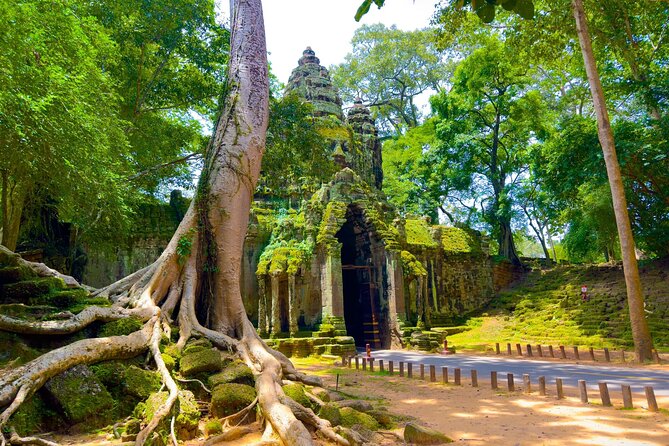
Ta Prohm is the temple most associated with the film Tomb Raider, but its appeal does not depend on the movie. Roots twist over walls, corridors narrow between fallen stones, and the ruins retain a rough, partly reclaimed look.
The tour allows about one hour here. That is enough to see the main paths and admire the strongest views, though you may want more time if you enjoy photography or close study of the carvings.
Ta Prohm once housed 2,740 monks, a reminder that this was a functioning religious center, not simply an abandoned pile of stones. The guide can help you picture the people and routines that once filled the site.
The drawback is that Ta Prohm is one of Angkor’s most popular temples. The small group helps with organization, but it cannot guarantee solitude. Keep your expectations realistic: you are visiting a famous place, not a private ruin.
Day three: quieter temples and a more varied route

The third day begins at Preah Khan, a large ruined temple with tree roots, crumbling structures, and long passageways. It has a similar atmospheric quality to Ta Prohm, but the mood and layout differ enough to make both worthwhile.
Preah Khan gives you room to notice how temples were built as complex institutions. It was not only a shrine. Its scale suggests religious, administrative, and residential functions, and the long corridors reward a slower pace.
Next comes Neak Pean, a smaller Buddhist temple on a circular island in Jayatataka Baray. The approach is part of the appeal, since you reach the temple across a causeway surrounded by water.
The stop lasts about 40 minutes. It is brief, but the site provides a welcome change from climbing through large temple compounds. Do not expect a long visit inside a major monument. Neak Pean is about setting, shape, and the idea of a sacred water complex.
Banteay Srei’s fine sandstone carving
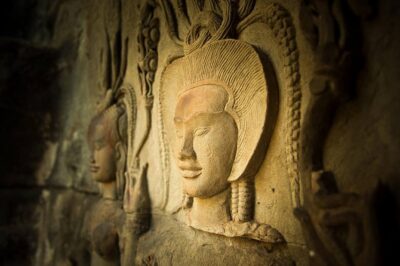
Banteay Srei is one of the most rewarding stops for close-up detail. This smaller temple is made from pinkish sandstone and is known for finely worked reliefs that remain unusually crisp.
The visit lasts about 90 minutes. That gives you time to study the carved figures, lintels, and doorways without rushing through the site. Because Banteay Srei is smaller than Angkor Wat or Angkor Thom, the decoration feels easier to read at eye level.
Its distance from the central Angkor area also means more driving. That is the tradeoff. You spend time in the vehicle, but the reward is a temple with a different scale and a more delicate style.
If you prefer grand towers and huge courtyards, Banteay Srei may seem modest. I think its small size is exactly why it works so well on a three-day tour. It gives your eyes a break from massive stone architecture.
Pre Rup and the final temple view
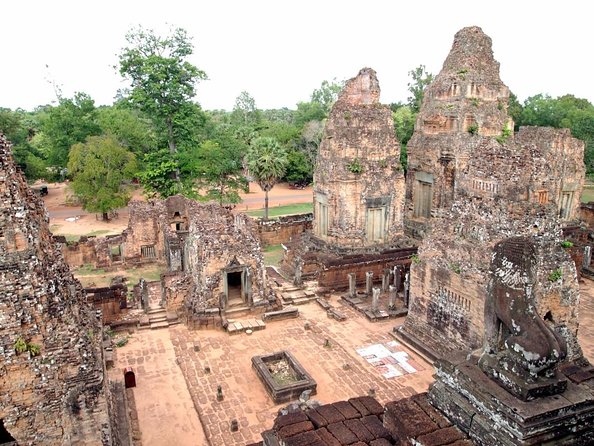
The final stop is Pre Rup, a Hindu temple mountain built as the state temple of King Rajendravarman and dedicated in 961 or early 962. Its construction combines brick, laterite, and sandstone.
The schedule allows about 90 minutes, with a late-afternoon visit noted in the program. Pre Rup’s raised form gives you a strong final view of Khmer temple planning and construction. It is a fitting place to think back over the earlier sites, from the older Roluos monuments to the grand central temples.
The steps can be steep and the stone surfaces uneven. Wear practical shoes and take care, especially after three days of walking. Shoulders and knees must be covered inside the temples, so pack light clothing that meets the dress rule.
What the $129 price really covers
At first glance, $129 for three days looks low for a private-style cultural tour. The included services explain much of the value: hotel pickup and drop-off, an air-conditioned vehicle, an English-speaking licensed guide, local tax, mineral water, and either the Tonlé Sap boat visit or Phare Circus.
The required $62 temple pass changes the calculation. Your basic tour cost becomes $191 per person, before meals. Meals are not included, so budget for food each day as well.
That total can still be fair if you want transportation, guiding, and a planned route. You are paying for the structure of the trip and for not having to arrange separate transport to distant temples. The small group is another reason the price may make sense.
The tour requires at least two people per booking and accepts groups of up to 15. Children must be accompanied by an adult, and children under five are not allowed.
Is this Siem Reap tour right for you?
Book it if you want the major Angkor temples in a logical three-day plan, prefer a small group to a large bus, and like the idea of adding either a lake village or a Cambodian performance. It suits first-time visitors who want help understanding what they are seeing.
You should skip it if you want long, unplanned time at one temple, dislike pre-dawn departures, or want every cost included up front. The $62 temple pass and meals need to be part of your budget.
For most people, I think the combination is strong. Sunrise at Angkor Wat supplies the big moment, while Bakong, Kampong Phluk, Phare Circus, Banteay Srei, and Preah Khan keep the trip from becoming a parade of famous names. Comfortable shoes, covered shoulders and knees, and a willingness to wake early will make this three-day plan much easier to enjoy.
FAQ
What is included in the $129 tour price?
The price includes three days of guided touring, an English-speaking licensed guide, air-conditioned transportation, hotel pickup and drop-off, local tax, mineral water, and either the Tonlé Sap boat visit or Phare Circus with a seat in section C.
Is the Angkor temple pass included?
No. The three-day temple pass costs $62 per person and must be paid directly at the site on the day of the activity.
Are meals included?
No. Meals are not included and are available at your own choice.
How early does the Angkor Wat sunrise visit begin?
The hotel departure is usually between 4:00 and 4:30 am, depending on the time of year.
Is Tonlé Sap Lake visited on every departure?
The program states that from March 1 through August 31, the group visits Phare, The Cambodian Circus instead of Tonlé Sap Lake. Confirm the exact seasonal arrangement for your dates.
How large is the group?
The tour has a maximum of 15 participants.
What should I wear at the temples?
Shoulders and knees must be covered inside the temples. Comfortable walking shoes are recommended because the tour includes substantial walking over uneven temple surfaces.
Can I cancel for a refund?
You can cancel at least 24 hours before the experience begins for a full refund. Cancellations or changes made less than 24 hours before the start time are not accepted for a refund.
Just added around Siem Reap
- Twilight Tastes of Siem Reap Include Dinner★ 5.0 · 13 reviews
- Ultimate Sunrise to Angkor Wat, Angkor Thom and Bayon Temple★ 5.0 · 3 reviews
- Trekking Tour at Phnom Kulen National Park from Siem Reap★ 5.0 · 3 reviews
- Professional Photo Shoot in Angkor Archaeological Park, Siem Reap★ 5.0 · 42 reviews
- Full-Day Private Tour of Angkor Wat with Pick Up★ 5.0 · 12 reviews
- Unveiling 2 Days Private Angkor Wat/Beyond In Sunrise/Sunset Tour★ 5.0 · 48 reviews
- Siem Reap City Tour with War Museum and Killing Field★ 5.0 · 27 reviews
- Private Day Trip to Angkor Temples with Expert Guide★ 5.0 · 4 reviews
3-Day Experiences, compared.
3-Day Angkor Wat with All Interesting Major Temples, Banteay Srei & Beng Mealea
Read our review →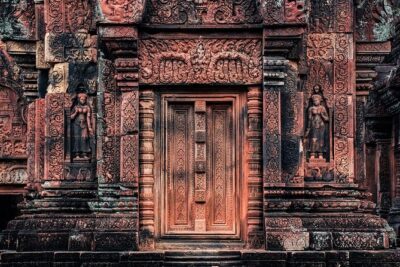
3-Day Angkor Wat & All Interesting Major Temples & Kulen Mount Waterfall
Read our review →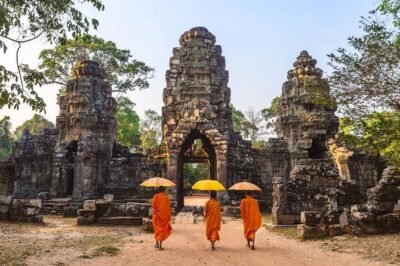
Best of Siem Reap 3-Day Private Tour to Angkor Wat & Tonle Sap
Read our review →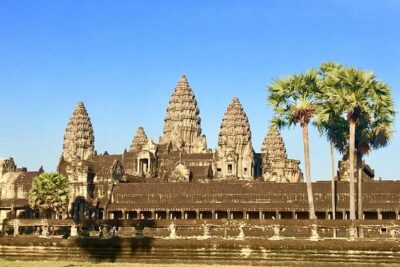
Private Siem Reap 3 Day Tour Discover All Highlight Angkor Temple
Read our review →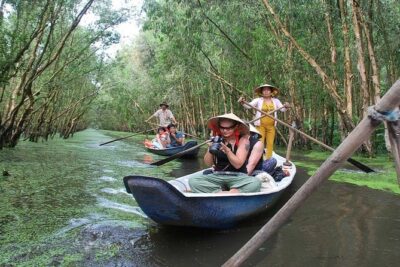
Private 3-Day Mekong Delta River Tour from Phnom Penh to Ho Chi Minh City
Read our review →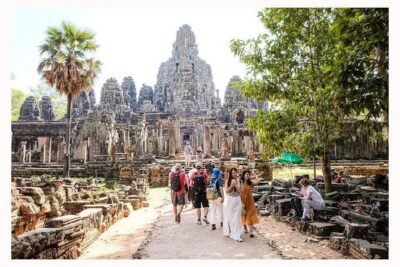
3-Day Tour(Unforgettable Angkor Temple Complex, Banteay Srei& Floating Village)
Read our review →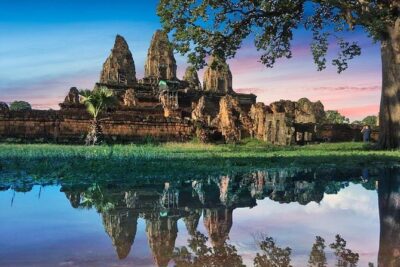
Browse the lists this tour appears in