
Reviewed · ANGKOR WAT TOURS
Angkor Wat Sunrise & Ancient City Discovery
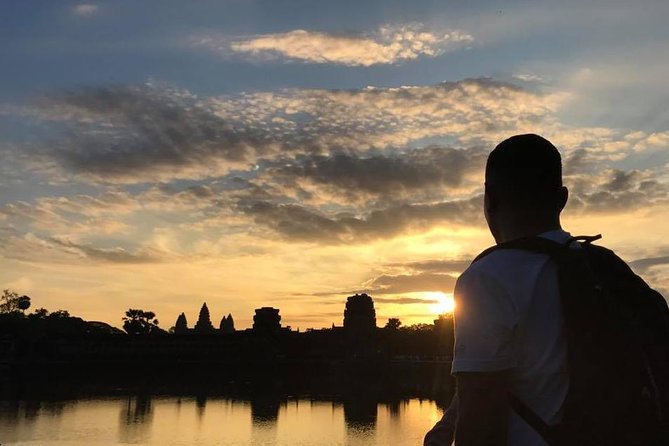
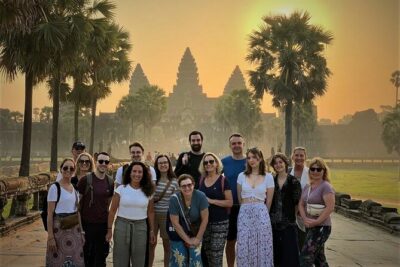
Angkor Wat is at its most moving before breakfast, when the towers appear out of the dark and the first sunlight turns the stone warm gold. This tour gets you there by bicycle, then uses forest paths and quiet roads to connect several major temples without keeping you inside a van all day. Sunrise is the headline, but the cycling is what gives the day its character.
I like two things here. First, the bike makes Angkor feel like a great park of temples rather than a string of parking lots. Second, the small group limit of 10 allows guides such as Vannarath, Mr. Seng, Bobo, Sihal, or Seyha to adjust the pace, explain small details, and help with photos. The tour includes breakfast, lunch, water, and coconut juice, too.
The catch is the early start and a full nine hours of pedaling, walking, stairs, and temple exploration. The $70 price does not include the $37 one-day temple pass, and hotel drop-off is not included, so budget for both the pass and your return ride.
Key points at a glance
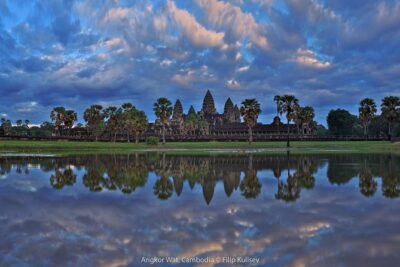
- Sunrise at Angkor Wat: Begin at 5:00 am, when the temple’s towers and reflecting pools take on the soft first light.
- Cycling between temples: Ride a provided Giant or Trek mountain bike along paved roads, dirt tracks, rainforest paths, and elevated trails.
- A full Angkor circuit: Visit Angkor Wat, Angkor Thom’s south gate, Bayon, Ta Prohm, Preah Khan, Tanei, Prasat Chrung, and other gates and walls.
- Food and drink included: Breakfast, lunch, fresh coconut juice, and drinking water are supplied during the day.
- Small-group guiding: The maximum is 10 people, with an English-speaking guide leading the route and temple visits.
- Important extra cost: Your one-day Angkor temple pass costs $37 and is separate from the tour price.
Why a bicycle changes the Angkor experience
Angkor is far larger than Angkor Wat alone. The famous temple is the anchor, but the surrounding complex includes gates, walls, jungle tracks, reservoirs, and several remarkable temples spread across a large area. A bicycle lets you feel that distance without spending every transfer looking through a vehicle window.
You ride from one site to the next, then leave the bike to explore on foot. That rhythm works well here: pedal, stop, listen, climb where permitted, take photos, and continue through the trees. The route includes asphalt, dirt roads, elevated trails, and narrower single-track sections, according to the equipment and route details associated with the tour.
A mountain bike and helmet are provided. The bikes are described as quality Giant or Trek models, which matters on a day that combines ordinary roads with rougher paths. You should still expect a physical outing rather than a gentle sightseeing ride. The heat, early wake-up, temple steps, and nine-hour schedule add up.
The maximum group size is 10. That is small enough to keep the group together more easily than a large coach excursion, while still giving you a social outing rather than a private tour. If you are the only booking, the company has been known to operate the tour rather than cancel or raise the price. That is a useful point for solo visitors, although the group size on your particular date cannot be promised.
More ways to walk into Angkor Wat:
- Angkor Wat Sunrise or Sunset Tour with Guide from Siem Reap
★ 5.0 · 12,109 reviews - Siem Reap: Angkor Wat: Small-Group Sunrise or Sunset Tour
★ 5.0 · 9,444 reviews - Siem Reap: Angkor Wat 2-Day Tour with Sunrise and Sunset
★ 4.9 · 4,429 reviews
5:00 am pickup and the first ride into Angkor
The day begins around 5:00 am with hotel pickup. The tour provides the ride to Angkor, but hotel drop-off is not included at the end, so you need to arrange your own return from the final point or confirm the day’s arrangements with the operator.
The morning darkness is part of the appeal. You are not simply arriving at a temple after the sun is already up. You enter Angkor while the complex is still quiet and watch the light build around the towers. Bring a camera, sunglasses, and sunscreen. You will want the sunscreen later even if the first hour feels cool.
The guide handles the route and temple interpretation in English. Names associated with this experience include Vannarath, Mr. Seng, Bobo, Sihal, and Seyha. Guide assignment depends on the date, but the strongest part of the guiding is not just historical information. It is the practical help: choosing photo spots, pointing out details you might pass, managing the morning timing, and keeping the ride comfortable.
Sunrise at Angkor Wat, then time to look closely
Angkor Wat is best approached with enough time to slow down. The sunrise is the visual opening, but the temple itself deserves more than a quick look at the silhouette. Your guide takes you through the complex chambers and explains the site’s past, architecture, and religious importance.
Do not treat the sunrise as the whole event. The first color can be subtle, and cloud or haze may affect the view. The reward is the changing stone: dark silhouettes become carved galleries, towers, courtyards, and passageways as the morning develops.
You also need to dress properly. Angkor remains an active spiritual place, and shorts or skirts above the knees and bare shoulders are prohibited in sacred palaces. Respectful clothing is not just a box to check at the gate. It makes it easier to enter religious spaces and shows consideration for the people who still worship, pray, and meditate here.
The main drawback is time pressure. Sunrise brings a fixed schedule, and Angkor Wat is only the first major stop. If you want several hours alone inside the temple, a private visit on another day may suit you better. This tour favors range and movement over an unhurried single-site study.
Angkor Thom’s south gate and the ride along the wall
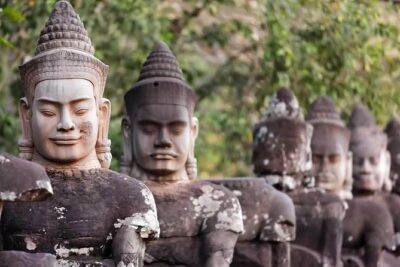
After Angkor Wat, the route moves toward Angkor Thom, the fortified royal city. The south gate is one of the most recognizable approaches in the complex, with its monumental entrance and protective setting. It gives you a sense of how Angkor was organized as a city, not just as a collection of isolated shrines.
The tour also takes you toward the west and north gates and along the protection wall. This is where the bicycle becomes especially useful. Instead of seeing the wall from one roadside stop, you travel beside it and reach Prasat Chrung, a smaller structure positioned on the wall.
Prasat Chrung offers a different kind of visit from Angkor Wat. The appeal is the elevated view and the sense of being away from the central monuments. The route can include climbing and an uneven trail, so this section may feel demanding after the early start. The payoff is space, trees, and a broader look at the old city’s setting.
Your guide can also help you judge the pace. That matters because it is easy to spend too much energy at the first temple and then struggle later. I would treat the morning as a long day, not a race. Save some strength for the forest sections and the later temples.
More early starts around Siem Reap:
- Angkor Wat Sunrise tour with Small – Group and Guide tours
★ 5.0 · 3,655 reviews - Angkor Wat Highlights and Sunrise Guided Tour from Siem Reap
★ 5.0 · 3,213 reviews - Full-Day Angkor Wat Sunrise Private Tour with Guide from Siem Reap
★ 5.0 · 2,920 reviews - Angkor Wat Sunrise & 3 Main Temples with Breakfast – Small Group
★ 5.0 · 2,857 reviews
Bayon and the faces at the center of Angkor Thom
Bayon is one of the essential stops on any first visit to Angkor. Its towers carry large carved faces, and the temple’s maze of galleries makes it feel more enclosed and intricate than Angkor Wat. The changing angles are part of the fun. A face appears between stone passages, then vanishes as you turn into another courtyard.
This is a place where a guide adds real value. The temple can seem confusing at first, with levels, narrow corridors, carvings, and towers competing for attention. An English-speaking guide can explain what you are looking at and steer you toward details that are easy to miss.
Bayon can also be busy, especially after the early morning rush begins. The cycling route cannot remove crowds from a major temple, but the guide can time your movements and suggest photo positions. Several guides connected with the tour have been praised for knowing good spots and trying to avoid the worst of the sunrise crowds.
Ta Prohm, Preah Khan, and the forest tracks
Ta Prohm is the temple most closely tied to jungle imagery. Trees and roots press against the old stone, giving the site a powerful, slightly unruly appearance. It is also one of the best-known temples in Angkor, so expect it to be popular.
The bicycle route adds something before and after the temple. You are not simply dropped at a coach stop, guided through a short loop, and taken away. You ride through wooded paths and arrive with a sense of moving through the old complex. The trail is part of the experience, but it may be uneven. If you are not comfortable on a mountain bike, tell the guide early.
Preah Khan provides another change of scale. Its long corridors and layered spaces reward a slower walk, and the setting gives you more room to notice transitions between open courtyards and enclosed galleries. Tanei is a quieter stop in the itinerary, useful for contrast with the better-known sites.
Together, these temples make the day feel varied. Angkor Wat gives you the grand opening, Bayon supplies the famous faces, Ta Prohm brings the roots and forest, Preah Khan offers long architectural lines, and Tanei gives you a less central stop. You are not repeating the same temple experience six times.
Breakfast, lunch, and the practical value of the package
Breakfast and lunch are included, along with drinking water and fresh coconut juice. That is more than a minor convenience on a nine-hour outing. Food stops save you from having to leave the temple zone to find a meal, and water is essential during a morning of riding and walking.
The supplied drinks are especially useful because cycling changes your needs. You may not feel thirsty during the cool pre-sunrise ride, but the day warms quickly. Carrying sunscreen and using the water provided will make the later temple visits more comfortable.
The meals are part of the tour, but the details of the menu are not specified. If you have dietary requirements, give that information when booking. Do not assume every preference can be handled at the last minute.
At $70 per person, the value depends on how you use the day. You are paying for the bike, helmet, guide, hotel pickup, two meals, drinks, and a route that links many sites. Add the $37 temple pass, and the known cost becomes $107 before your return transport. That is not the cheapest way to enter Angkor, but it is reasonable if you want transport between temples, guiding, food, and an active route in one package.
The price is less attractive if you mainly want Angkor Wat at sunrise and plan to spend the rest of the day sitting in one temple. It becomes stronger value if you would otherwise need to arrange a bike, guide, meals, and transport separately.
Who will enjoy the day, and who may not
I would choose this tour if you like being outside, want to cover several major temples, and prefer an active day to a vehicle-based circuit. It suits visitors who enjoy a local guide’s explanations and want help with timing, photos, and route finding.
It is also a good fit for solo visitors and couples who want a small-group setting. The company has operated the tour for a single booking, and guides have sometimes taken on extra photography help when the group is very small.
I would think twice if you dislike early mornings, have difficulty riding on dirt or uneven trails, or want a slow architectural study of Angkor Wat alone. The itinerary is long and ambitious. You will walk through temple chambers, ride between sites, climb at some points, and keep moving for most of the day.
Most people can participate, but the description does not provide a specific fitness standard or bike-fit procedure. If you have concerns about cycling ability, mobility, or dietary needs, ask before booking. The activity is not presented as a relaxed sightseeing transfer.
Booking details that matter before you go
The tour starts at 5:00 am and lasts about nine hours. Pickup is offered, but drop-off is not included. The mobile ticket makes entry details easy to keep on your phone, while confirmation is provided at booking.
The one-day temple pass is separate and costs $37. Plan for this required extra rather than treating the $70 tour price as the full admission cost.
Book at least several days ahead if possible. The experience is booked, on average, nine days in advance, and the maximum group size is 10. Free cancellation is available up to 24 hours before the start time. Changes or cancellations inside that 24-hour window are not accepted for a refund.
Should you book this Angkor cycling tour?
Book it if you want the best-known Angkor sites tied together by bike, with sunrise at Angkor Wat, an English-speaking guide, food, drinks, and hotel pickup included. The most praised qualities are the guides’ temple knowledge, careful pacing, photo help, and ability to use jungle routes instead of relying only on main roads.
Skip it if the early start or physical effort sounds unpleasant, or if your priority is spending a whole day at Angkor Wat. For the right person, this is a strong way to understand the scale of Angkor and enjoy the ride between its monuments, not just collect temple photos from a vehicle.
FAQ
What time does the tour start?
The tour starts at 5:00 am.
How long does the experience last?
The cycling and temple experience lasts approximately nine hours.
Is hotel pickup included?
Yes. Hotel pickup is included, and round-trip hotel transfers are described as part of the experience. However, the detailed inclusions also state that hotel drop-off is not included, so confirm your return arrangements with the operator.
Is the Angkor temple pass included?
No. The one-day temple pass costs $37 and must be purchased separately.
What equipment is provided?
A quality mountain bike, described as a Giant or Trek, and a helmet are provided.
What food and drinks are included?
Breakfast, lunch, pure drinking water, and fresh coconut juice are included.
How large is the group?
The maximum group size is 10 people.
What should I wear to Angkor?
Wear respectful clothing that covers your shoulders and reaches below the knees. Revealing clothing, shorts or skirts above the knees, and bare shoulders are prohibited in sacred palaces.
Can I cancel for a refund?
Yes. You can cancel at least 24 hours before the experience starts for a full refund. Cancellations or changes made less than 24 hours before the start time are not refunded or accepted.
Just added around Siem Reap
- Twilight Tastes of Siem Reap Include Dinner★ 5.0 · 13 reviews
- Ultimate Sunrise to Angkor Wat, Angkor Thom and Bayon Temple★ 5.0 · 3 reviews
- Trekking Tour at Phnom Kulen National Park from Siem Reap★ 5.0 · 3 reviews
- Professional Photo Shoot in Angkor Archaeological Park, Siem Reap★ 5.0 · 42 reviews
- Full-Day Private Tour of Angkor Wat with Pick Up★ 5.0 · 12 reviews
- Unveiling 2 Days Private Angkor Wat/Beyond In Sunrise/Sunset Tour★ 5.0 · 48 reviews
- Siem Reap City Tour with War Museum and Killing Field★ 5.0 · 27 reviews
- Waterfall & River of 1000 Siva Linga- Kulen Mountain Private Tour★ 5.0 · 3 reviews
Angkor Wat Tours, compared.
Angkor Wat Sunrise or Sunset Tour with Guide from Siem Reap
Read our review →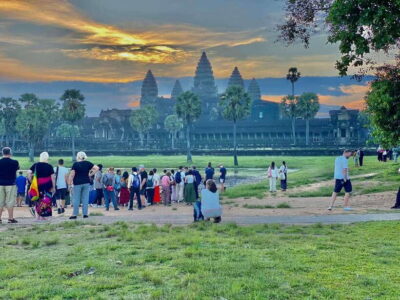
Angkor Wat: Small-Group Sunrise or Sunset Tour
Read our review →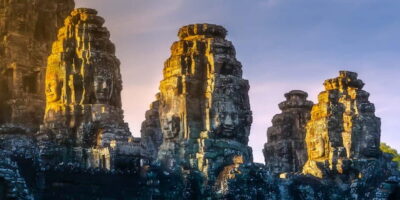
Angkor Wat Highlights and Sunrise Guided Tour from Siem Reap
Read our review →
Angkor Wat Sunrise & 3 Main Temples with Breakfast – Small Group
Read our review →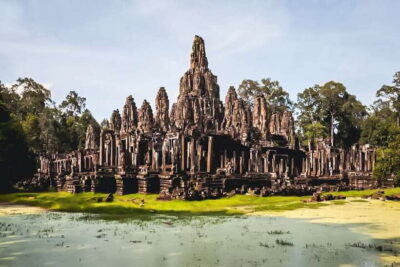
Angkor Wat Sunrise and Full-Day Sightseeing Tour
Read our review →
Angkor Wat Small-Group Exploration with Expert Guide
Read our review →Browse the lists this tour appears in