
Reviewed · ANGKOR WAT TOURS
One Day Private Guide Tour of Angkor Thom, Bayon, Ta Phrom & Angkor Wat
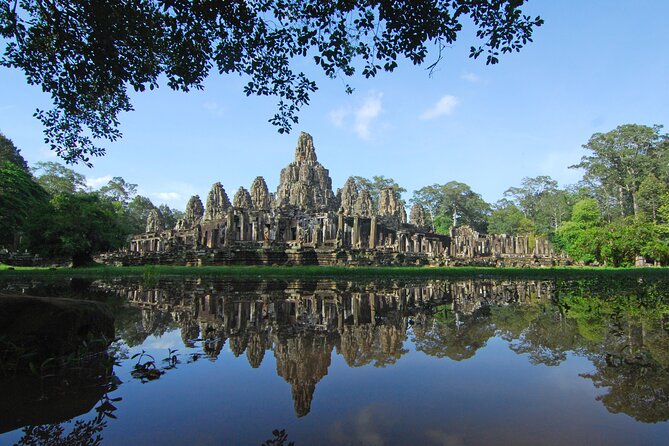
Angkor’s greatest temples are spread across a huge archaeological area, and this private tour gives you a sensible way to see the main sights in one long day. You’ll begin with the smiling stone faces of Bayon, walk through the old royal center of Angkor Thom, visit tree-covered Ta Prohm, then finish at Angkor Wat during the late afternoon and sunset hours.
I like the private vehicle and guide, which let you move between sites without dealing with a large group. I also like the careful split between a morning walk and an afternoon visit, since Cambodia’s heat can make a full day on foot punishing. The drawback is the pace: eight major stops in about nine hours leaves limited time for quiet wandering, and lunch is not included.
Key points to know before you book
- Angkor Wat admission is included: The price covers the single-day Angkor Archaeological Park ticket, listed at $37.
- Your day is private: Only your own group participates, with a modern air-conditioned vehicle and an English-speaking licensed guide.
- Sim is one named guide associated with the experience: His strength is explaining temple history, Cambodian life, and useful photo spots.
- The route covers the essential monuments: You’ll see Angkor Thom, Bayon, Baphuon, the Royal Enclosure area, Ta Prohm, and Angkor Wat.
- The timing avoids one long midday slog: Morning sightseeing is followed by lunch on your own, then a longer afternoon visit to Angkor Wat.
- Plan for substantial walking: The tour includes terraces, courtyards, temple towers, and open paths across several large sites.
Why this private Angkor day works
At $146.67 per person, this is not the cheapest way to see Angkor. Its value comes from combining a private car, a licensed English-speaking guide, temple admission, water, and a full day of sightseeing. If two people book together, the price buys privacy and door-to-door movement. Larger groups may also receive a discount.
The private format matters here. Angkor Thom alone contains several separate monuments, and the park is too spread out for a simple walk between everything. You can ask your guide to slow down at Bayon, explain a carving, or help you find a better angle for a photograph without holding up strangers.
The tour also gives you a break in the middle of the day. You are responsible for lunch and drinks during the meal, but you are not expected to walk through every major temple in one continuous stretch. That pause is practical in Siem Reap’s heat.
A small caution: the schedule is ambitious. Angkor Wat receives three hours, Ta Prohm two, and most of the Angkor Thom stops receive 30 to 60 minutes. That is enough for a strong first look, but not enough to inspect every corridor or sit quietly at each monument.
More Private Tours in Siem Reap
- Full-Day Angkor Wat Sunrise Private Tour with Guide from Siem Reap
★ 5.0 · 2,920 reviews - Siem Reap: Angkor Wat Private Tuk-Tuk Tour
★ 4.9 · 2,222 reviews - Angkor Wat Private Day Tour from Siem Reap
★ 5.0 · 834 reviews
Starting at Angkor Thom’s South Gate
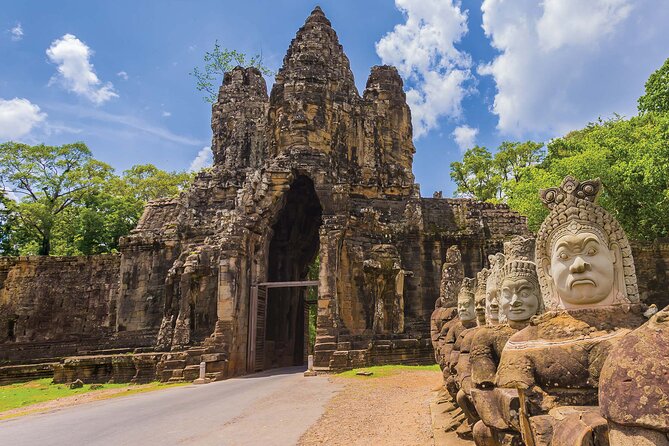
Your first stop is the South Gate of Angkor Thom, reached after the 8:00 a.m. meeting time. This is a good opening because the approach introduces the scale of the old capital before you enter its central monuments.
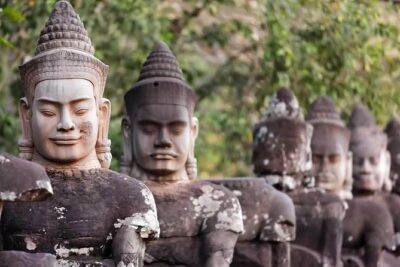
The gate is associated with the famous Churning of the Ocean of Milk scene. Large stone figures line the approach, creating a dramatic entrance over the moat. The statues represent opposing forces pulling a serpent, and the arrangement gives you an immediate sense that Angkor’s builders were thinking in grand religious and political symbols.
You have about 45 minutes here. That allows time to study the gate, look at the statues, and hear how the entrance fitted into Angkor Thom’s design. It also gives you a chance to take photographs before the day becomes hotter.
Angkor Thom was the capital at the center of one of the world’s largest cities around 1200. The walls, gates, and central monuments were built under the Khmer kings, whose power extended beyond modern Cambodia into parts of Laos, Thailand, and Vietnam.
Meeting the faces of Bayon
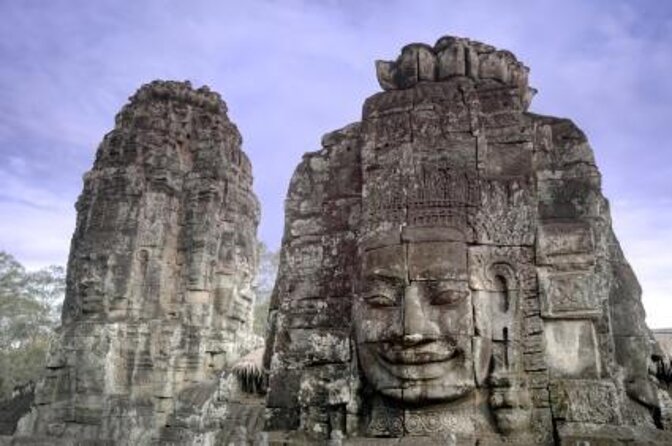
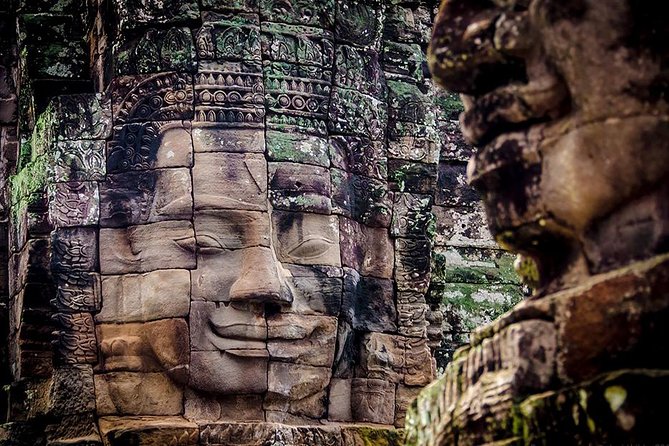
Inside Angkor Thom, you’ll spend about an hour at Bayon. This is the temple most likely to create an instant sense of wonder. Its towers carry more than 200 large faces associated with Avalokitesvara, the compassionate bodhisattva, and they look out from many directions at once.
Bayon is not an easy temple to understand by simply looking at a map. Towers, narrow passages, courtyards, and carved galleries overlap in a compact arrangement. A good guide helps you see how the pieces fit together and points out the difference between the calm faces above and the lively scenes carved lower down.
I would give Bayon your full attention rather than racing through it for photographs. The faces change as you move around the temple, and the close quarters make the monument feel more personal than its scale suggests.
The one-hour stop is useful but firm. If Bayon captures your imagination, you may wish you had longer. Still, a private guide can make that hour count by directing your attention to the most important structures instead of leaving you to puzzle through the site alone.
Baphuon and the royal center
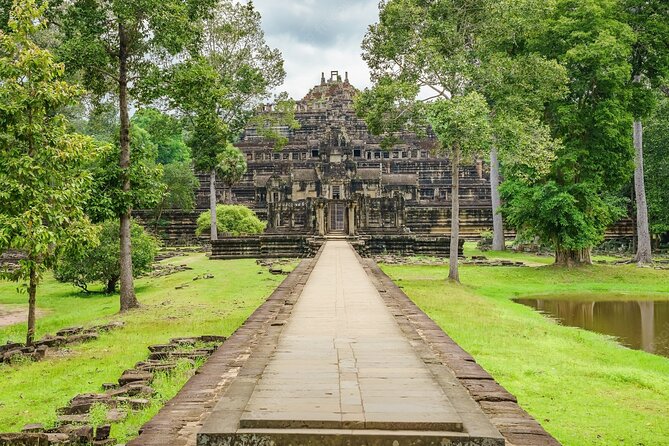
Next comes Baphuon, about 30 minutes from the schedule. This three-tiered temple mountain was built in the mid-11th century as a state temple for King Udayadityavarman II. It is located northwest of Bayon within Angkor Thom.
Baphuon has a different mood from Bayon. Instead of a forest of famous faces, you get a strong upward design, with terraces leading toward the temple’s higher levels. The monument went through years of restoration and has reopened for visitors, making it an important part of the central Angkor Thom route.
Thirty minutes is enough for a focused visit, but you should not expect a long exploration. The walk and steps can add effort to an already active morning, so use the short stop wisely. Your guide can explain the building’s purpose and point out how its design differs from the later monuments nearby.
The route then touches the Royal Enclosure and Phimeanakas. The Royal Enclosure is part of the former political heart of Angkor Thom, while Phimeanakas is a Hindu temple built in the Khleang style. Construction began under Rajendravarman and was completed under Suryavarman I.
Phimeanakas receives about 30 minutes. You may find it less visually overwhelming than Bayon or Ta Prohm, but it helps complete the picture of Angkor Thom as a working royal capital rather than a collection of isolated ruins.
More ways to walk into Angkor Wat:
- Angkor Wat Sunrise or Sunset Tour with Guide from Siem Reap
★ 5.0 · 12,109 reviews - Siem Reap: Angkor Wat: Small-Group Sunrise or Sunset Tour
★ 5.0 · 9,444 reviews - Siem Reap: Angkor Wat 2-Day Tour with Sunrise and Sunset
★ 4.9 · 4,429 reviews - Siem Reap: Full-Day Angkor Wat Guided Tour with Sunset
★ 4.9 · 3,803 reviews
The Elephants and Leper King terraces
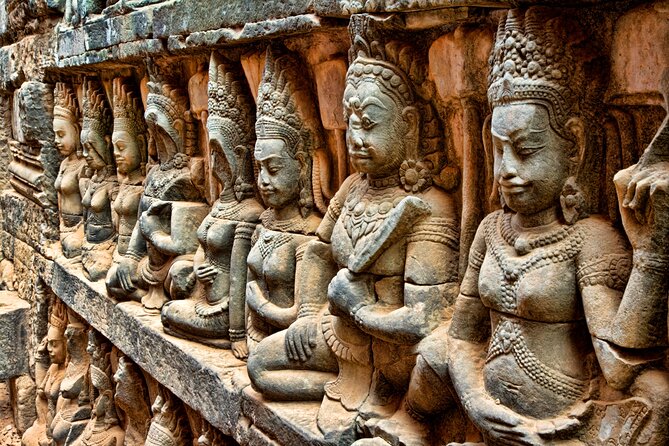
The Terrace of the Elephants was used by Jayavarman VII as a platform from which to view returning armies. The carved elephants and other details give the long terrace its name, while its position beside the Royal Square connects it to ceremony and power.
You’ll have about 30 minutes here. This is a good place to appreciate the scale of the former city, although the terrace itself is more about carved stone and historical function than enclosed temple chambers.
The Terrace of the Leper King lies near the northwest corner of Angkor Thom’s Royal Square. It was built in the Bayon style under Jayavarman VII. Its modern name comes from a statue and later associations, rather than from a clear description of its original purpose.
The terrace has hidden carvings and enclosed sections that reward a slower look. With only 30 minutes, listen closely to your guide’s explanation and inspect the reliefs instead of treating the stop as a quick photo break.
Together, these two terraces show why Angkor Thom deserves more than a short drive through. The city was not only about temples. It had royal spaces, ceremonial platforms, gates, and public symbols designed to express the king’s authority.
The shadowed courtyards of Ta Prohm
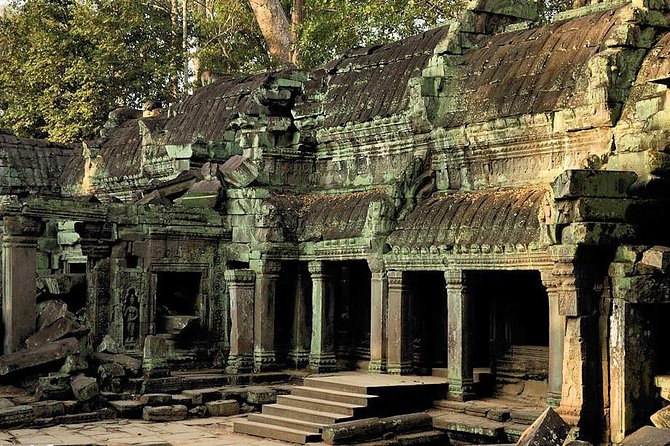
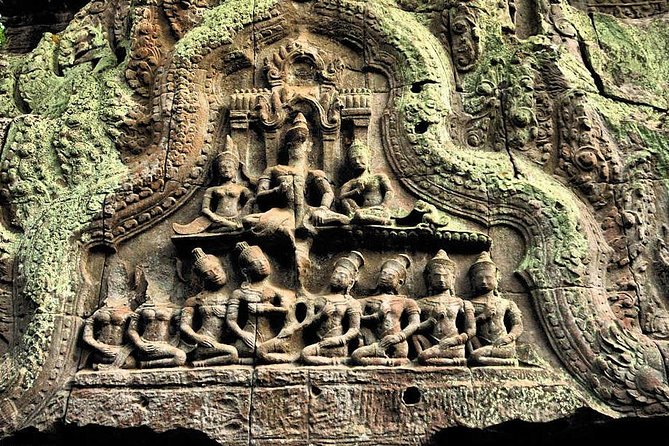
Ta Prohm receives two hours, and that longer stop is welcome. Built in 1186 by Jayavarman VII, the temple was dedicated to his mother and served as a monastery. Its gray sandstone towers, courtyards, and dark passages create a mood unlike the more open spaces of Angkor Thom.
Ta Prohm is famous for the way trees and roots press against the old stone. The effect is striking, but the temple is more than a dramatic backdrop. Its layout gives you a sense of a religious complex with multiple courtyards and connecting galleries, even when parts of the structure are weathered or difficult to read.
This is one place where a private guide can improve the experience. You can ask about the carvings, the temple’s role, or which parts deserve your attention. The guide can also help you manage the two-hour visit so you do not spend all your time in the first courtyard.
Ta Prohm can be physically tiring. Expect uneven ground, steps, and a good amount of walking. The shaded areas may offer relief, but you should still carry water. Two bottles of mineral water per person are included during sightseeing and transfers.
Angkor Wat in the late afternoon
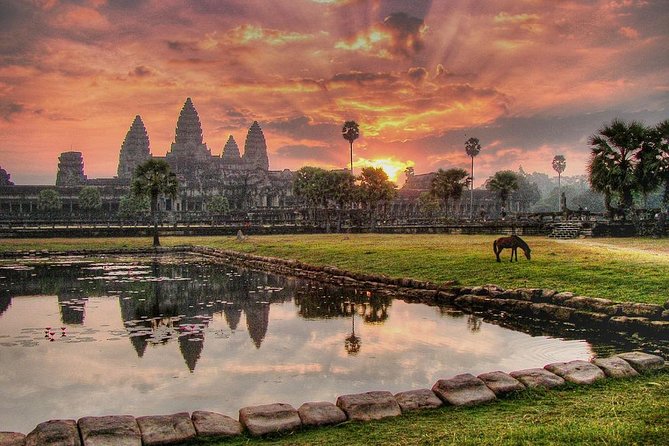
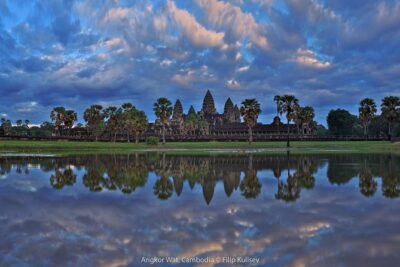
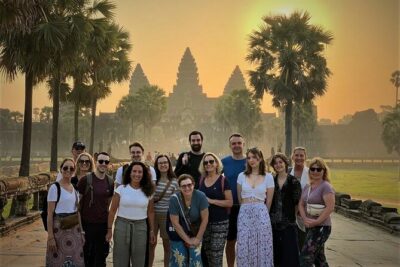
After lunch on your own, the tour continues to Angkor Wat for about three hours. The timing is one of the strongest parts of the day. You see Cambodia’s largest monument after the morning sequence, when you already understand more about Khmer temples and royal power.
Angkor Wat was built as the funeral temple of King Suryavarman II. Its galleries, towers, courtyards, and long approach reflect a carefully ordered religious design. The central towers are the image most people associate with Cambodia, but the carved galleries deserve serious attention too.
Three hours gives you room to see the main approach, outer galleries, central areas, and major views without treating the temple as a quick final stop. You should still expect walking and stairs, and some parts may take more effort than they first appear to require.
The late afternoon and sunset period can make the stone look different as the light changes. The exact quality of the sunset cannot be guaranteed, but the schedule gives you a chance to experience Angkor Wat at that end-of-day hour rather than leaving immediately after lunch.
The guide’s role is especially useful here. One guide connected with this tour, Sim, is praised for explaining history and Cambodian ways of life in clear English. The strongest practical detail associated with his guiding is knowing where to stand for photographs and how to avoid the heaviest crowds at certain points.
Transport, water, and the practical details
You meet at 8:00 a.m., and the experience lasts about nine hours. Pickup is offered, though the supplied details do not specify every pickup location, so confirm the exact arrangement when booking.
Travel between the monuments is by modern air-conditioned vehicle. That is more than a comfort feature. After walking through exposed courtyards and broad temple approaches, a cool ride gives you a real break before the next stop.
The price includes a professional licensed English-speaking guide, transportation, sightseeing listed for the day, temple entrance fees, taxes, service charges, and two bottles of mineral water per person. The single-day Angkor Archaeological Park ticket is specifically valued at $37 within the package.
Lunch is not included, and drinks during meals are also your responsibility. Because the schedule pauses before Angkor Wat, you should budget for that meal separately. Personal, travel, and health insurance are not included either.
Most people can take part, according to the supplied booking information, but the route involves walking across temple grounds and uneven historic surfaces. If you have mobility concerns, ask the operator how the planned stops can be adjusted before booking.
Free cancellation is available if you cancel at least 24 hours before the local start time. Changes or cancellations made within that final 24-hour period are not accepted for a refund.
Who should book this Angkor tour
I would choose this tour if you want the major Angkor monuments in one organized day and prefer having one guide explain the connections between them. It suits first-time visitors who want context without arranging separate transport, tickets, and timing.
It also works well for couples, families, or a small private group that values flexibility. You can ask for more explanation at Bayon, spend longer with a favorite carving, or seek photo advice without fitting into a large coach schedule.
The tour is less suitable if you want a slow archaeological study. The day includes eight stops, and several receive only 30 minutes. Independent visitors who want to sit for long periods or return to one temple may prefer a shorter, custom-built plan.
At $146.67 per person, the decision depends on group size and how much organization you want handled. The included $37 temple pass, private transport, licensed guide, and nine-hour schedule make the price easier to justify, especially when you value clear explanations and efficient movement.
Should you book it?
Book this private day if your priority is seeing Angkor Thom, Bayon, Ta Prohm, and Angkor Wat with a guide who can explain the symbols, royal setting, and religious purpose behind the stone. The morning and afternoon split is sensible, the air-conditioned vehicle matters in the heat, and the sunset timing gives Angkor Wat a strong finish.
Before paying, confirm your pickup point and decide how you will handle lunch. If you know you need long, unhurried visits, ask about adjusting the schedule. For a first visit with limited time in Siem Reap, this is a practical and well-rounded choice.
FAQ
What time does the tour start?
The tour starts at 8:00 a.m. and lasts approximately nine hours.
Is the tour private?
Yes. Only your own group participates in this private activity.
Is Angkor Wat admission included?
Yes. The package includes the single-day Angkor Archaeological Park admission ticket, listed as $37.
Is transportation included?
Yes. Transport is provided in a modern air-conditioned vehicle.
Is a guide included?
Yes. A professional licensed English-speaking guide is included. Sim is one named guide associated with the experience.
Is lunch included?
No. Lunch is on your own account, and drinks during meals are not included.
Can I cancel for a full refund?
Yes, if you cancel at least 24 hours before the experience start time. Cancellations or changes made less than 24 hours before the start are not accepted for a refund.
More Bayon and Angkor Thom Mornings
- Siem Reap Tour: Angkor Wat Sunrise, Bayon, Ta Prohm, Banteay Srei
★ 5.0 · 931 reviews - Angkor Wat Private Driver Tours to Angkor Wat Sunrise, Angkor Thom & Ta Prohm
★ 5.0 · 98 reviews - Angkor Wat Sunrise and Angkor Thom Sunset Tour
★ 5.0 · 89 reviews - Private Temples Guided Tour (Angkor Wat, Ta Prom & Angkor Thom)
★ 5.0 · 75 reviews
Just added around Siem Reap
- Twilight Tastes of Siem Reap Include Dinner★ 5.0 · 13 reviews
- Ultimate Sunrise to Angkor Wat, Angkor Thom and Bayon Temple★ 5.0 · 3 reviews
- Trekking Tour at Phnom Kulen National Park from Siem Reap★ 5.0 · 3 reviews
- Professional Photo Shoot in Angkor Archaeological Park, Siem Reap★ 5.0 · 42 reviews
- Full-Day Private Tour of Angkor Wat with Pick Up★ 5.0 · 12 reviews
- Siem Reap City Tour with War Museum and Killing Field★ 5.0 · 27 reviews
- Unveiling 2 Days Private Angkor Wat/Beyond In Sunrise/Sunset Tour★ 5.0 · 48 reviews
- Private Day Trip to Angkor Temples with Expert Guide★ 5.0 · 4 reviews
Angkor Wat Tours, compared.
Angkor Wat Sunrise or Sunset Tour with Guide from Siem Reap
Read our review →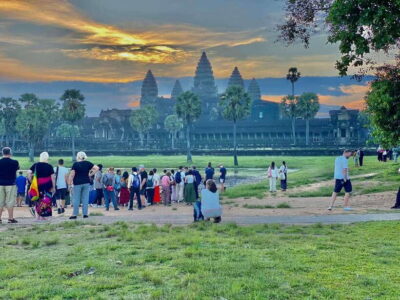
Angkor Wat: Small-Group Sunrise or Sunset Tour
Read our review →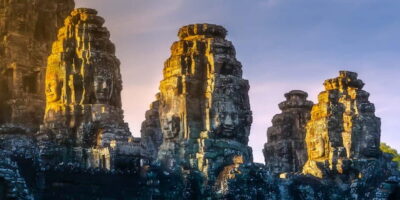
Angkor Wat Highlights and Sunrise Guided Tour from Siem Reap
Read our review →
Angkor Wat Sunrise & 3 Main Temples with Breakfast – Small Group
Read our review →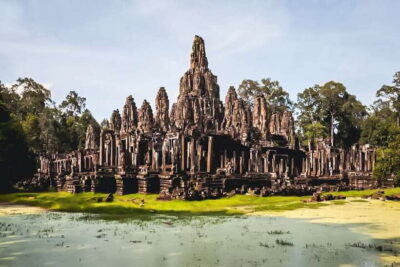
Angkor Wat Sunrise and Full-Day Sightseeing Tour
Read our review →
Angkor Wat Small-Group Exploration with Expert Guide
Read our review →Browse the lists this tour appears in