
Reviewed · ANGKOR WAT TOURS
Angkor Wat 2-Day Tour
Angkor Wat is only the beginning here. This two-day private tour brings you from the great temple’s galleries to Bayon’s 216 carved faces, the jungle-wrapped ruins of Ta Prohm, and the long ceremonial terraces of Angkor Thom. Day two is intended for the jewel of Angkorian art and the River of a Thousand Lingas, giving you a broader look at the empire than a one-day temple run.
I like the private format, since your group can discuss timing and make reasonable detours with the driver. I also like the small comforts: cold drinking water and chilled towels matter when you return to the tuk-tuk hot and dusty. Guides and drivers named Vutha, Ly, Seng, Lucky, and Pheach have handled past departures, with several praised for patience, clear explanations, and flexibility.
The main catch is that the $360 price does not include temple tickets, lunch near the temples, or personal expenses. The second day is also described in broad terms rather than with a full stop-by-stop schedule, so ask exactly which sites are planned before paying. Sunset at Angkor Wat or Phnom Bakheng can also depend on crowd controls and local access rules.
Key points at a glance
- Bayon’s smiling faces give you one of Angkor’s most memorable sights, with 54 towers and 216 carved faces.
- Ta Prohm and Banteay Kdei offer two very different views of ruins being reclaimed by the forest.
- A private guide and driver make this a useful choice for families, solo visitors, and groups with their own pace.
- Cold water and towels are supplied, a welcome service during hot temple walks.
- The $360 fee excludes temple admission and lunch, so calculate the full cost before booking.
- Day two needs clarification, since the broad description does not name every stop or give its exact timing.
Why two days works better than one
Angkor is not one building. It is a large archaeological park spread around Siem Reap, with temples that differ in age, purpose, scale, and style. A single day can cover the famous names, but it often turns into a hot race from one photo stop to the next.
This tour gives you roughly two days, beginning at 8:00 a.m. on day one. That early start gives you useful morning time at Angkor Wat and Angkor Thom before the day becomes more tiring. You still need stamina. Temple stairs, uneven stone, heat, and repeated walks from the vehicle add up quickly.
The private setup is especially useful here. You are not tied to the pace of a large bus group, and the driver can respond to your needs. A past solo booking was arranged with a private guide and driver, showing that one person can use the format rather than needing a family or larger party.
The guide is important. These temples are more than photogenic ruins, and the carved scenes make better sense when someone explains their religious and political purpose. English-speaking guides used on past departures include Vutha, Seng, Lucky, Bunanal, and Pheach. Drivers such as Ly and Ly Hol have also been praised for punctual service and a willingness to accept reasonable detours.
More ways to walk into Angkor Wat:
- Angkor Wat Sunrise or Sunset Tour with Guide from Siem Reap
★ 5.0 · 12,109 reviews - Siem Reap: Angkor Wat: Small-Group Sunrise or Sunset Tour
★ 5.0 · 9,444 reviews - Siem Reap: Angkor Wat 2-Day Tour with Sunrise and Sunset
★ 4.9 · 4,429 reviews
Angkor Wat at the 8:00 a.m. start
Your first major stop is Angkor Wat, the largest religious building in the world. Its scale can be difficult to grasp from photographs. You approach a massive complex of towers, galleries, causeways, courtyards, and bas-reliefs, then continue inward through layers of stone architecture.
Give yourself time to notice the details. The outer galleries carry long carved scenes, while the central towers create the famous vertical profile. The site was built as a Hindu temple dedicated to Vishnu and later used as a Buddhist place of worship. A guide can help you read the carvings instead of simply walking past them.
The tour begins at 8:00 a.m., not at the popular sunrise hour. That may disappoint you if a dawn photograph is your top priority. On the other hand, you are not promised a sunrise start, and the later departure avoids making the entire first day begin in the darkest hours.
Wear clothing that covers your shoulders and knees. Temple dress rules apply, and you may be refused entry to certain areas if your clothing is not suitable. Comfortable shoes are more useful than stylish ones, since the ground can be rough and the site is large.
South Gate and the road into Angkor Thom
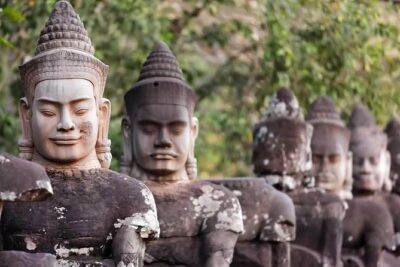
From Angkor Wat, the route continues to Angkor Thom, the last great capital of the Khmer Empire. The South Gate is one of the most recognizable entrances, with a causeway lined by two rows of figures.
One side shows devas, or benevolent divine beings, while the other shows asuras, their opposing figures. Together they represent the Hindu story of the Churning of the Sea of Milk. The arrangement gives the entrance a dramatic quality, but it also has a practical role: this was a protected gateway into the capital.
Do not rush through the gate simply because it is a short stop. It is one of the places where the road, sculpture, moat, and city plan work together. Your guide can explain how the figures fit into the wider religious symbolism and the defensive design of Angkor Thom.
Bayon’s towers and the face of Jayavarman VII
About one kilometer from the South Gate, Bayon forms the heart of Angkor Thom. This was the state temple of King Jayavarman VII, and its many towers carry the calm, slightly mysterious faces associated with the site.
The temple has 54 towers decorated with 216 faces of Avalokiteshvara. As you move through the dense upper levels, faces appear from different angles, often seeming to look directly at you. It is a strange and memorable effect, one reason Bayon is often the temple people remember most clearly after Angkor Wat.
Bayon is not an easy building to understand without help. Its crowded layout can feel confusing, and the best views are mixed with narrow passages and stairs. A good guide earns the fee here by explaining what you are seeing and helping you find the important carvings without turning the visit into a blur of stops.
A few more Siem Reap half-days worth weighing up
- Angkor 2-Day Sunset & Sunrise Small-Group Tour
★ 5.0 · 2,567 reviews - 2 Days Exclusive Temple Highlights with Sunset and Sunrise Tour
★ 5.0 · 1,157 reviews - Siem Reap: Angkor Sunrise 1- or 2-Day Guided Temples Tour
★ 4.9 · 1,132 reviews - 2 Days Guided Historical Tour in Angkor
★ 5.0 · 855 reviews
Baphuon and the royal terraces
Baphuon is a large pyramid-shaped temple built in the mid-11th century as a state temple for the Hindu god Shiva. Its three tiers give it a strong, rising form, and the climb offers a different experience from Bayon’s enclosed galleries.
You should take care on the steps and allow time to look back at the temple’s structure. Baphuon is about mass and geometry, while Bayon is about faces and crowded detail. Seeing both in one morning helps you understand how varied Angkorian design could be.
Next come the Terrace of Elephants and the Terrace of the Leper King. The Terrace of Elephants runs for about 350 meters along the front of the former royal palace. It served as a viewing platform for public ceremonies and as a place where the king could watch military training.
The nearby Terrace of the Leper King is smaller but packed with carvings. Its enclosed sections contain detailed figures that are easy to miss if you only photograph the outer wall. This is another stop where a guide’s explanation adds real value.
Chau Say Tevoda, Thommanon, and Takeo
Outside Angkor Thom, Chau Say Tevoda, Thommanon, and Takeo provide a change of scale and mood. These temples are not presented as long, separate visits, but they are included as important stops on the small circuit.
Chau Say Tevoda and Thommanon are particularly useful for comparing temple design. Their smaller size can make carved details easier to appreciate than at Angkor Wat. Takeo has a more severe, pyramid-like appearance and rewards a slower look at its structure.
The practical advantage of visiting these sites with a private vehicle is simple: you can spend more time at the temple that interests you and less time waiting for a large group to gather. Do not expect every site to receive the same length of explanation. The exact balance depends on your guide, your energy, and the timing of the day.
Ta Prohm, where trees enter the ruins
Ta Prohm was used as a Buddhist monastery and university during the Angkor period. Today it is widely associated with the film Tomb Raider, but the movie is not the main reason to visit.
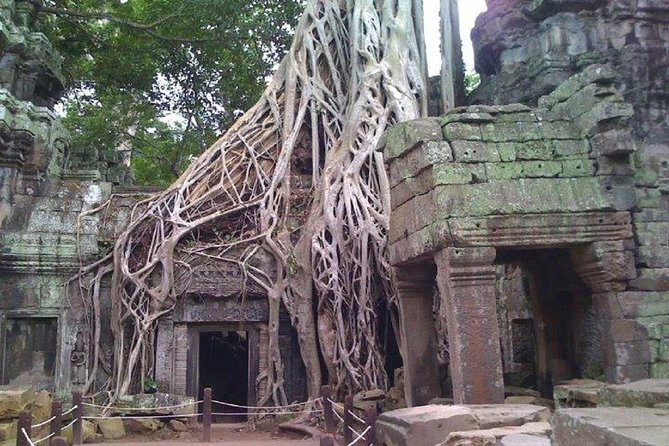
The temple’s appeal comes from the uneasy meeting of stone and forest. Large trees grow through parts of the ruins, with roots gripping walls and galleries. You get the feeling of a site being slowly taken back by nature, even though the temple is open and maintained for visitors.
Ta Prohm is one of the busiest places on the route, and its most famous tree-covered corners can attract a line of cameras. The private tour does not guarantee an empty temple. It does give you a better chance to discuss timing with the guide and avoid treating the entire visit as a single photograph.
Banteay Kdei and Srah Srang
Banteay Kdei offers a quieter counterpoint to Ta Prohm. It was recently restored and remains open to visitors, with forest around the temple adding to its secluded feel.
The structure is less instantly famous than Ta Prohm, which can make it a more relaxed place to examine doorways, galleries, and carved stone. I would not skip it just because its name is less familiar. It helps show how much variety can fit into the Angkor area.
Across from Banteay Kdei is Srah Srang, a large reservoir, or baray, connected with the temple. The water creates broad views and can be especially attractive around sunrise or sunset. The tour description includes Srah Srang, but it does not promise a specific sunrise stop there, so confirm the timing if that view is important to you.
Sunset at Angkor Wat or Phnom Bakheng
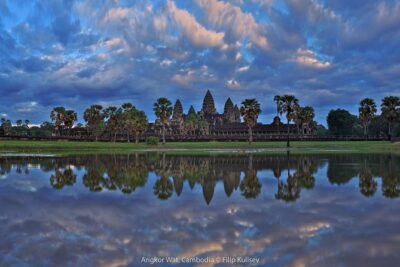
At the end of the first day, the tour aims for sunset at Angkor Wat or Phnom Bakheng. Angkor Wat gives you a grand setting beside the largest temple, while Phnom Bakheng offers a high viewpoint from the top of a mountain.
This choice is practical as well as scenic. You may prefer the broad temple view from Phnom Bakheng, or you may want to remain near Angkor Wat and avoid another climb after a full day. Access and crowd limits can affect the experience, so treat the sunset stop as an intended plan rather than an absolute guarantee.
Ask your guide early in the day how the choice will be handled. If you are tired, Angkor Wat may be the easier option. If you want a higher viewpoint and still have the energy, Phnom Bakheng may suit you better.
What day two adds
The second day is described around two major themes: the jewel of Angkorian art and the River of a Thousand Lingas. The wording points toward a broader circuit beyond the first day’s major stops, but the supplied details do not name every temple or give a complete schedule.
That matters. You should ask the operator which exact sites are included, how long the day lasts, and whether transport remains by tuk-tuk or uses another vehicle. The first day is clearly laid out, while day two requires more direct confirmation.
This second day should suit you if you want more than the standard Angkor Wat, Angkor Thom, and Ta Prohm circuit. It may also help spread the physical effort over two days. You will still want water, sun protection, and clothing that follows the temple dress code.
One past booking also included a trip to Tonle Sap Lake and a stilted fishing village after discussion with the operator. That was an added arrangement, not a guaranteed part of this tour, so do not assume it is included. Ask before booking if you want to add it.
Guides, drivers, and the private format
The strongest part of this experience is the local transport and human support. Drivers named Vutha, Ly Hol, and Pheach have been described as punctual, friendly, flexible, and attentive. One driver was especially appreciated by a family with a three-year-old child, while another solo booking was arranged without difficulty.
Guide quality matters more than a polished vehicle at Angkor. Past departures have used guides including Seng, Lucky, Bunanal, and Ten, with English explanations and help answering questions. Lucky has also worked as a photographer, which may appeal to you if you want help finding good angles as well as temple facts.
The included cold towels and drinking water are small but useful. After a hot walk through stone courtyards, a chilled towel is not a luxury. Transportation is included, but the exact vehicle type for every part of both days should be confirmed.
Is $360 good value?
At $360, the tour is not an inexpensive way to see Angkor, especially because temple tickets and lunch are extra. The price makes more sense if you are traveling with several people and can share the private tour cost.
For a solo visitor, the value is less obvious, but the private arrangement can still be useful if you want a flexible schedule and direct attention from a guide. One solo booking was accommodated with a private guide and driver, so the format is not limited to couples or families.
Your final budget should include:
- The $360 tour price
- Temple admission
- Lunch near the temples
- Personal expenses
- Any optional additions, such as a Tonle Sap trip, if arranged separately
The tour includes an English-speaking guide, transportation, cold towels, drinking water, and a mobile ticket feature. Because temple admission is excluded, check exactly how the mobile ticket element works before assuming it covers entry.
Who should book this tour?
I would choose this tour if you want a private two-day plan, prefer having an English-speaking guide, and like the option to adjust the pace. It is also a sensible match for families, solo visitors, and small groups that do not want to follow a large coach schedule.
It is less suitable if you want a clearly fixed, minute-by-minute plan for both days, or if your main goal is the cheapest possible visit. The second day needs clarification, and the extra cost of temple admission and meals changes the headline price.
The tour is also physically demanding. You will walk over uneven ground, climb temple steps, and spend long periods outside in hot conditions. Dress properly, drink water often, and tell the guide if you need a slower pace.
Should you book it?
Book it if the freedom of a private guide, the range of temple stops, and the support of a local driver are worth paying for. The first day covers the essential Angkor sights in a logical order, while the second day promises a wider look at Angkorian art and sacred waterworks.
Before you commit, get the exact day two route in writing and confirm the temple ticket cost. If those details suit your budget, this is a strong choice for seeing Angkor with more context and less pressure than a rushed one-day visit.
FAQ
Where does the tour start?
The tour starts in Siem Reap, Siem Reap Province, at 8:00 a.m.
Is this a private tour?
Yes. Only your group participates, allowing the guide and driver to work around your group’s needs.
Is an English-speaking guide included?
Yes. An English-speaking guide is included in the tour.
Are temple tickets included?
No. Temple tickets are not included in the $360 price.
Is lunch included?
No. Lunch near the temples and personal expenses are excluded.
Can I cancel for a full refund?
Yes, if you cancel at least 24 hours before the experience start time. Cancellations or changes made less than 24 hours before the start time are not accepted for a refund.
Just added around Siem Reap
- Twilight Tastes of Siem Reap Include Dinner★ 5.0 · 13 reviews
- Ultimate Sunrise to Angkor Wat, Angkor Thom and Bayon Temple★ 5.0 · 3 reviews
- Trekking Tour at Phnom Kulen National Park from Siem Reap★ 5.0 · 3 reviews
- Professional Photo Shoot in Angkor Archaeological Park, Siem Reap★ 5.0 · 42 reviews
- Full-Day Private Tour of Angkor Wat with Pick Up★ 5.0 · 12 reviews
- Unveiling 2 Days Private Angkor Wat/Beyond In Sunrise/Sunset Tour★ 5.0 · 48 reviews
- Siem Reap City Tour with War Museum and Killing Field★ 5.0 · 27 reviews
- Private Day Trip to Angkor Temples with Expert Guide★ 5.0 · 4 reviews
Angkor Wat Tours, compared.
Angkor Wat Sunrise or Sunset Tour with Guide from Siem Reap
Read our review →
Angkor Wat: Small-Group Sunrise or Sunset Tour
Read our review →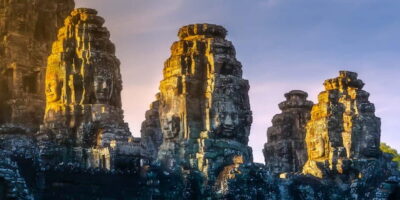
Angkor Wat Highlights and Sunrise Guided Tour from Siem Reap
Read our review →
Angkor Wat Sunrise & 3 Main Temples with Breakfast – Small Group
Read our review →
Angkor Wat Sunrise and Full-Day Sightseeing Tour
Read our review →
Angkor Wat Small-Group Exploration with Expert Guide
Read our review →Browse the lists this tour appears in