
Reviewed · ANGKOR WAT TOURS
Angkor Wat Sunrise & All Highlight Angkor Temple Private Day Tour
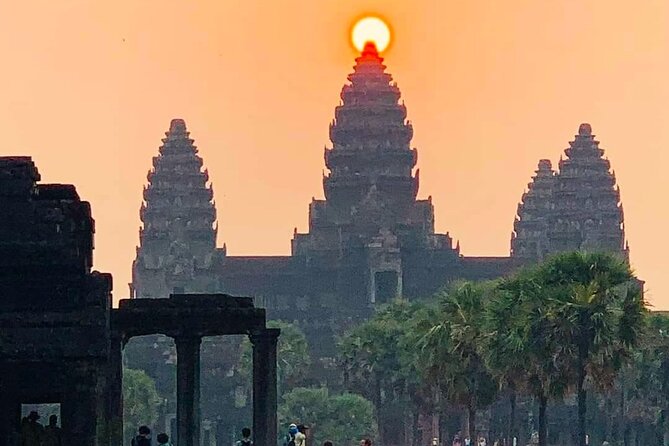
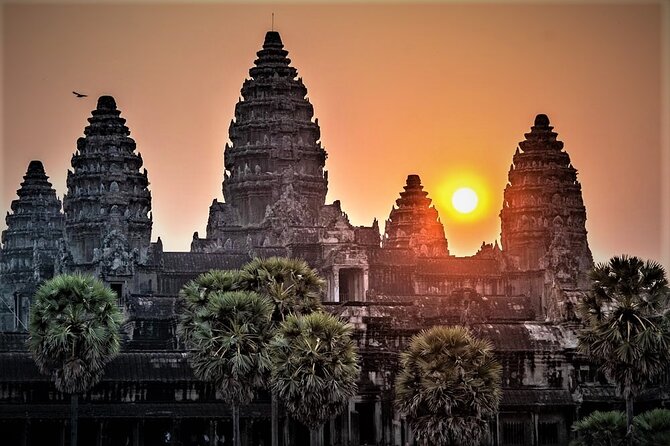
Angkor Wat at sunrise is the main event, but this private day tour keeps going long after the sky brightens. You start at 4:30 am, claim your place near the reflection pools, then move through Angkor Thom, Bayon, Ta Prohm, Banteay Kdei, and several quieter monuments with an English-speaking guide.
I like the private format, since your guide can adjust the pace and help with photos instead of shepherding a large group. I also like the practical touches: an air-conditioned vehicle or tuk-tuk, cold drinking water, and cold towels after hours in the Cambodian heat. Guides such as Rain, Sara, and Leap are praised for clear English, humor, patience, and smart timing.
The catch is the early alarm and the packed schedule. The tour lasts about eight to nine hours, and Angkor Wat’s reflection pools can be crowded even before sunrise. The Angkor Pass and lunch are extra, so the advertised price is not the final cost.
Key points to know before booking
- 4:30 am hotel pickup: You leave Siem Reap before dawn to reach Angkor Wat for sunrise.
- Private group only: Your party travels with its own licensed English-speaking guide and driver.
- Eleven major stops: The route covers Angkor Wat, Angkor Thom, Bayon, Baphuon, Ta Prohm, Banteay Kdei, and several lesser-known sites.
- Comfort in the heat: Air conditioning, cold water, and cold towels are included.
- Extra costs matter: The Angkor Pass and lunch are not included in the $65.55 tour price.
- Guide quality is central: Rain, Sara, Leap, Ree, and Ry are praised for clear explanations, good humor, patience, and careful driving support.
Sunrise at Angkor Wat requires an early start
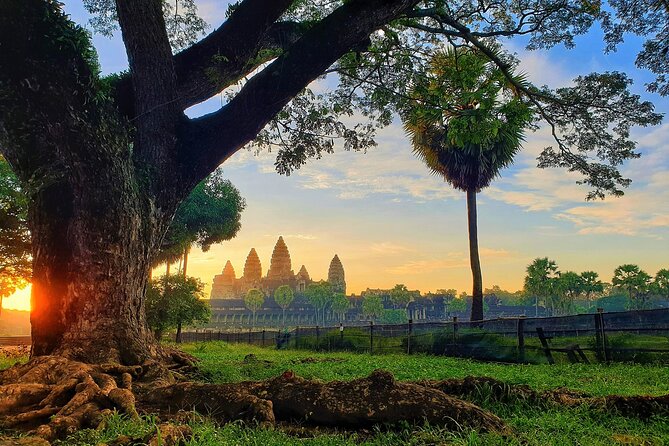
The day begins at 4:30 am with pickup from your hotel in Siem Reap city. You need to provide the hotel name and address when booking so the guide and driver can meet you in the lobby.
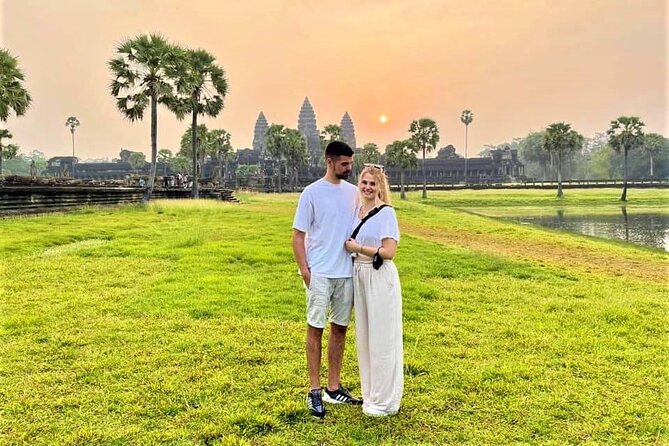
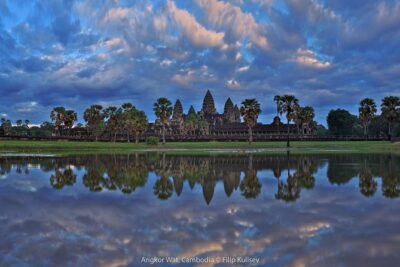
That early departure serves a clear purpose. Angkor Wat is especially busy at sunrise, with many people heading straight for the reflection pools in front of the temple. Arriving early gives you the best chance of finding a useful viewing place, but it does not promise solitude. You should expect a crowd around the water, particularly at the most popular pool.
The sunrise portion lasts about two hours, including time at the temple. This is not just a quick photo stop. You can watch the changing light, enter the temple grounds, and begin learning how Angkor Wat fits into Cambodia’s past.
Bring patience and a small amount of water for the opening wait. The tour supplies cold drinking water, but you will still want comfortable shoes and clothing suitable for a religious site. Because this is a full day, the first hour requires real commitment.
More Private Tours in Siem Reap
- Full-Day Angkor Wat Sunrise Private Tour with Guide from Siem Reap
★ 5.0 · 2,920 reviews - Siem Reap: Angkor Wat Private Tuk-Tuk Tour
★ 4.9 · 2,222 reviews - Angkor Wat Private Day Tour from Siem Reap
★ 5.0 · 834 reviews
Angkor Wat gives the day its grand opening
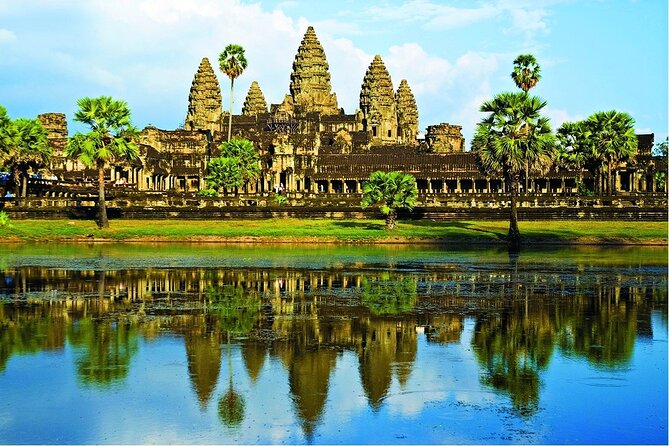
Angkor Wat is the largest and most famous stop on the route, and sunrise is a sensible way to see it. The temple’s outline and reflection pools create the familiar view, but the value of a guide becomes clearer once you move beyond the standard photograph.
An English-speaking guide can explain the temple’s place in Cambodian history while pointing out details you might otherwise pass without noticing. The provided information does not name one fixed guide for every departure, but guides including Rain, Sara, and Leap have been praised for strong English, humor, clear explanations, and an ability to answer questions.
Keep your expectations realistic. This is not a quiet private sunrise. It is a private tour in the sense that only your own group participates, while the temple itself remains a shared public site.
After sunrise, the route turns toward Angkor Thom. The vehicle or tuk-tuk matters here. You will be moving between monuments rather than walking the entire circuit, and the included transport helps conserve energy for the temple interiors and terraces.
South Gate and Bayon reveal Angkor Thom’s royal scale
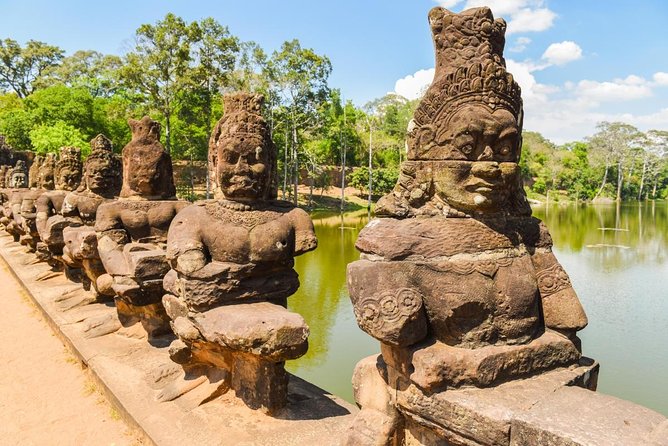
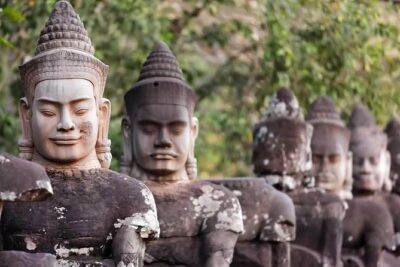
The South Gate of Angkor Thom is a short, 30-minute stop. It is one of the best-known entrances, with many restored heads still in place. This makes it an efficient introduction to the walled city before you reach the monuments inside.
The gate is on the main road from Angkor Wat, so it also works well as a transition point. Your guide can explain the figures lining the approach and place the entrance within the larger plan of Angkor Thom.
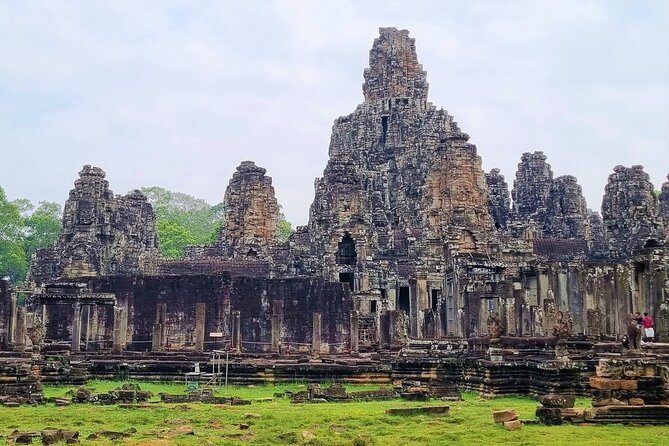
Bayon follows, with about an hour devoted to the temple. Built nearly a century after Angkor Wat, Bayon is known for its large carved faces and unusual, tightly packed structure. The temple once occupied the center of Angkor Thom, which helps explain why it feels less like an isolated shrine and more like the heart of a royal city.
This is one of the stops where a good guide earns the fee. Bayon can feel confusing at first, with passages, towers, and carvings crowding together. The strongest feedback about this tour centers on guides who explain clearly, keep things entertaining, and choose the order of stops to reduce time in the thickest crowds.
You then spend about 30 minutes seeing Angkor Thom itself. That stop is broad rather than a single building, so expect your guide to connect the walls, gates, royal center, and nearby monuments into one picture.
Baphuon and the royal enclosure slow the pace
Baphuon receives about an hour. The temple rises on a rectangular sandstone base with five levels of roughly similar size, rather than the more familiar pattern of smaller upper levels. That design gives it a broad, imposing shape.
The stop rewards visitors who enjoy architecture and restoration details. It is less instantly recognizable than Angkor Wat or Ta Prohm, but it helps you understand how varied Angkor’s temple designs can be.
Phimeanakas is a shorter 25-minute visit near the center of the area once enclosed by the Royal Palace. The temple is linked with a golden pinnacle described by the Chinese diplomat Zhou Daguan, though the surviving structure is far less complete than the name and old descriptions suggest.
Because Phimeanakas is brief, you should treat it as a historical pause rather than a major photo stop. It adds context to the royal center of Angkor Thom, especially after Bayon and Baphuon have shown you the city’s public and ceremonial scale.
More ways to walk into Angkor Wat:
- Angkor Wat Sunrise or Sunset Tour with Guide from Siem Reap
★ 5.0 · 12,109 reviews - Siem Reap: Angkor Wat: Small-Group Sunrise or Sunset Tour
★ 5.0 · 9,444 reviews - Siem Reap: Angkor Wat 2-Day Tour with Sunrise and Sunset
★ 4.9 · 4,429 reviews - Siem Reap: Full-Day Angkor Wat Guided Tour with Sunset
★ 4.9 · 3,803 reviews
The Elephants and Leper King terraces show Angkor’s public face
The Terrace of the Elephants takes about 30 minutes and is one of the more visually direct stops. Its carved elephants and long reliefs were tied to royal processions, servants, and princes. The terrace is open and linear, so your guide can explain how it related to public ceremonies and the royal center.
I like this stop because it is different from the enclosed temple spaces. You are looking at a ceremonial platform rather than climbing through dark galleries. The scale makes more sense when you consider that Angkor Thom was planned as a royal city, not simply a collection of shrines.
The Terrace of the Leper King follows for another 30 minutes. It carries dense bas-reliefs on both its interior and exterior faces. The carvings reward a closer look, and a guide can point out details that are easy to miss when you are simply walking along the wall.
These terraces also provide a change of rhythm. By this point, you have already seen major towers and gates. The terraces let you focus on sculpture, public space, and the way the Khmer builders used long surfaces to tell stories.
Ta Nei offers a quieter temple stop
Ta Nei is scheduled for about 30 minutes. This late 12th-century stone temple was built during the reign of Jayavarman VII and dedicated to the Buddha. It sits near the northwest corner of the East Baray, a large sacred reservoir.
The stop is shorter and less famous than the next two temples. That is part of its appeal. It gives the day a break from the most heavily photographed places and shows another side of the Angkor area.
Do not expect the same scale as Angkor Wat or Bayon. Ta Nei works best as a compact architectural stop, especially if you want your guide to explain how temples from the same broad period can differ in size and setting.
Ta Prohm is the day’s most atmospheric temple
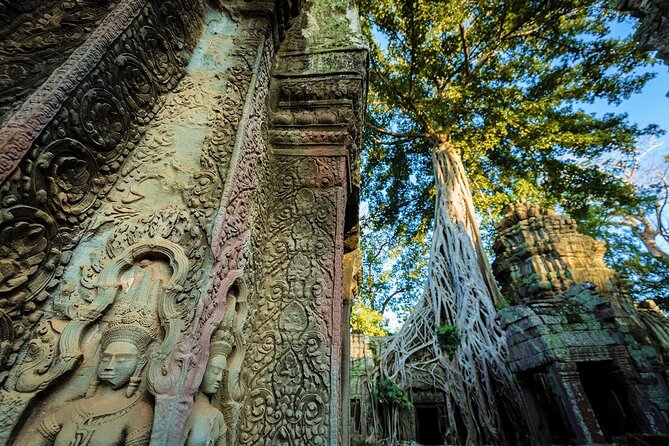
Ta Prohm receives about an hour and will likely be one of the most memorable parts of the tour. It is known for trees growing around and over the stonework, giving the site its famous weathered appearance.
The temple has been left largely untouched by archaeologists, apart from clearing paths and adding structural support where needed. That balance is important. Ta Prohm is not simply a ruined building swallowed by forest. It is an active heritage site where preservation work allows you to see the old stones safely.
This stop can be crowded, so your guide’s timing matters. One guide, Leap, is specifically praised for choosing the order of temple visits to avoid heavier crowds. That does not remove the crowds altogether, but a smart sequence can make a real difference at Ta Prohm’s narrow passages and popular tree-framed views.
Allow time to look beyond the best-known tree. Ta Prohm has courtyards, galleries, carved doorways, and long walls that show how large the complex once was. The supplied schedule gives you enough time to see more than one famous corner, though the full day means you will need to keep moving.
Banteay Kdei closes the listed temple route
The final scheduled stop is Banteay Kdei, with about an hour. It was built at ground level as a Buddhist monastery, which gives it a different feel from the taller, more formal temples earlier in the day.
Banteay Kdei is also linked with the discovery of a cache of 274 broken Buddha statues and other Buddhist objects in 2001. That detail helps explain the site’s religious importance and gives your guide a useful story to share as your energy begins to fade.
The temple is a fitting close because it is less about one famous view and more about examining a working religious complex through its remains. After the scale of Angkor Wat and the faces of Bayon, the lower and more open layout can feel like a change of pace.
One point needs checking before you book. The general description says the day ends at Pre Rup, but the detailed stop list ends at Banteay Kdei and does not include Pre Rup. Ask the operator to confirm the final stop and route. Do not assume Pre Rup is included unless it is written into your booking confirmation.
What the $65.55 price really covers
At $65.55 per person, the tour offers solid value if you want a full day with private transport and a guide. The price includes hotel pickup and drop-off, a professional English-speaking licensed guide, private transport by air-conditioned vehicle or tuk-tuk depending on your selected option, cold water, cold towels, service charges, and government VAT.
The private format is the key value. You are not paying only for transport between temples. You are paying for a guide who can explain the sites, help with photos, answer questions, and adjust the pace for your own group.
The main extra is the Angkor Pass, which covers the temples. It is not included, and the guide assists with purchasing it at the entrance to Angkor Park before the tour begins. The price of the pass is not provided here, so budget for it separately.
Lunch is also extra. Local restaurants offer vegetarian and non-vegetarian choices, with dishes listed at about $3 to $10 each. Bring enough cash or confirm payment options with your guide. The tour is long, and skipping lunch would make the final temples harder work.
Tips for the guide and driver are not included. You can decide what feels appropriate after seeing the service you receive. Guides named Rain, Sara, and Leap are praised for clear communication, humor, patience with photographs, and strong historical explanations. Drivers such as Ree and Ry are noted for being ready with water and cold towels between sites.
Comfort, pace, and who should book
This tour suits you if you want to see many of Angkor’s major highlights in one day without joining a large group. It is especially useful for a first visit when you want someone to connect the sites rather than simply drop you at each entrance.
The private setup also helps families and small groups. A guide can wait while you take photos, and the vehicle gives you a place to cool down between stops. Most people can participate, and the tour is near public transportation, though the schedule still involves extensive walking and temple visits.
The pace may not suit you if you prefer slow photography, long periods of quiet, or a single temple explored in detail. Eleven stops plus sunrise is a lot. Baphuon, Bayon, Ta Prohm, and Banteay Kdei each deserve time, but the schedule asks you to keep moving.
The early start is the biggest practical test. You need to be ready in the hotel lobby at 4:30 am, then stay alert through a full morning and afternoon. The reward is cooler conditions at the start and a chance to see Angkor Wat before the worst heat of the day.
Free cancellation is available if you cancel at least 24 hours before the start time. Changes or cancellations made within 24 hours are not accepted for a refund, based on local time.
Should you book this Angkor day tour?
Book it if you want maximum coverage in one private day, especially for a first stay in Siem Reap. The route combines the essential names, Angkor Wat, Bayon, Ta Prohm, and Angkor Thom, with useful additions such as Ta Nei, the terraces, Phimeanakas, and Banteay Kdei.
The tour is strongest when your guide is assigned well. Names including Rain, Sara, and Leap appear in the service details, and the praised qualities are practical ones: clear English, humor, patience, good timing, and helpful support with photographs. Ask who your guide will be if that matters to you.
I would not choose it for a relaxed temple day. For that, a shorter private route would be easier on your feet and mind. But if you have one full day, want hotel pickup, and prefer an expert explanation over independent wandering, the $65.55 base price is reasonable once you add the Angkor Pass, lunch, and any tip. Confirm the Pre Rup question before paying, set your alarm, and expect a busy but rewarding day.
FAQ
What time does the tour start?
Pickup starts at 4:30 am from your hotel in Siem Reap city. You need to provide your hotel name and address when booking.
Is the tour private?
Yes. Only your own group participates, with a private guide and private transport.
Is the Angkor Pass included?
No. The Angkor Pass is extra and covers the temples on the route. Your guide assists you with purchasing it at the entrance to Angkor Park.
Is lunch included?
No. Lunch is at your own expense. Local restaurants offer vegetarian and non-vegetarian dishes, with menu prices listed at about $3 to $10 per dish.
What transport is included?
Private transport is included by either a luxury air-conditioned vehicle or tuk-tuk, depending on the option you choose. Hotel pickup and drop-off are also included.
Can I cancel for a full refund?
Yes, if you cancel at least 24 hours before the experience start time. Cancellations or changes made less than 24 hours before the start are not eligible for a refund.
More Temple Tours in Siem Reap
- Siem Reap: Full Day Angkor Wat Temple Experience with Sunset
★ 4.9 · 1,490 reviews - 2 Days Exclusive Temple Highlights with Sunset and Sunrise Tour
★ 5.0 · 1,157 reviews - Full-Day Banteay Srei & 4 Temples – Grand Tours Join-in Tour
★ 5.0 · 1,155 reviews - Siem Reap: Angkor Sunrise 1- or 2-Day Guided Temples Tour
★ 4.9 · 1,132 reviews
More Early Starts in Siem Reap
- Angkor Wat Sunrise tour with Small – Group and Guide tours
★ 5.0 · 3,655 reviews - Angkor Wat Highlights and Sunrise Guided Tour from Siem Reap
★ 5.0 · 3,213 reviews - Angkor Wat Sunrise & 3 Main Temples with Breakfast – Small Group
★ 5.0 · 2,857 reviews - Siem Reap: Angkor Wat Sunrise and Full-Day Sightseeing Tour
★ 4.9 · 2,828 reviews
Just added around Siem Reap
- Twilight Tastes of Siem Reap Include Dinner★ 5.0 · 13 reviews
- Ultimate Sunrise to Angkor Wat, Angkor Thom and Bayon Temple★ 5.0 · 3 reviews
- Trekking Tour at Phnom Kulen National Park from Siem Reap★ 5.0 · 3 reviews
- Professional Photo Shoot in Angkor Archaeological Park, Siem Reap★ 5.0 · 42 reviews
- Full-Day Private Tour of Angkor Wat with Pick Up★ 5.0 · 12 reviews
- Unveiling 2 Days Private Angkor Wat/Beyond In Sunrise/Sunset Tour★ 5.0 · 48 reviews
- Siem Reap City Tour with War Museum and Killing Field★ 5.0 · 27 reviews
- Private Day Trip to Angkor Temples with Expert Guide★ 5.0 · 4 reviews
Angkor Wat Tours, compared.
Angkor Wat Sunrise or Sunset Tour with Guide from Siem Reap
Read our review →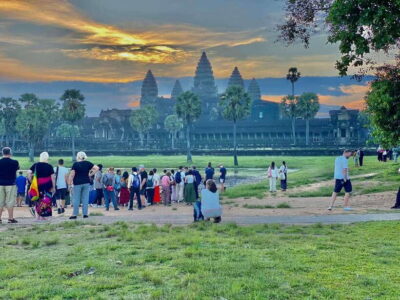
Angkor Wat: Small-Group Sunrise or Sunset Tour
Read our review →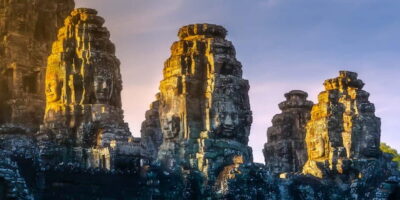
Angkor Wat Highlights and Sunrise Guided Tour from Siem Reap
Read our review →
Angkor Wat Sunrise & 3 Main Temples with Breakfast – Small Group
Read our review →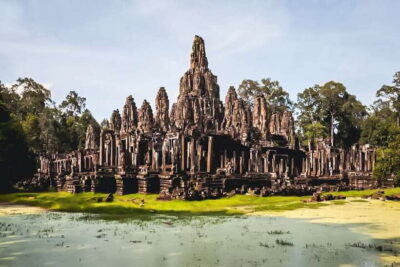
Angkor Wat Sunrise and Full-Day Sightseeing Tour
Read our review →
Angkor Wat Small-Group Exploration with Expert Guide
Read our review →Browse the lists this tour appears in