
Reviewed · ANGKOR WAT TOURS
Angkor Wat: Sunrise: Ta Prohm and Bayon Temple Tour
Angkor Wat at sunrise is the reason to set the alarm before 4 a.m. This tour gets you inside the temple in darkness through its quieter eastern side, then leads you past carved galleries and upper terraces as the day begins. The timing is excellent, and the $16 tour fee covers transport, a guide, water, and hotel pickup.
I like the two full hours at Angkor Wat, rather than a quick photo stop, and the sensible order of Ta Prohm followed by Bayon and Angkor Thom. Guides such as Chhay, Sokpee, Kiz, and Sopheaprath have been praised for clear explanations, humor, and helpful photography. The main drawback is the early start, plus the separate $37 temple pass and breakfast cost.
Key points to know before booking
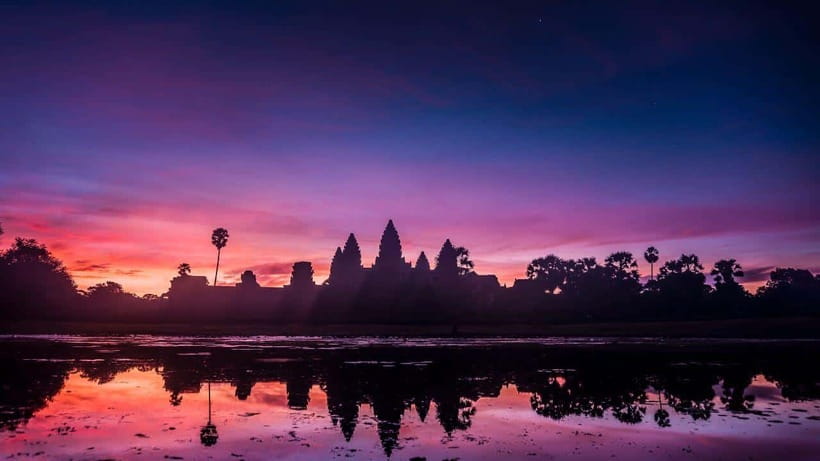
- Sunrise starts the day at Angkor Wat: Arrive early enough to find a good view of the temple and its reflection pools.
- The quieter eastern entrance matters: You enter through dark cloisters and reach the main temple interior before the morning heat builds.
- Two hours inside Angkor Wat: Expect time for bas-reliefs, central chambers, galleries, and upper terraces.
- Three major temple stops follow: Ta Prohm, Bayon, and Angkor Thom give you very different views of Khmer architecture.
- The $16 price is only the tour cost: Add the one-day Angkor pass at $37, plus breakfast if you buy it locally.
- Comfort is built into the morning: Air-conditioning, bottled water, cool towels, hotel pickup, and drop-off help after the long walks.
Why the pre-dawn start is worth it
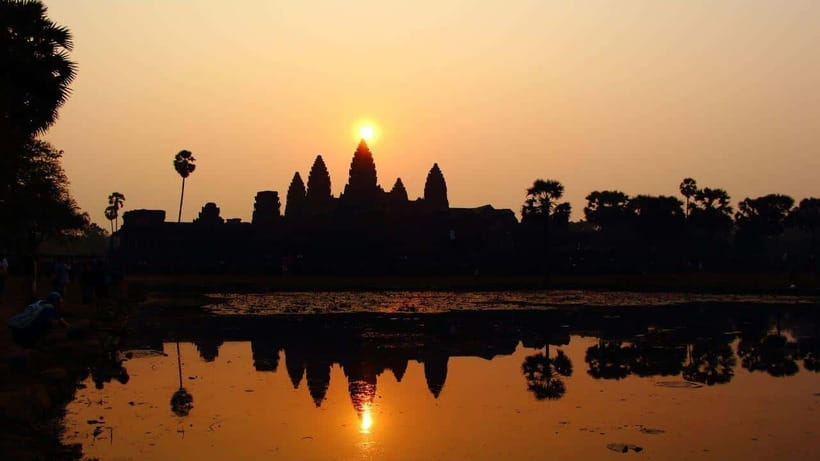
The day begins with pickup in Krong Siem Reap, followed by roughly 20 minutes in an air-conditioned van. You need to be ready before dawn, and some departures involve waking before 4 a.m. That sounds harsh on paper, but it puts the most famous temple in Cambodia at the front of your day, before the heat becomes serious.
Your guide leads you into Angkor Wat in darkness from the eastern side. This is a useful detail. Many people focus only on the western approach and the famous reflection view, but the eastern route gives the opening minutes a quieter, more mysterious feel. You walk through old cloisters and corridors, with a torch useful for watching your footing.
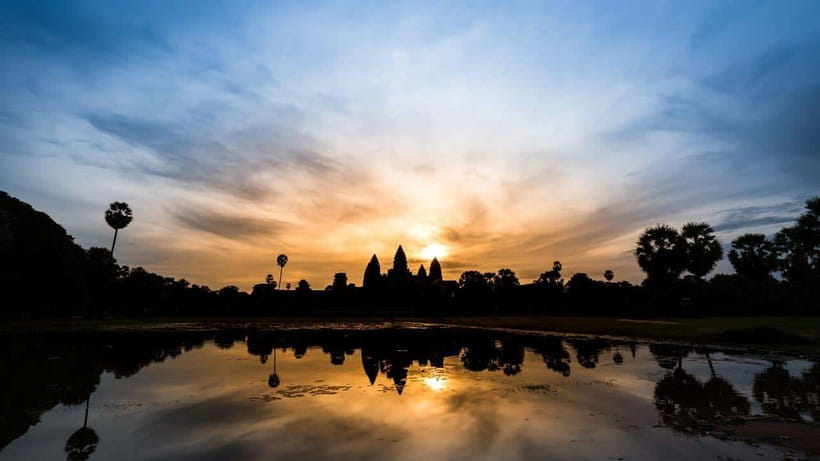
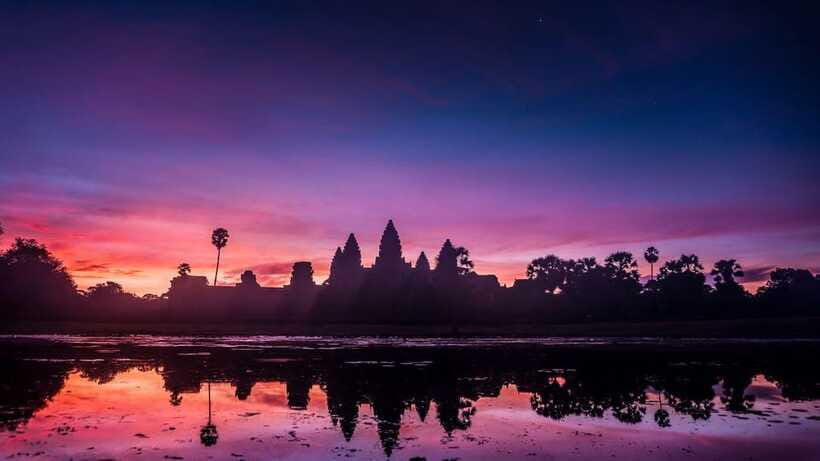
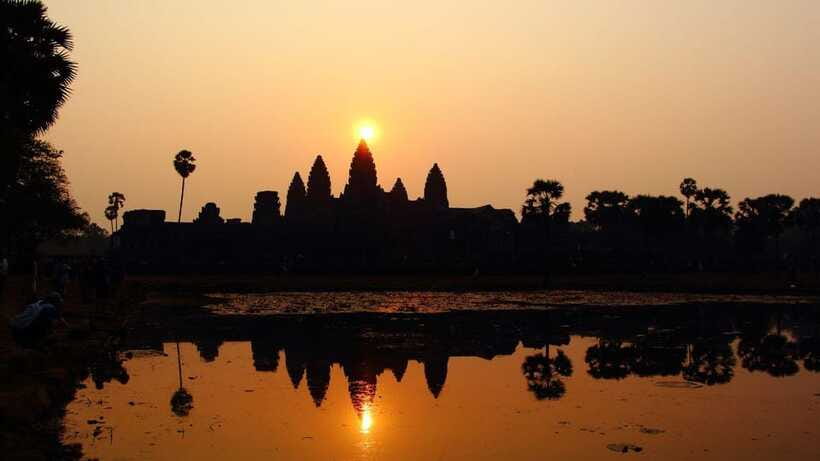
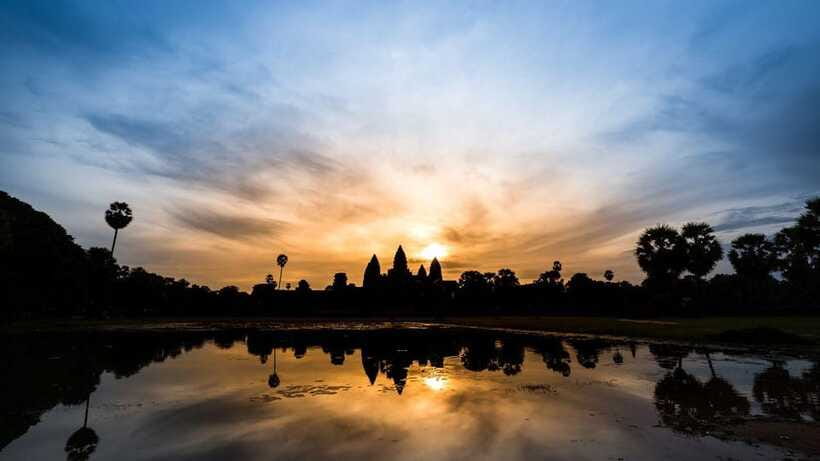
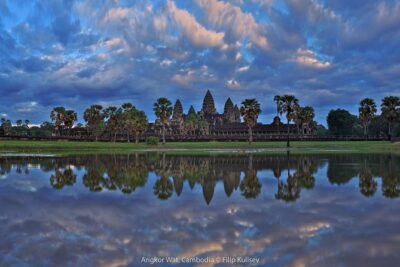
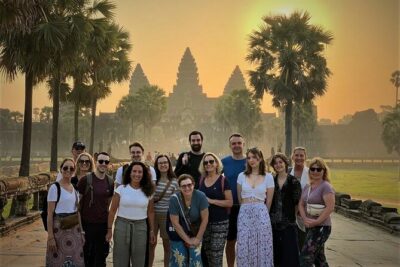
The sunrise itself depends on the sky. On a clear morning, the temple towers and their reflection appear across the water in the classic Angkor view. Clouds can soften or obscure the colors, so you should treat the sunrise as a chance rather than a promise. Even without a dramatic sky, being inside the complex as daylight spreads across the stone is the main reward.
Bring your camera, but do not let it take over the morning. The best position for photographs can fill quickly, and early arrival helps. One guest specifically appreciated getting there early enough for a good view of both the temple and its reflection.
More ways to walk into Angkor Wat:
- Angkor Wat Sunrise or Sunset Tour with Guide from Siem Reap
★ 5.0 · 12,109 reviews - Siem Reap: Angkor Wat: Small-Group Sunrise or Sunset Tour
★ 5.0 · 9,444 reviews - Siem Reap: Angkor Wat 2-Day Tour with Sunrise and Sunset
★ 4.9 · 4,429 reviews
Two hours inside Angkor Wat
After the first light, the tour moves into the temple itself. You get about two hours to explore the corridors, central chambers, and upper terraces. That amount of time makes a real difference because Angkor Wat is far too large for a quick walk-through.
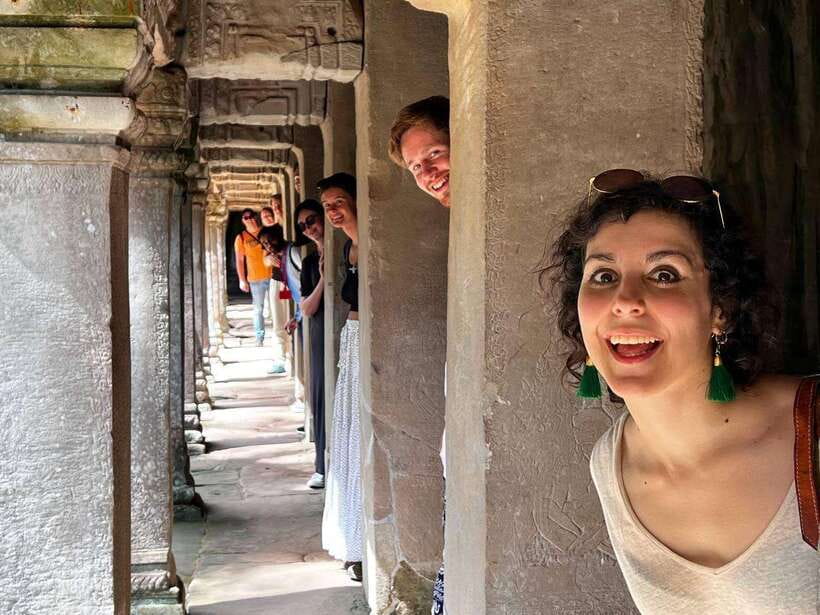
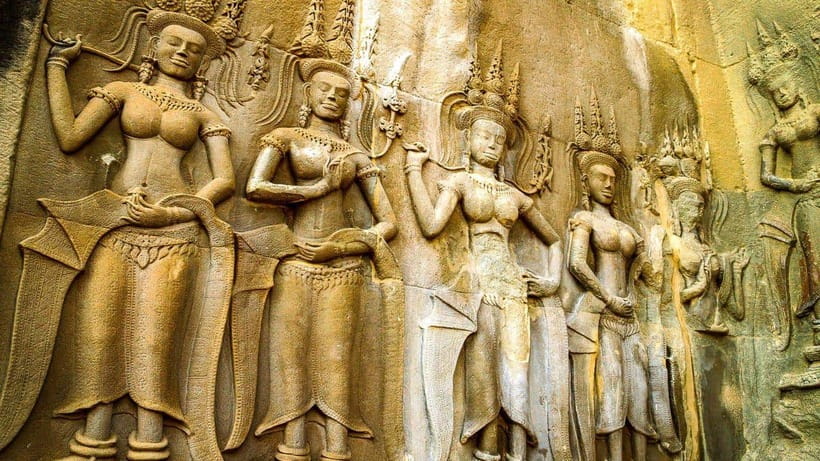
The galleries are lined with long stretches of bas-relief carving. Your guide explains the scenes and points out details that are easy to pass without context. The carvings connect to religious stories, royal power, battles, and daily life during the Khmer Empire. This is where the guided format earns its keep. Without help, you can admire the stonework, but you may miss what the figures and panels are showing.
Several guides have drawn especially warm praise for their mix of facts and personality. Chhay has been described as friendly, funny, and able to answer questions. Sokpee has been noted for explaining religious traditions, architectural styles, and the kingdoms linked to the site. Sopheaprath has been praised for historical knowledge and for knowing useful photo spots. These names reflect guides who have led the activity, but your assigned guide may be different.
The upper terraces require walking and climbing. The information provided does not promise an easy route, and the experience is not suitable for wheelchair users. Wear shoes that can handle uneven stone and bring water, although the tour supplies bottled water along the way.
Angkor Wat can feel grand and formal from the outside. Inside, the details make it human. You see how much labor went into the carvings, how carefully the temple was planned, and how religion and royal authority shaped the site. I would give this section your full attention instead of treating it as a backdrop for sunrise photographs.
Breakfast and a pause at Srah Srang
After Angkor Wat, you stop near Srah Srang for about an hour. This is the practical reset in the middle of the morning. You can eat, rest, and let your feet recover before the next two temples.
Breakfast is not included, but you can buy it at a local restaurant. The price of the meal is not fixed in the tour details. One useful point from the experience is that the breakfast stop was not considered overly expensive, but you should still carry cash.
You can also bring a boxed breakfast from your hotel. That choice worked well for one couple, who used the break to eat and decompress after the long first visit. If your hotel offers an early packed meal, ask for one the night before. It saves time and gives you something familiar to eat.
The break is not a luxury. You have already walked Angkor Wat for around two hours, often after very little sleep. A cool towel and more water from the tour also help. The schedule remains active, but the pause keeps the morning from becoming one long march.
Ta Prohm and the power of the jungle
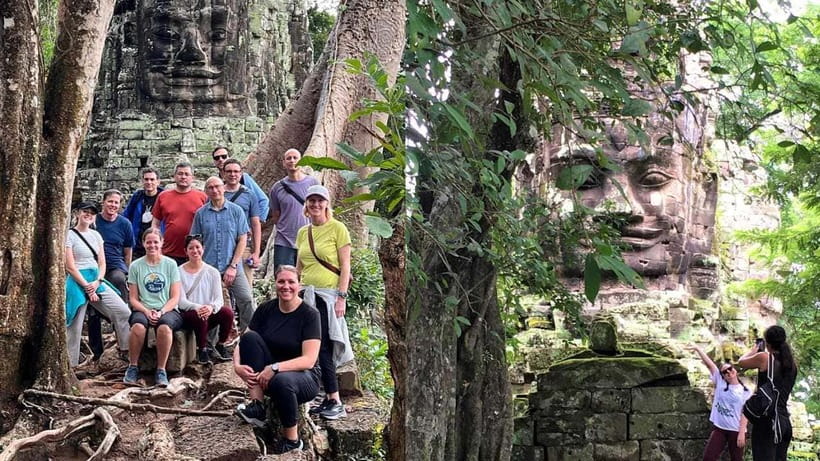
Ta Prohm is the most atmospheric stop on this route. You spend about an hour walking through the temple, where trees and roots have grown over walls, galleries, and doorways. The site looks close to the condition recorded by French explorer Henri Mouhot in the early 1850s, which helps explain its lasting appeal.
Ta Prohm was once home to 2,740 monks. That number gives the ruined corridors some scale, even when the paths feel intimate. You are not simply looking at abandoned stone. You are walking through a former religious community that once needed food, housing, worship spaces, and daily order.
The jungle setting gives Ta Prohm a different character from Angkor Wat. Angkor Wat feels planned, balanced, and monumental. Ta Prohm feels fragile and tangled. Roots press against masonry, and open sections reveal how time and vegetation have changed the building.
The drawback is that Ta Prohm can be tight in places. You may need to walk slowly around other people, and uneven ground remains part of the experience. Comfortable shoes matter here, as does patience. A one-hour stop is enough to see the major areas, but not enough for a leisurely study of every carving.
Your guide can help you separate the temple’s real history from the easy movie-style image of a ruin swallowed by trees. Ask questions while you walk. Guides such as Chhay and Kiz have been praised for mixing solid facts with humor, which is useful after an early wake-up and several hours of stonework.
More time among the roots at Ta Prohm:
- Siem Reap Tour: Angkor Wat Sunrise, Bayon, Ta Prohm, Banteay Srei
★ 5.0 · 931 reviews - Angkor Wat Private Driver Tours to Angkor Wat Sunrise, Angkor Thom & Ta Prohm
★ 5.0 · 98 reviews - One Full Day Private tour of Angkor Wat, Ta Prohm, Angkor Thom & Banteay Srie
★ 5.0 · 64 reviews - Siem Reap Private Day Tour: Angkor Wat Sunrise, Bayon & Ta Prohm
★ 5.0 · 48 reviews
Bayon’s many stone faces
The next major stop is Bayon Temple, part of Angkor Thom. You get around an hour here, with time to walk around the central towers and look up at the famous stone faces.
More than 200 enormous faces cover the towers. They are the feature you will remember most, but Bayon is not just a collection of faces. The crowded structure, layered towers, and changing views make it worth walking through rather than stopping at the first photo point.
Your guide explains the temple’s place in the Khmer Empire and helps make sense of the architecture. The faces can look similar at first, but changing light and viewing angles give them different expressions. This is a good stop for slowing down. You do not need to race from one tower to the next.
Bayon follows Ta Prohm well. Ta Prohm gives you roots, shade, and crumbling walls. Bayon turns your attention upward to carved stone towers and the rulers who commissioned them. Angkor Wat, Ta Prohm, and Bayon are not repetitive stops. Each presents a different side of the Angkor complex.
The walk is still demanding. You have already been on your feet for several hours, and the heat usually builds as the morning progresses. Take the water offered after stops, and use the cool towel rather than saving it for later.
Angkor Thom and the Southern Gate
Before or after Bayon, the route takes you through Angkor Thom, the fortified city. The stop at the Terrace of the Leper King and the Terrace of Elephants adds another layer to the morning. These are not as instantly recognizable as Angkor Wat, but they help you see Angkor Thom as a huge royal city rather than a single temple.
The Terrace of Elephants is linked to ceremonial life, while the Terrace of the Leper King features detailed carvings. Your guide provides the context that makes these structures more than quick roadside views. The official stop at Bayon remains the main focus, but these terraces give the wider city more meaning.
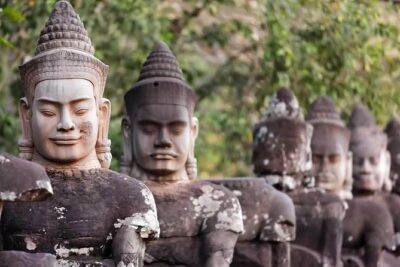
At the Southern Gate, a row of 54 stone figures lines each side of the approach. Gods stand to the left and demons to the right, creating a striking entrance sequence. You have about 20 minutes here, enough for photographs and a short explanation.
The gate is also a good place to understand the scale of Angkor Thom. The fortified city was designed with grand approaches, strong boundaries, and symbolic guardians. A short stop cannot explain every detail, but it gives you a clear final impression before returning to Siem Reap.
What the $16 tour really costs
At $16 per person, the tour price is low for an eight-hour outing with hotel pickup, air-conditioned transport, an English-speaking guide, bottled water, and cool towels. The transport is especially useful because the sites are spread across the Angkor Archaeological Park. You avoid arranging a separate driver for each stop.
The major extra cost is the temple entrance fee: $37 for one day. That makes your basic total $53 per person before breakfast. Seen that way, this is not a $16 day at Angkor, but it is still a fair price for the amount of ground covered and the guide service included.
Breakfast adds another small cost if you eat at a local restaurant. You can lower that expense by arranging a boxed breakfast through your hotel, though the tour does not include it.
The value depends on what you want. If you only need transportation, a private car or tuk-tuk may give you more control over timing. If you want explanations at each major stop and do not want to organize the route yourself, this tour makes sense. The high transport score and repeated praise for punctual pickup, careful driving, water, and towels add practical value.
The group size is not stated, so do not book expecting a private tour unless your confirmation says so. The activity is conducted in English, and the guide assignment can vary. Names associated with the experience include Chhay, Sokpee, Sopheaprath, Kiz, and Samnung, also called Sam in one account.
Who will enjoy this temple morning
I would choose this tour if you are visiting Angkor for the first time and want the essential circuit in one morning. You get the signature sunrise, the main interior of Angkor Wat, Ta Prohm, Bayon, Angkor Thom, and a guide to connect the pieces.
It also suits solo visitors. One solo participant found the organization and guide support useful, and the fixed route removes the awkwardness of arranging transport alone. Couples and small groups benefit from the same convenience.
You should be comfortable with early waking, extended walking, stairs, uneven stone, and warm conditions. Children under eight are not accepted, and wheelchair users cannot take part. Shorts are not allowed, and shoulders and knees must be covered inside the temples. Casual clothing is fine if it meets those rules.
Pack comfortable shoes, a camera, biodegradable sunscreen, cash, and a small torch. The torch is most useful during the first walk into Angkor Wat. The tour ends between about 12:30 and 1:30 p.m., leaving the afternoon free, though you may want a quiet rest after the early start.
The free cancellation window is up to 24 hours before departure, and you can reserve now and pay later. Those terms are useful if your Siem Reap plans are still moving around.
Should you book this Angkor Wat sunrise tour?
Book it if you want a well-priced introduction to the main Angkor sights and prefer a guide to explain the carvings, temples, and Khmer history as you go. The strongest features are the early entrance at Angkor Wat, the full two-hour temple visit, reliable transport, and the care shown by guides and drivers with water, towels, and pickup timing.
Think twice if you dislike pre-dawn starts or want to linger at one temple for most of the day. The route covers a lot, so each stop has a set time. Also budget honestly: the $37 temple pass and breakfast are separate from the $16 tour fee.
For most first-time visitors with one day at Angkor, I would book it. Arrive prepared, bring a hotel breakfast if you like, and choose sleep the night before over a late evening out. The sunrise is beautiful, but the real value is having a guide help you understand what you are seeing after the first light fades.
FAQ
How long does the Angkor Wat sunrise tour last?
The tour lasts about eight hours and usually ends between 12:30 and 1:30 p.m.
What time does the tour begin?
It begins before dawn, with some participants waking before 4 a.m. Check availability for the exact starting time.
Is the Angkor temple entrance fee included?
No. The one-day temple pass costs $37 per person and covers the temples visited during the day.
Is breakfast included?
No. Breakfast is available at a local restaurant near Srah Srang, or you can bring a boxed breakfast from your hotel.
Which temples and sites does the tour visit?
The route includes Angkor Wat, Srah Srang, Ta Prohm, Bayon Temple, Angkor Thom, the Terrace of the Leper King, the Terrace of Elephants, and the Southern Gate.
Is transportation provided?
Yes. The tour includes hotel pickup and drop-off in Krong Siem Reap and transport in an air-conditioned vehicle.
What language does the guide speak?
The live guide speaks English.
What should I wear?
Wear comfortable clothing that covers your shoulders and knees inside the temples. Shorts are not allowed, and comfortable shoes are recommended.
Is the tour suitable for children and wheelchair users?
The tour is not suitable for children under eight or for wheelchair users.
More Early Starts in Siem Reap
- Angkor Wat Sunrise tour with Small – Group and Guide tours
★ 5.0 · 3,655 reviews - Angkor Wat Highlights and Sunrise Guided Tour from Siem Reap
★ 5.0 · 3,213 reviews - Full-Day Angkor Wat Sunrise Private Tour with Guide from Siem Reap
★ 5.0 · 2,920 reviews - Angkor Wat Sunrise & 3 Main Temples with Breakfast – Small Group
★ 5.0 · 2,857 reviews
More Bayon and Angkor Thom Mornings
- Angkor Wat Sunrise and Angkor Thom Sunset Tour
★ 5.0 · 89 reviews - Private Temples Guided Tour (Angkor Wat, Ta Prom & Angkor Thom)
★ 5.0 · 75 reviews - Angkor Wat & Bayon: the Smiling Temple
★ 5.0 · 47 reviews - Unveiling Angkor Wat Sunrise, Bayon, Ta Prohm In Small Group Tour
★ 5.0 · 28 reviews
Just added around Siem Reap
- Twilight Tastes of Siem Reap Include Dinner★ 5.0 · 13 reviews
- Ultimate Sunrise to Angkor Wat, Angkor Thom and Bayon Temple★ 5.0 · 3 reviews
- Trekking Tour at Phnom Kulen National Park from Siem Reap★ 5.0 · 3 reviews
- Professional Photo Shoot in Angkor Archaeological Park, Siem Reap★ 5.0 · 42 reviews
- Full-Day Private Tour of Angkor Wat with Pick Up★ 5.0 · 12 reviews
- Unveiling 2 Days Private Angkor Wat/Beyond In Sunrise/Sunset Tour★ 5.0 · 48 reviews
- Siem Reap City Tour with War Museum and Killing Field★ 5.0 · 27 reviews
- Private Day Trip to Angkor Temples with Expert Guide★ 5.0 · 4 reviews
Angkor Wat Tours, compared.
Angkor Wat Sunrise or Sunset Tour with Guide from Siem Reap
Read our review →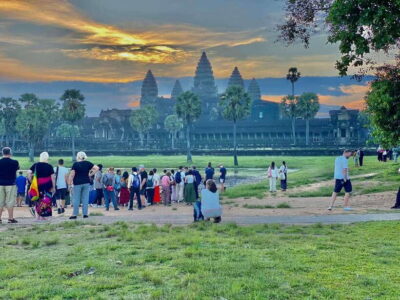
Angkor Wat: Small-Group Sunrise or Sunset Tour
Read our review →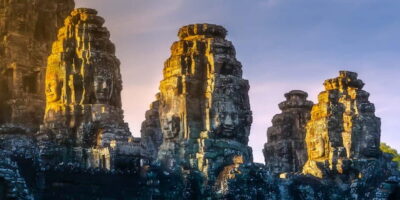
Angkor Wat Highlights and Sunrise Guided Tour from Siem Reap
Read our review →
Angkor Wat Sunrise & 3 Main Temples with Breakfast – Small Group
Read our review →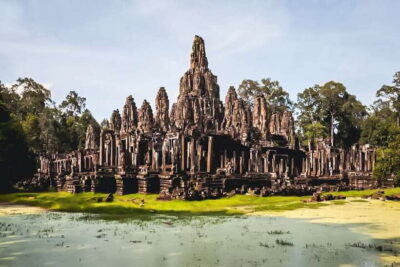
Angkor Wat Sunrise and Full-Day Sightseeing Tour
Read our review →
Angkor Wat Small-Group Exploration with Expert Guide
Read our review →Browse the lists this tour appears in