
Reviewed · ANGKOR WAT TOURS
Four-day tour Angkor Wat, Banteay Srey, Beng Melea and Siem Reap discovery
This four-day private tour does more than tick off Angkor Wat. It takes you from the famous stone faces of Bayon to the quiet ruins of Beng Mealea, then out to Tonle Sap’s floating village communities. The range is the real attraction: grand temples, forest ruins, countryside roads, museum displays, and everyday Cambodian life.
I like the private format, since your group can ask questions and move at a pace that suits you. I also like the mix of major sights and less-visited places, especially Banteay Srei, Kbal Spean, Beng Mealea, and the Roluos temples. The main consideration is the pace. Several days include long drives and up to five temple stops, so you will need good walking stamina and a taste for full days.
Key points to know before booking
- A private four-day route: Only your group takes part, with an air-conditioned vehicle and an English-speaking guide.
- Strong guide-led storytelling: Guide Sa is praised for explaining Khmer history, Hindu and Buddhist beliefs, legends, and local family life in clear English.
- Major and remote temples together: Angkor Wat, Bayon, and Ta Prohm share the schedule with Beng Mealea, Kbal Spean, and the Roluos group.
- A useful culture day: Kompong Phluk, the Angkor National Museum, and Artisans Angkor add modern Cambodian life to the temple program.
- Budget carefully: The $202.57 price covers transport, guiding, cold water, and cold towels, but not temple tickets or meals.
- Early planning helps: The listed start time is 8:30 a.m., and the guide aims to arrange visits to reduce crowd exposure where possible.
What the $202.57 price really covers
At $202.57 per person, this is not an all-inclusive package. Your price pays for a private tour, air-conditioned transport, an English-speaking guide, cold water, and cold towels. Temple admission, food, and drinks beyond the supplied water are separate.
That distinction matters at Angkor, where entrance costs can add a sizeable amount to a multi-day visit. You should also budget for breakfast, lunch, and dinner each day. The tour does not include any of them.
Still, the price has a sensible value if you want four days of organized sightseeing without joining a large group. A private vehicle is especially useful here because the route covers the central Angkor area, remote temples north and east of Siem Reap, the Roluos group, and Tonle Sap.
You are also paying for interpretation, not just a ride between ruins. Sa, the guide named in several tour accounts, is praised for explaining temple details, Khmer history, Hindu and Buddhist stories, Buddhist traditions, folk tales, and aspects of Cambodian family life. That kind of context changes what you see. A carved figure is easier to understand when someone explains its role in a larger story.
More ways to walk into Angkor Wat:
- Angkor Wat Sunrise or Sunset Tour with Guide from Siem Reap
★ 5.0 · 12,109 reviews - Siem Reap: Angkor Wat: Small-Group Sunrise or Sunset Tour
★ 5.0 · 9,444 reviews - Siem Reap: Angkor Wat 2-Day Tour with Sunrise and Sunset
★ 4.9 · 4,429 reviews
Day one: Bayon faces, Ta Prohm roots, and Angkor Wat
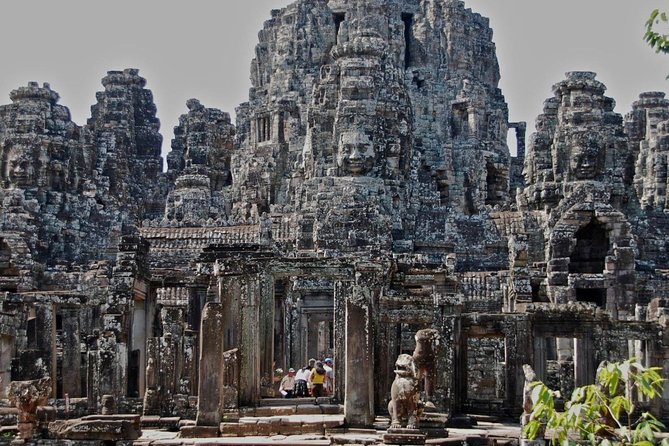
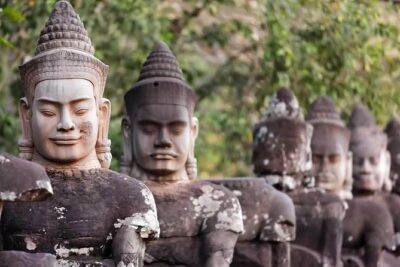
The first day begins with the South Gate of Angkor Thom and continues to Bayon. The temple once had 54 towers and 216 carved faces associated with Avalokitesvara, a Buddhist figure linked with compassion. Bayon is not a quick photo stop. Give yourself time to look up, compare the faces, and notice how the narrow passages and towers create a sense of movement.
The planned visit lasts about two hours. That is useful because Bayon can feel confusing at first. A guide can help you understand the temple’s layout and point out features you might otherwise walk past.
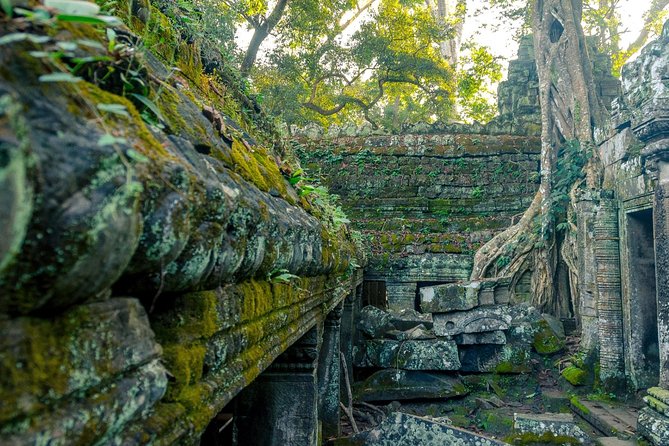
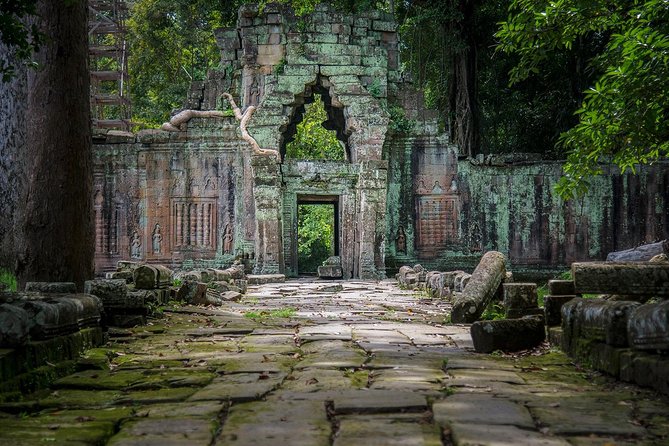
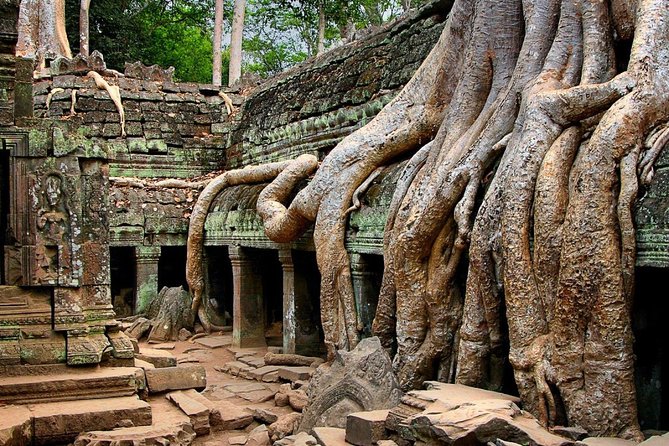
Next comes Ta Prohm, often called the jungle temple or tree temple. Its fame comes from the enormous roots that grip the stone ruins. The trees are not simply decoration. They show how the site changed after centuries of exposure and how the temple’s present appearance is tied to nature as well as architecture.
Ta Prohm is one of the busiest stops on the route, so the effort to manage the timing of visits matters here. Even with good planning, expect a popular site. The two-hour allocation gives you room to see more than the best-known root-covered corners.
Banteay Kdei follows, with about an hour at the temple. Built by Jayavarman VII in the late 12th century, it gives you another look at the religious building style of his reign. After Bayon and Ta Prohm, this stop can feel quieter and more open.
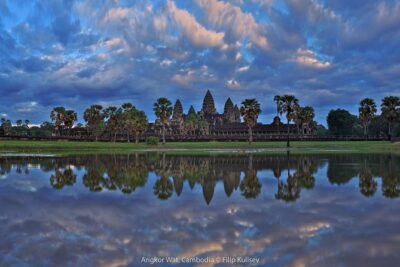
The day ends at Angkor Wat, with about three hours planned. Built by King Suryavarman II in the early 12th century and dedicated to Vishnu, it began as a Hindu temple. Its scale is hard to grasp in a short visit, so the generous time is welcome.
You can expect long walks, steps, exposed areas, and plenty of stone underfoot. The tour description also refers to ending the day by watching the sunset around Angkor Wat and the surrounding temples. Since the exact sunset arrangement is not specified, treat this as an intended feature rather than a guaranteed viewpoint or fixed schedule.
Day two: Kbal Spean and the finest carving at Banteay Srei
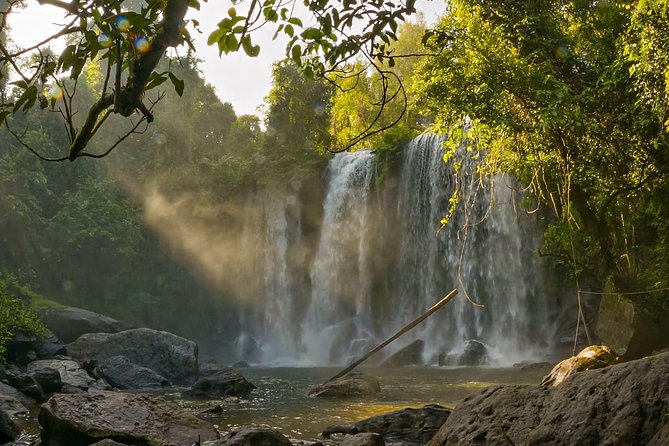
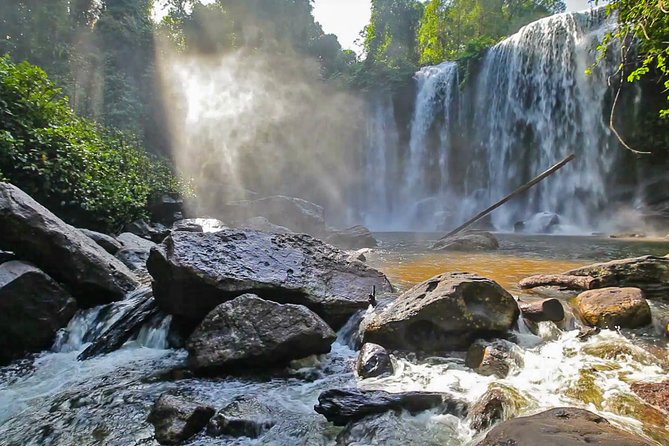
Day two reaches farther from Siem Reap. Kbal Spean is planned as a four-hour visit and includes a walk to a waterfall and the river of 1,000 lingas. The carvings are found in and around the water, with figures connected to Vishnu and Brahma.
This is a different kind of archaeological visit from the large temple compounds. You are looking at sacred images worked into a riverbed, so the setting is part of the experience. The four-hour allocation also signals that this is not a quick roadside stop.
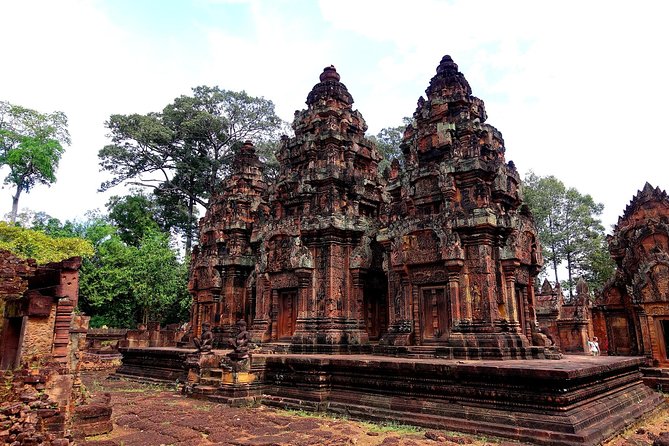
After Kbal Spean, the route continues to Banteay Srei, about an hour from Siem Reap. The temple is made from pinkish stone and is known for fine, detailed carving. Its smaller scale can make the decoration easier to appreciate than the massive walls of Angkor Wat.
Two hours are planned at Banteay Srei. That is a good match for a site where you will want time to study lintels, doorways, and carved figures rather than simply walk around the outer walls. Your guide can also help explain how its imagery relates to Hindu worship and Khmer art.
The afternoon returns to the main Angkor area. Eastern Mebon, a temple-mountain structure, receives about an hour. Neak Pean follows, located on an artificial island in an ancient reservoir called the Baray. The approach to Neak Pean is part of its character, since the temple is tied to water and the old reservoir system.
The final stop is Preah Khan, a large monastic complex associated with the sacred sword. One hour is listed, but the site is extensive and highly explorable. That creates a small tension in the schedule: you will see the main areas, but you may want more time if you enjoy wandering through side corridors and stonework.
This is the fullest temple day, with five stops after the morning excursion. I would expect a satisfying but tiring schedule. If you prefer slow photography or long periods at each ruin, tell your guide early so you can discuss priorities.
Day three: Beng Mealea and the older Roluos temples
Beng Mealea is about 70 kilometers northeast of Siem Reap and is known as the lost temple of Angkor. The distance gives the day a different rhythm. You spend more time on the road, but the reward is a more secluded setting and a stronger sense of discovery.
Four hours are planned at Beng Mealea. That longer visit makes sense. The temple is large, damaged, and surrounded by fallen stone, so it rewards careful movement rather than a fast circuit. The less restored appearance is part of its appeal, though it also means uneven surfaces and a less polished route through the ruins.
If you want the most atmospheric part of the tour, this may be it. Angkor Wat shows the power of a major royal project. Beng Mealea lets you see what a temple can feel like when the ruins and surrounding growth remain central to the experience.
The afternoon goes to the Roluos group, about 11 kilometers southeast of Siem Reap Market. Bakong, Lolei, and Preah Ko sit close together across an area of roughly three kilometers. The three temples give you a look at an earlier phase of Khmer building than many of the better-known Angkor sites.
Three hours are planned for Roluos. This is a useful contrast after Beng Mealea. Instead of one large, remote complex, you compare several related monuments in one area. The route also keeps the day connected to the development of Khmer temple design rather than treating every temple as an isolated sight.
The practical drawback is the drive to Beng Mealea. You should choose this tour because you want remote ruins, not because you want four easy days based entirely near central Siem Reap.
More runs out to Banteay Srei:
- Full-Day Banteay Srei & 4 Temples – Grand Tours Join-in Tour
★ 5.0 · 1,155 reviews - Siem Reap Tour: Angkor Wat Sunrise, Bayon, Ta Prohm, Banteay Srei
★ 5.0 · 931 reviews - 2-Day Angkor Wat With Small, Big Circuit and Banteay Srei Tour
★ 5.0 · 545 reviews - From Siem Reap: Banteay Srei Temple & Grand 5 Temple Tour
★ 4.8 · 262 reviews
Day four: Tonle Sap, museum context, and working crafts
Kompong Phluk is the first stop on the final day, with a drive of about 45 minutes from Siem Reap. The village lies on Tonle Sap, described here as the largest freshwater lake in Southeast Asia. The visit offers a look at Cambodian life connected to the lake and its changing water conditions.
This is an important change of pace after three days of temple archaeology. Instead of looking mainly at royal monuments, you see a place tied to homes, transport, and local routines. The visit is planned for about four hours, so it is not treated as a quick photo stop.
The schedule then moves to the Angkor National Museum for one hour. The museum presents a large collection of Buddha statues and relics in one gallery. I like having this stop after several days among temple carvings because it can help connect loose sculptures and religious images to the sites you have already seen.
One hour is enough for an introduction, not a full museum study. If you are passionate about sculpture or archaeology, you may wish the museum had more time. For most people, it works as a useful indoor pause and a way to organize what you have been seeing outdoors.
The final stop is Artisans Angkor, a local nonprofit organization that aims to improve the lives of disadvantaged Cambodians from rural areas. You can enter a workshop and see stone carving, with the description also referring to crafting your own stone carving.
This stop adds a practical human side to the tour. It connects traditional skills with current work and training, rather than leaving Cambodian culture frozen in the Angkor period. It is also a gentler finish after several demanding temple days.
Why the guide can make or break the experience
A four-day Angkor program contains a lot of names, kings, religious figures, architectural terms, and competing periods. Without explanation, the sites can blur together. With a good guide, Bayon, Ta Prohm, Banteay Srei, and Preah Khan begin to feel like different chapters.
Sa is the guide most often identified in the supplied tour information. His strengths are described in specific terms: clear English, strong explanations of Hindu and Buddhist beliefs, Khmer legends, temple backgrounds, and everyday Cambodian culture. He is also praised for helping with shopping and checking that guests handled their US dollar currency correctly.
You should still confirm who will guide your departure, since an individual guide is not guaranteed by the general tour description. The important point is that this is designed as a guided experience, not a simple driver service.
The private format lets you ask about details that interest you. You might want to focus on Hindu mythology at Angkor Wat, Buddhist symbolism at Bayon, local stories at Ta Prohm, or family life in Cambodia. A private group is better suited to that kind of conversation than a large fixed group.
The pace, comfort, and practical tradeoffs
Pickup is offered, and the listed start time is 8:30 a.m. The vehicle is air-conditioned, which matters in Siem Reap’s heat. Cold water and cold towels are included, small comforts that become welcome after hours among stone temples.
The tour is private, but the itinerary is not leisurely. Day two includes Kbal Spean, Banteay Srei, Eastern Mebon, Neak Pean, and Preah Khan. Day three combines a long trip to Beng Mealea with three Roluos temples. Expect walking and repeated transitions.
Most people can participate, and children must be accompanied by an adult. The information provided does not give detailed accessibility guidance for steps, uneven ruins, or the route at Kbal Spean, so you should ask the operator before booking if mobility is a concern.
The tour offers group discounts, though the exact discount is not stated. Confirmation is received at booking, and free cancellation is available if you cancel at least 24 hours before the start time. Changes or cancellations inside that window are not accepted for a refund.
Who should book these four days?
I would choose this tour if you want the main Angkor temples but also care about places beyond the standard circuit. It suits you if you enjoy a guide’s explanations, prefer a private vehicle, and want Cambodian culture included through Tonle Sap, the museum, and Artisans Angkor.
It is also a good fit for first-time visitors who do not want to plan a complicated temple route on their own. The schedule handles the broad geography for you, from central Angkor to Kbal Spean, Beng Mealea, Roluos, and Kompong Phluk.
I would hesitate if you want slow mornings, long lunches, or only one or two temples per day. The route is full, and the separate ticket and meal costs mean the headline price is not the final cost.
Should you book this Angkor tour?
Book it if your priority is range and interpretation. You will see Angkor Wat’s grand scale, Ta Prohm’s roots, Banteay Srei’s delicate carving, Beng Mealea’s rougher ruins, the Roluos temples, Tonle Sap, and two useful cultural stops.
Before paying, confirm the total temple ticket cost, who your guide will be, and how the sunset plan fits the daily schedule. If the guide is Sa, you can reasonably expect a strong focus on stories, religion, and Cambodian daily life based on the information provided.
The best reason to choose this tour is not simply the number of temples. It is the way the four days connect royal monuments with countryside, water-based life, museum objects, and living craft traditions.
FAQ
Where does this four-day tour take place?
The tour is based in Siem Reap, Cambodia, and visits Angkor Wat, Angkor Thom, Kbal Spean, Banteay Srei, Beng Mealea, the Roluos temples, Kompong Phluk, the Angkor National Museum, and Artisans Angkor.
How long does the tour last?
The experience lasts approximately four days.
What time does the tour start?
The listed start time is 8:30 a.m.
Is this a private tour?
Yes. Only your group participates in the private activity.
Is hotel pickup available?
Pickup is offered, though the supplied information does not specify the exact pickup locations or times.
Is an English-speaking guide included?
Yes. An English-speaking guide is included. Sa is the guide named in the supplied tour information and is praised for explaining Khmer, Hindu, and Buddhist history and stories.
Are temple entrance tickets included?
No. All entrance fees are separate from the tour price.
Are meals included?
No. Breakfast, lunch, and dinner are not included.
What is included in the tour price?
The price includes an air-conditioned vehicle, an English-speaking guide, cold water, and cold towels. Group discounts are also offered, though the discount amount is not specified.
Just added around Siem Reap
- Twilight Tastes of Siem Reap Include Dinner★ 5.0 · 13 reviews
- Ultimate Sunrise to Angkor Wat, Angkor Thom and Bayon Temple★ 5.0 · 3 reviews
- Trekking Tour at Phnom Kulen National Park from Siem Reap★ 5.0 · 3 reviews
- Professional Photo Shoot in Angkor Archaeological Park, Siem Reap★ 5.0 · 42 reviews
- Full-Day Private Tour of Angkor Wat with Pick Up★ 5.0 · 12 reviews
- Unveiling 2 Days Private Angkor Wat/Beyond In Sunrise/Sunset Tour★ 5.0 · 48 reviews
- Siem Reap City Tour with War Museum and Killing Field★ 5.0 · 27 reviews
- Private Day Trip to Angkor Temples with Expert Guide★ 5.0 · 4 reviews
Angkor Wat Tours, compared.
Angkor Wat Sunrise or Sunset Tour with Guide from Siem Reap
Read our review →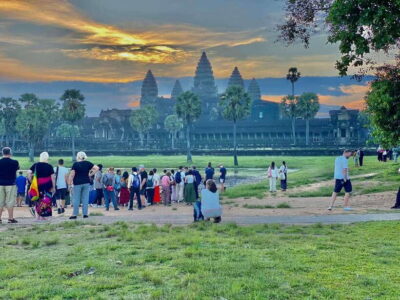
Angkor Wat: Small-Group Sunrise or Sunset Tour
Read our review →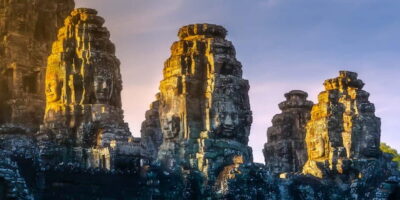
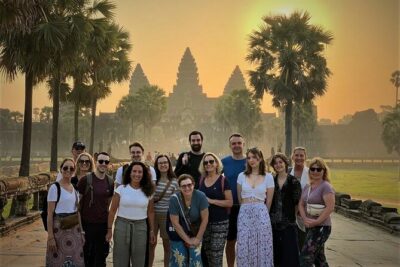
Angkor Wat Highlights and Sunrise Guided Tour from Siem Reap
Read our review →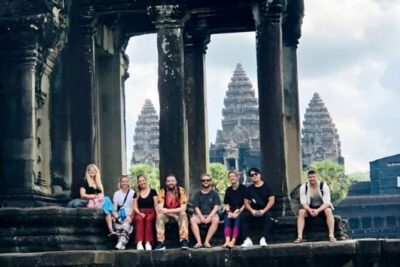
Angkor Wat Sunrise & 3 Main Temples with Breakfast – Small Group
Read our review →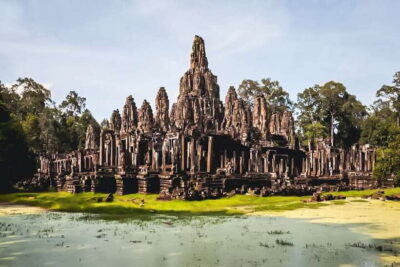
Angkor Wat Sunrise and Full-Day Sightseeing Tour
Read our review →
Angkor Wat Small-Group Exploration with Expert Guide
Read our review →Browse the lists this tour appears in